
What is the African lion?
It is the second-largest living big cat after the tiger. Males are unique among the cat species for their thick mane of brown or black hair encircling their head and neck. The mane darkens with age, and the thicker and darker a mane is the healthier the cat. Both males and females roar — a sound heard as far as 8 kilometers away.
Vulnerable
Panthera Leo
125 to 272 kilograms (277 to 600 pounds)
1.2 meters at the shoulder (48 inches) and about 2 to 3.3 meters in length (7 to 11 feet)
10 to 18 years in the wild. Up to 30 years in captivity.
Grassy plains and open woodlands
Carnivorous
Average about 109 days
Humans

Challenges
Humans are pushing big cats out of their habitats.
This cat’s population is steadily decreasing in the wild. In just two decades, populations decreased by 43 percent, and it’s estimated that as few as 23,000 remain today. One of the main causes is the alarming rate at which they are losing their habitats due to expanding human populations and the resulting growth of agriculture, settlements, and roads.
Human-wildlife conflict is also a major threat.
As lion habitats shrink, the big cats are being forced into closer quarters with humans. This, coupled with a decrease in their natural prey, causes them to attack livestock. In turn, farmers oftentimes retaliate and kill these big majestic cats.
They are hunted by humans.
These big cats are being killed in rituals of bravery, prized as hunting trophies, and, increasingly, for their body parts' perceived medicinal and magical powers.
Solutions
Here's how we're protecting Africa's largest cat from extinction:
Retaliation is the primary reason people kill this big cat. We work with communities to help them realize the big cat’s value and to help them protect their families and livestock from carnivore predation. In Ruaha National Park, where 10 percent of the world’s remaining lion population can be found, AWF’s Ruaha Carnivore Project is fostering a much-needed shift in the local opinion of carnivores.
Since 2012, AWF has been working with Ruaha’s communities to build livestock enclosures to protect livestock from predation, and, in turn, protect big cats and other carnivores from conflict with humans. In addition, Ruaha Carnivore Project provides community benefits to villages that demonstrate success in living peacefully with carnivores.
African Wildlife Foundation’s researchers are working to gain an understanding of carnivores’ populations, behaviors, movements, and interactions with people in order to develop appropriate conservation actions. Since 2002, our Large Carnivore Research Project has undertaken research aimed at ensuring the continued survival of large predators living around Botswana, Namibia, Zambia, and Zimbabwe.
There are few regions as important to the viability of lion populations as the Tarangire-Manyara ecosystem. Halting the decline of lion populations in this region is imperative to the long-term success of the species. The African Wildlife Foundation partners with the Tarangire Lion Research Initiative to compile data from the local lion population. This data helps us better understand the demographic composition of lions in the landscape and pinpoint areas of potential threat to the species. To mitigate human-lion conflict, AWF has designed and constructed predator-proof enclosures for herdsmen to protect their cattle from lion attacks and hosts ongoing education and awareness programs to inform the community about safeguarding their livestock. As a result of AWF and community efforts, there has not been a single retaliatory killing in the landscape since March 2018.
With the continental population decreasing and threats continuing to mount, it’s become more important than ever to closely track this species. In Tanzania’s Manyara Ranch, AWF tagged the lions with high-tech collars equipped with radio transmitters to track the animals’ natural movements. This allows scientists and conservationists to monitor for potential disease outbreaks, home range, productivity, behavior, habitat use, survival, predator-prey interactions, and ultimately population estimates.
Behaviors
They are the most social cats.
While most cat species are solitary, this big cat is an exception. It has developed a social system based on teamwork, division of labor, and an extended family unit. The average pride consists of about 15 individuals, with five to 10 females, their young, and two or three territorial males. These are usually brothers or pride mates who have formed a coalition to protect their females.
They are affectionate.
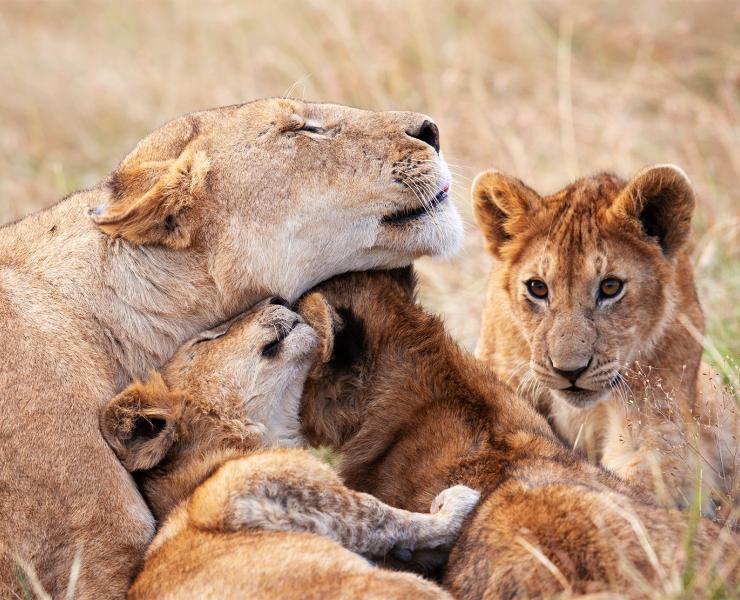
When resting, which may be up to 20 hours a day, these cats seem to enjoy good fellowship with lots of touching, head rubbing, licking, and purring.
Their parenting styles are wildly different.
Usually, two or more females in a pride give birth around the same time, and the cubs are raised together. Some mothers carefully nurture their young and will even permit other lion cubs to suckle, sometimes enabling a neglected infant to survive. However, at times, a female may also neglect or abandon her cubs, especially if food is scarce.
Diet
African lions are both hunters and scavengers.
Antelope, zebra, and wildebeests are common prey for this big cat. However, scavenged food provides more than 50 percent of their diets—these big cats will often take over kills made by other carnivores—and cooperative hunting enables them to take down prey as large as buffaloes, rhinos, hippos, and giraffes. The female does 85 to 90 percent of the hunting, usually by setting up an ambush for its prey. The kill is not shared equally within a pride, and at times of prey scarcity, cubs might experience higher mortality rates as hungry females may not even share with their offspring.
Habitats
Where are lion habitats found?
Africa's largest cat can be found in savanna, plains, grassland, dense bush, and woodland habitats.


