The African fish eagle has a white head, neck, chest, shoulder and tail reminiscent of the American bald eagle. It is the African equivalent of the bald eagle, filling the same ecological niche.

Lion Conservation Challenges: Building a Better Boma


04 Mar 2009
8:30 AM UTC
By Kissui

Posted in:
Lions


Comments:
9 Comments »

Over the years we have learnt that ineffective husbandry – especially poor livestock security at night – contributes significantly to high levels of livestock predation. At night, livestock is kept in enclosures (bomas) usually made of thorn bush walls. Such bomas do not provide adequate security against invading predators.

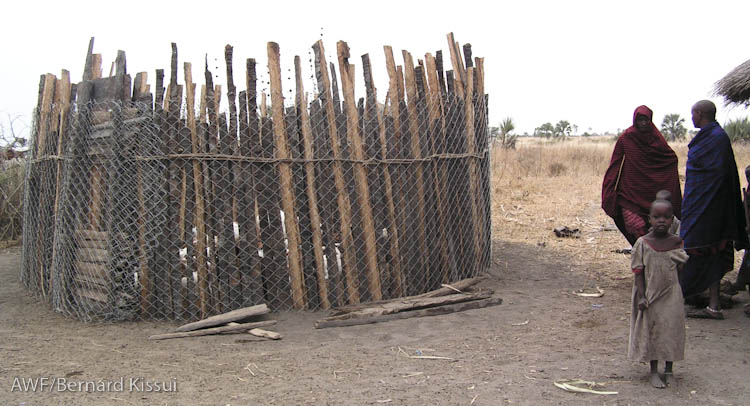
We are now working with pastoralists’ communities to implement a program towards livestock security improvement by reinforcing bomas with sturdy materials such as chain-link fences. Under this program, pastoralists’ families contribute 50% of the costs towards the purchase of reinforcement materials for their boma while we support by providing the remaining half.

We are seeing an increased interest among pastoralists’ families participating in this program, and we are optimistic that more will be joining the program. The success of this program not only will reduce livestock losses experienced by pastoralists but will also promote the coexistence between human and large carnivores in this social-ecological landscape by reducing incidences of retaliatory killing of lions and other large predators.
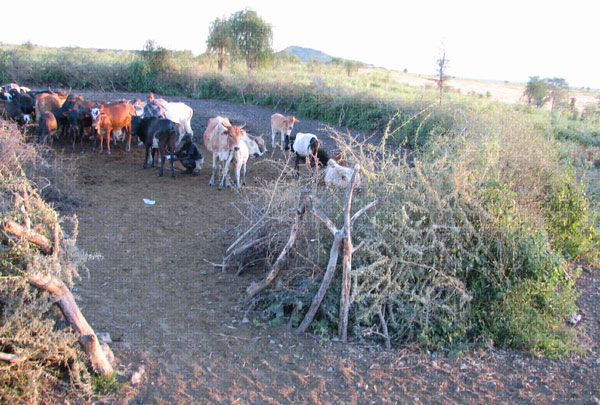
A typical boma made of thorn bush walls for livestock keeping. These bomas are not effective in preventing lion attacks on cattle.
A typical boma made of thorn bush walls for livestock keeping. These bomas are not effective in preventing lion attacks on cattle.

One of our reinforced predator-proof bomas.

One of our reinforced "predator-proof" bomas.


9 Responses to “Lion Conservation Challenges: Building a Better Boma”

  1. sauwah Says:

    does the government gives a share of its revenue from safari tourism to the local livestock owners? and any compensation of predation on their livestock by lions and other big cats? such policy will be nice if the government can afford it as it does in Kenya.

  2. Susie Says:

    Have you had the problem they have had in Kenya where carcasses are being poisoned with Furadan (pesticide Carborfuram) and killing lions, vultures, and other scavengers?

  3. Kissui Says:

    Sauwah,
    The government through its main stream wildlife authorities has programs such as outreach programs by Tanzanian National Park Authority and a proportion of income from hunting activities is distributed to district councils by the wildlife division. These programs are geared towards revenues sharing with local communities. But it appears these programs needs to be supplemented with other programs to be effective in changing the attitude and behavior of livestock owners towards predator killing.

    There is currently no compensation for livestock predation, but given the large number of wildlife across the country, compensation might prove to be unaffordable to the government.

  4. Kissui Says:

    Susie,
    We have had cases of using poison to target predators, although we haven’t done the analysis to determine chemical composition of poison used.

  5. Babu Says:

    Kissue,

    thanks for your updates. Seems you have a good amount of information about the history of predation in the area and will be able to get some definitive answers over time from the use of the lion proof bomas and their effectiveness. It still leaves the problem of predation when the cattle are out with their sheppard boys and the attention they pay to the livestock/wildlife interaction during their grazing time

  6. F.Araeb Says:

    Kissui

    March 19th, 2009
    Sauwah,
    The government through its main stream wildlife authorities has programs such as outreach programs by Tanzanian National Park Authority and a proportion of income from hunting activities is distributed to district councils by the wildlife division. These programs are geared towards revenues sharing with local communities. But it appears these programs needs to be supplemented with other programs to be effective in changing the attitude and behavior of livestock owners towards predator killing.

    There is currently no compensation for livestock predation, but given the large number of wildlife across the country, compensation might prove to be unaffordable to the government.

  7. Kissui Says:

    Babu,
    The problem of livestock predation in the grazing field during the day is much more complex. We are currently undertaking a detailed study of the husbandry practices related to livestock security in the grazing fields-Ifura Ukio our field research assistant is undertaking this study as part of her Msc degree. I am hoping we will have some ideas on possible interventions for this problem at the completion of this study. We will keep you updated of what we find

  8. Albert Says:

    Hi,
    Have seen the reinforced predator free enclosure.It looks good and predator proof…my concern is the amount of wooden poles used. The amount of poles used shows amount of tree felled from one area to be used to conserve in other area. Can we balance this by using other materials……!!!!

  9. AWF Says:

    Hello Albert! At AWF we are as concerned as you are about protecting trees and forests. It is possible to use materials other than wood to make the bomas predator proof, but other options such as iron are very costly. Cost is often a limiting factor for the families adopting predator free bomas. We advocate using wooden poles as an affordable alternative to using thorn bushes for enclosures because wooden poles last longer than thorn bushes, and thus reduce the frequency of tree cutting and boma repairs.

Leave a Comment