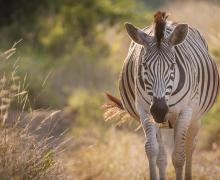
A few decades ago, more than 15,000 Grevy’s zebra inhabited Africa. Today, fewer than 2,500 remain.

Grevy's Zebra


Physical Characteristics

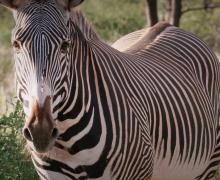
The long-legged Grevy's zebra is the biggest of the wild equids. It is more closely related to the wild ass than the horse (whereas the plains zebra is more closely related to the horse). One can distinguish the Grevy’s zebra from the plains zebra by its larger size, big rounded ears, white unmarked belly, and finer black stripes. An endangered species, Grevy’s zebras are only found in northern Kenya and south eastern Ethiopia.
Zebra foals are born with a coat that is stripped reddish-brown. This gradually darkens to black. Young zebras also have a dorsal mane extending all the way to the base of the tail, which can be raised when the animal is excited and lies flat when it is relaxed.

> To learn about the common plains zebra click here.

^ Back to top

Habitat

Historically, the Grevy's zebra inhabited the semi-arid scrublands and plains of Somalia, Ethiopia, Eritrea, Djibouti, and Kenya in East Africa. However, due to a rapid decline in their population, they are now restricted to the northern parts of Kenya and a few pockets in southern Ethiopia.

^ Back to top

Behavior

The Grevy’s zebra is a loosely social animal - herd composition varies daily as members come and go. A stallion’s attachment to his land and a mare’s attachment to her young are the most stable relationships in Grevy’s zebra society. Within the herd, dominance is relatively non-existent, except for the right a territorial male has to a breeding female. If no females are around, the resident male will associate with bachelor males in a friendly manner (though always asserting dominance upon initiation of contact).

Grevy's mate throughout the year, but the peak birth and mating periods for the Grevy's zebra are usually July through August and October through November. Grevy's zebras breed in 2 year intervals starting at the age of 3 for females and age 6 for males. Newborn foals are russet-colored with a long hair crest down the back and belly. The mother keeps other zebras at a distance while the offspring imprints on her and they spend time playing, nuzzling and nursing. Newborns can walk just 20 minutes after they are born, which is an important survival adaptation for this migrating species. Young Grevy's are especially vulnerable to predators, and foal survival has been directly related to the extent to which their mothers move.

Want to Help?

^ Back to top

Diet
Grevy’s zebra is a grazer and can digest many types and parts of plants that cattle cannot. However, it is water dependant and will migrate to grazing lands within daily reach of water.

^ Back to top

Predators and Threats

Habitat loss in an already restricted range is a serious threat to the endangered Grevy’s zebra. Additionally, it must compete with livestock for a limited water supply and is hunted by poachers for its striking hide. In the Samburu Heartland, AWF supports the Grevy’s Zebra Project. Its goal is to gain a better understanding of this animal’s population and distribution patterns to aid in the development of a viable conservation strategy.

Because the largest remaining population of Grevy's zebras is located within Samburu Heartland, AWF is taking action to research this endangered animal and help ensure its survival. Dr. Paul Muoria, who heads the research project, is hard at work to help AWF make recommendations on what needs to be done to increase Grevy's numbers.


Did You Know?
  • Stripes to a zebra are like fingerprints to a human. No two patterns are identical. AWF researchers use the unique stripes to identify individuals.
  • Grevy's zebras can run up to 40 mph (64 kph).
  • Foals can run with the rest of the herd within an hour of their birth. They can also recognize their mothers using their eyesight and their sense of smell.

^ Back to top

Back to Wildlife Gallery

Find another Animal

Search our gallery for a specific animal found in our 8 Heartlands


Quick Facts

Found in these Heartlands: Samburu

Scientific Name: Equus grevyi

Size: 50 to 60 inches (127 to 152 cm) at the shoulder

Weight: 770 to 990 pounds (349 to 449 kg)

Lifespan: 20 years

Habitat: Grasslands and savannas

Diet: Herbivorous

Gestation: 13 months

Predators: Lions, cheetahs, hyenas, hunting dogs, leopards; habitat destruction and poaching

Related Images

View More Photos