
What is a bushbuck?
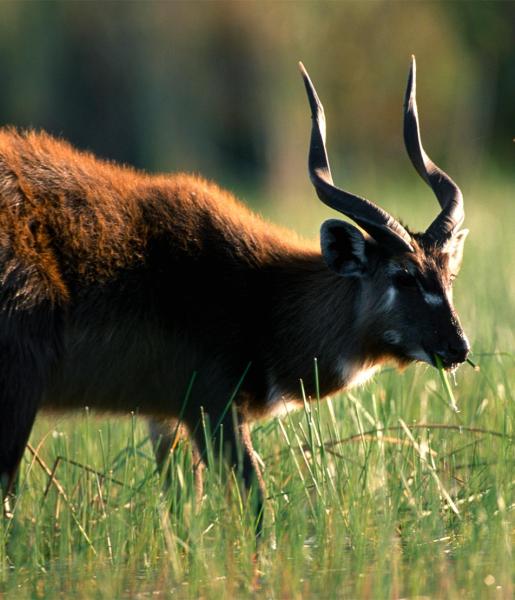
The bushbuck is an antelope with geometrically shaped white patches or spots on the most mobile parts of its body — the ears, chin, tail, legs, and neck. Male bushbucks have horns, which are between 10 and 20 inches long and grow straight back. At 10 months, young males sprout strongly twisted horns that form the first loop of a spiral at maturity.
Tragelaphus scriptus
25 to 80 kilograms (55 to 180 pounds)
.5 to 1 meter tall (25 to 40 inches)
About 15 years in captivity. No data for in the wild.
Wherever there is adequate cover — typically found in forest edges or brushy cover near rivers and streams.
Herbivorous
About 6 months
Humans and any large carnivore, mostly leopards

Challenges
Habitat loss is the bushbuck’s biggest threat.
Their living space is decreasing as human populations grow and expand, resulting in habitat loss from the unsustainable growth of agriculture, settlements, and roads.
Humans hunt them for their hides.
While bushbucks are able to coexist with human habitation to a greater extent than many other species, some African tribes continue to hunt them for its skin, which makes leather that is supple, thin, and the hair sheds easily. Heavy hunting pressure has enabled the bushbuck from persisting over its former, historic range. In some areas, bushbuck meat is significantly lower in price resulting in it being the most commonly purchased bushmeat. They are also viewed as a pest species in some areas because of their tendency to damage people’s gardens.
Solutions
Our solutions to protecting the bushbuck:
African Wildlife Foundation brings together communities and private investors to construct conservation tourism lodges, like The Sanctuary at Ole Lentille, in Kenya. The lodge provides sustainable income for the community and the 20,000-acre conservancy is a safe home to a variety of wildlife.
AWF works with governments and villages to designate wildlife corridors — large swaths of land that bushbucks use to roam freely and safely from one park, or country, to another. Wildlife corridors link protected areas and allow wildlife to follow rains or travel to their calving grounds.
Behaviors
Bushbucks do not commit to relationships.
They are the least social of the African antelopes and are generally solitary. Most group associations, except for a female and her latest young, are very temporary and only last a few hours or days. These antelopes have small home ranges, which may overlap with those of other bushbucks. Even so, there still is not much contact, as adult individuals prefer to stay by themselves in their separate areas. Mature males usually go out of their way to avoid contact with each other. They are also not territorial but will defend an area inhabited by a female in heat.
Female bushbucks go to great lengths to hide their young.
After giving birth, the mother cleans and hides the newborn calf. When she visits and suckles it, she eats its dung, so no scent remains to attract predators. The young calf does not accompany its mother for long periods during the day until it is about four months old. A female and her calf often play together, running in circles chasing each other.
They are not confrontational.
Usually most active during early morning and part of the night, bushbucks become almost entirely nocturnal in areas where they are apt to be distributed frequently during the day. When alarmed, individuals react in a variety of ways. If they are in the forest or thick bush, then they may freeze in one position and remain very still, allowing their coloring to camouflage them. Sometimes they will sink to the ground and lie flat, or they may bound away, making a series of hoarse barks. When surprised in the open, they sometimes stand still or slowly walk to the nearest cover.
Diet
If water is scarce, bushbucks can survive on dew.
They need some water but can subsist on dew if necessary. Foods vary in different habitats, with leguminous herbs and shrubs making up most of the diet. They may also eat grass, fallen fruit, acacia pods, tubers, bark, and flowers.
Habitats
Where do bushbucks live?
They are forest-edge antelopes. They live in various habitats, including rain forests, montane forests, forest-savanna mosaics, and bush savannas.


