
What is an impala?
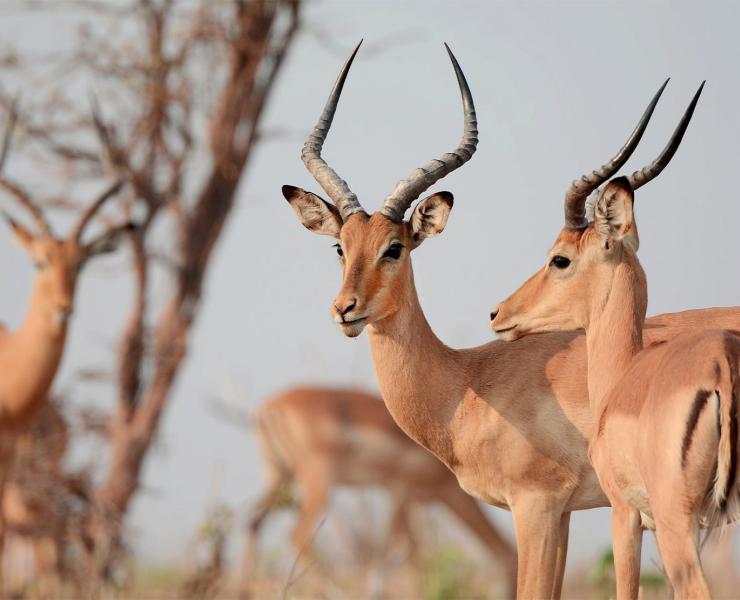
The impala is reddish-brown with white hair inside the ears, over each eye and on the chin, upper throat, underparts, and buttocks. A narrow black line runs along the middle of the lower back to the tail, and a vertical black stripe appears on the back of each thigh. Impalas have unique brush-like tufts of black hair that cover a scent gland located just above the heel on each hind leg. The female is similar to the male but does not have horns. The male's graceful lyre-shaped horns are about 40 to 90 centimeters long.
Aepyceros melampus
40 to 60 kilograms (90 to 130 pounds)
About 1 meter tall (28 to 36 inches)
Average 13 to 15 years in the wild (about 17 in captivity)
Savannas, grasslands, shrubland, and light woodlands
Herbivorous
Between 6 and 7 months
Lions, leopards, cheetahs, hyenas, hunting dogs, humans

Challenges
Habitat fragmentation threatens impalas’ safety.
Unsustainable livestock farming and human encroachment are major threats to impala’s future. Wildlife habitats are being disrupted with the expansion of roads and settlements. As roads segment habitats, wildlife migrations are affected, and wildlife has difficulty moving between parks to find food, mates, and give birth.
One of the most commonly hunted antelope.
Impalas are one of the most commonly hunted antelope on hunting safaris in South Africa and are also the second most numerous species harvested for biltong. Poaching along the outskirts and even within protected areas combined with the agro-pastoral development, is threatening stable populations.
Solutions
Our solutions to protecting the impala:
African Wildlife Foundation works with government entities to help plan and propose alternative growth solutions that avoid habitat fragmentation. AWF provides its scientists as resources to assist in proper planning that ensures a balance between modernization and conservation.
Wildlife corridors are large sections of land that allow wildlife to move from one national park to another—and even from one country to another. AWF works with people on all levels—from governments to small villages—to designate corridors and, in some cases, purchase land to set it aside for wildlife, like impalas, to move through safely as they migrate.
Behaviors
Impala social structures change with the seasons.
The impala’s social organization allows it to adapt to environmental conditions. The average female herd is between 15 and 100 individuals. When food is plentiful, males become territorial, shepherding females about their land. In dry periods, territories are abandoned as herds must travel farther to find food and clans tend to overlap and intermix with each other.
They move in leaps and bounds.
A surprised impala herd will leap about in what appears to be a disorganized way. However, this reaction helps keep the herd together and is also an anti-predator technique. Initially, an individual impala leaps up, casting about from left to right, bringing individuals into contact with each other. High jumps also allow impalas to release signals from the fetlock scent gland in midair, easier for a rapidly running impala to pick up.
Impala births usually coincide with rains.
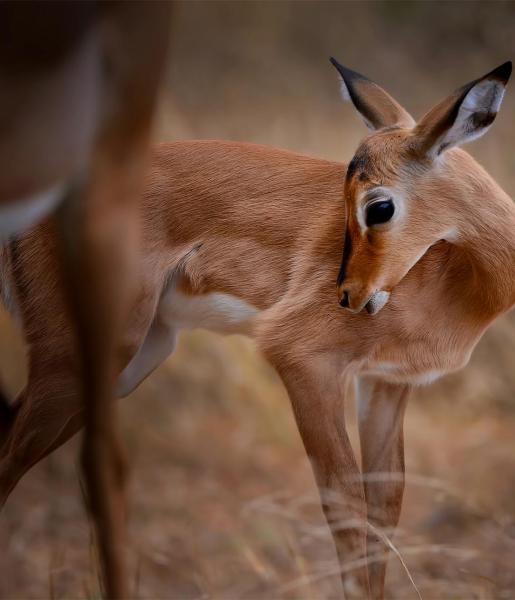
Young are born year-round, but birth peaks usually coincide with the rains. The female leaves the herd and seeks a secluded spot to bear her fawn. If the fawn is born at a time when there are few other young around, then the mother will stay with it in seclusion for a few days, or even a week or more before returning to the herd. If there are many other fawns, she may take hers back to the herd in a day or two, where a nursery group may form. Nursery groups are safer because predators have more difficulty selecting an individual. The young are suckled for four to six months and reach maturity at a little over a year.
Diet
Impalas have more well-adjusted diets than many other antelopes.
Able to both graze and browse, the impala has a greater and more reliable food supply than animals that do either one or the other. It eats young grass shoots in the rainy season and herbs and shrubs at other times.
Habitats
Where do impalas live?
Impalas are found at grassland and woodland edges, usually very close by water.


