Dr. Philip Muruthi Visits the Leopard Project
Dr. Philip Muruthi, AWF’s Senior Director of Conservation Science, recently came from Nairobi to visit the leopard project. During his stay he managed to hold very important and fruitful meetings with Dr. Sam Ferreira from SANParks, Mr. Thomas Ramabulana also from SANParks as well as Mr. Jason Trollip, the General Manager at Singita KNP. Through the meetings Dr. Muruthi got an opportunity to see the project from different viewpoints and in the process share his own insights with the above mentioned gentlemen.
After all the meetings were done, we went to the field where I showed him some of the cage traps. I was hoping to take him on a long walk to check some of the cameras that I left out in the field to help me answer, though not statistically relevant, some of the outstanding questions.
Unfortunately, things didn’t turn out as we were hoping: we met some people who told us that there was a lioness covered in porcupine quills somewhere in the west, 30 kilometers away. The lioness was also apparently in a bad shape.
Compared to other animals, porcupines appear as easy prey to most carnivores because their movements are rather sluggish. This makes them come across as easy prey; however, a slight misjudgment by would-be attacker may result in some nasty injuries, which may be fatal as was seen with Paddy a few weeks ago.
We went in that direction, but were unsuccessful in locating the cat. We then headed back to the concession.
It was time for the next part: locating the recently collared leopard. That took us a while and when we finally got the signal, the leopard was too far in to the block to follow up. No off-road driving is allowed in Kruger National Park. We then headed back to the lodge to discuss some of the methodology surrounding the project.
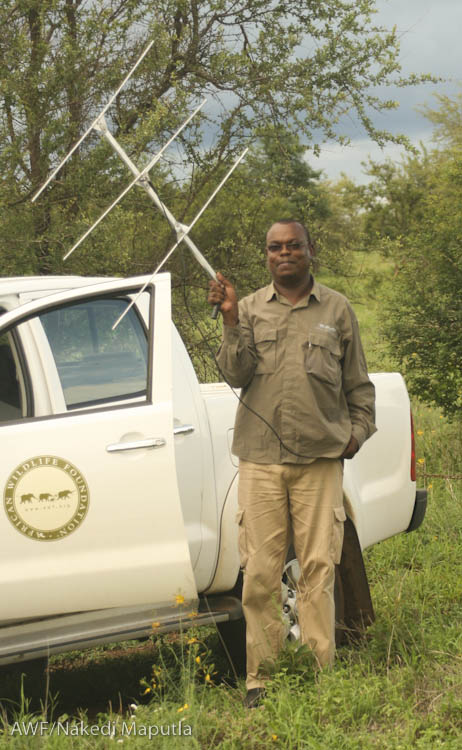 Dr. Philip Muruthi checks out my radio antennae.
On Sunday Dr. Muruthi had to go back to the airport, so on our way there we stopped at Satara, where we met with Rob and Tionette Gedes who are both very dedicated Friends of the Kruger National Park. They are currently involved in the Bird Census. I met them while following the previous leopard.
It turns out they had a lot of leopard pictures that they have taken over time in the Kruger Park and were willing to share so that I can add those to the current leopard database. On that day they were very excited because they had just seen the fattest leopard they had ever seen. I didn’t believe them at first, but when I saw the cat on their video, it was the fattest leopard I have ever seen. They gave me all the pictures they had together with GPS position of each animal.
Thank you very much Tionette and Rob!
After that we were on our way and we managed to drive through some of the villages surrounding the Park. I would like to thank Dr. Muruthi for making time to come and visit the leopard project.