
What are bonobos?
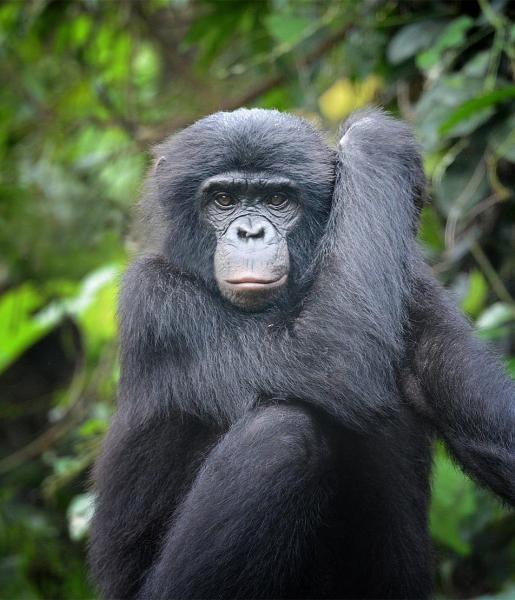
Our closest cousins, bonobos share 98.7 percent of our genetic makeup. They are about two-thirds the size of humans and are covered with dark hair. They are distinguished by their black faces, red lips, two or three webbed toes, a tail tuft, and parted long hair. Unlike their closest cousins, the common chimpanzees, they are not divided into subspecies.
Pan paniscus
Males: 36 to 61 kilograms (80 to 135 pounds)<br/>Females: 27 to 38 kilograms (60 to 84 pounds)
Up to 1.2 meters tall (4 feet)
60 years in captivity. 20 to 50 years in the wild
Lowland rainforest, swamp forests
Frugivorous
About 8 months
Humans

Challenges
Bonobos have experienced a significant population reduction in the past 12 to 20 years.
Unfortunately, only a small portion of their habitat is protected. Due to war in the Democratic Republic of Congo, illegal activities in the national parks have continued unchecked. Locals depend on the wildlife for protein — even if it’s meat from endangered species. These great apes are also targeted by poachers because of their large size. The civil strife has also caused an increase of destruction and degradation to the bonobo habitat. Logging and subsistence agriculture are also a threat. Industrial extraction could also become a big risk to the species' future as 99.2 percent of their range and habitat has been found to be suitable for palm oil.
Their population is shrinking and reproduction is slow.
Females become sexually mature after they are 12 years old and may give birth soon after. However, females give birth to a single infant every five to six years, and they tend to nurse and carry their babies for five years. As a result, population growth cannot happen fast enough to counter high levels of poaching, habitat loss, and human encroachment.
Solutions
Our solutions for bonobo conservation are hands-on, up close, and personal:
Bonobos live in the heart of the Congo, and the African Wildlife Foundation has set up a conservation plan to help stop the destruction of these gentle animals and their habitat. We created The Lomako Conservation Science Center in the heart of their habitat. This center supports wildlife surveys, training of Congolese researchers, and developing wildlife conservation plans.
AWF has surveyed key areas of their habitat and polled local communities on how their needs could fit within AWF's conservation goals.
By regularly monitoring the endangered species numbers and keeping track of where they are, conservationists can develop strategies to find economic alternatives for communities who hunt them for protein.
Behaviors
Bonobos whimper when they fail, just like humans.
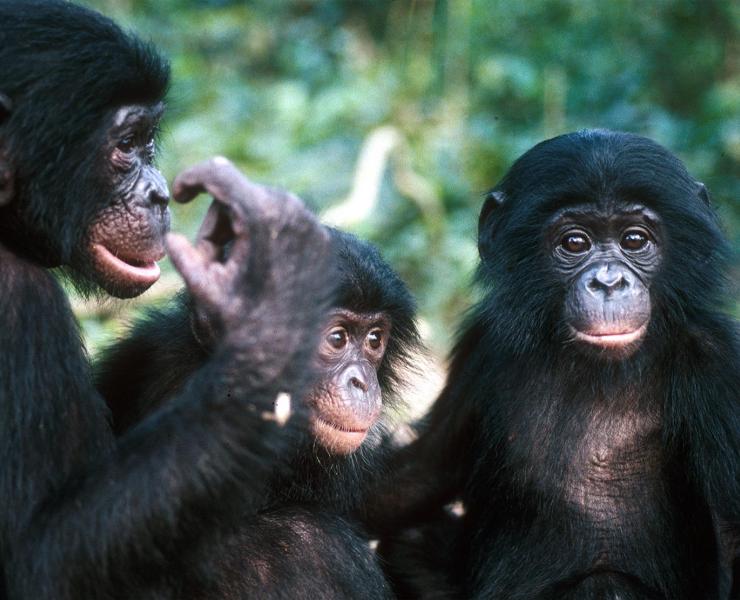
They control their emotions during times of happiness, sorrow, excitement, or anger. They also have human-like gestures when communicating without sound — they beg by stretching out an open hand and they whimper if they fail at something.
They walk on their feet and their knuckles.
Bonobos move quadrupedally in a special position called knuckle-walking. In trees, they also tend to suspend themselves from their arms to move around easier. And on the ground, they can walk bipedally (upright on its two feet) as well, making it the most human-like of all apes.
Even the bonobos need their own space.
They live in a fission-fusion society. Their communities range from 30 to 80 individuals but they separate and reunite on a regular basis. During the day, they break off into small groups to gather food. At night, they rejoin their group to make sleeping nests from branches and leaves.
Diet
Bonobos love to feast on fruit.
While fruit is their favorite food, they also eat leaves, flowers, seeds, bark, fungus, and honey. More than 113 types of plants make up their diet. They play an important role as seed dispersers, which is critical for forest regeneration. They have been documented eating invertebrates and small vertebrates. If they eat meat, then it is usually opportunistic versus the result of an organized hunt.
Habitats
Where do bonobos live?
They are found only in the Democratic Republic of Congo. Their discontinuous range extends from the Lualaba River in the east to the Kasai/Sankuru rivers in the south and as far as the Congo River in the west and around Lake Tumba/Lake Mai-Ndombe. Only 28 percent of their geographic range is suitable and only four distinct bonobo strongholds have been identified — Maringa-Lopori-Wamba, Tshuapa-Lomami-Lualaba, Solong, and Lac Tumba-Lac Mai Ndombe. Total bonobo population numbers are unknown because only 30 percent of its historic range has been surveyed. Estimates from the four strongholds, suggest a minimum of 15,000 to 20,000 individuals remain. Only a small portion of their habitat is protected and deforestation is rapidly destroying the rest.
They can survive in close proximity to human communities that are willing to cohabitate with these peaceful apes. Recent surveys show that many areas had bonobos 20 years ago but now they have none. The political instability in the DRC has had a major impact on the decline of bonobos.


