
What is a bat?
After rodents, they are the most numerous mammals on earth. African bats fall into two major categories: large fruit bats and smaller, insect-eating bats, neither of which attacks people. In addition to a difference in size between the two types, there is a great variation in the extent and details of the wings, which are formed by the naked membrane of skin that extends from the neck to the wrist and between the fingers, and finally to the tail. Wing shapes vary from species to species. Usually, the swift fliers have long, narrow wings while the slow fliers have broad, rounded ones.
The bones of the hand that support the wing membrane are unusually long. The hind legs are rotated 180 degrees at the hip joint, so the knee flexes backward rather than forward. This arrangement does not hamper the bat when it is perched but rather helps it push off from the roost for a quick getaway. They are very agile even on land, scuttling quickly over objects and squeezing their bodies through small openings.
Over 200 species of African bats — Africa is home to 20 percent of the world’s bats.
Varies by species, with the smallest only 5 grams (.18 ounces) and the largest about 377 grams (13 ounces)
Varies by species — the largest African bat (hammer-headed fruit bat) has average wingspan of 840 mm (33 inches).
15 years in the wild
Tropical and lowland rainforests as well as savannas
Herbivorous or frugivorous
Average 9 months
Humans, owls, hawks, falcons, and snakes.

Challenges
Humans are killing bats.
In some parts of Africa, bats are considered a delicacy. Elsewhere, they are considered pests and killed to prevent the destruction of fruit crops and due to the musky odors and noise emanating from their roosting places. Elsewhere, the flying mammals are slaughtered because of superstition. In West and Central Africa, they are harvested for bushmeat.
People are encroaching on bats’ habitats.
Bats are highly susceptible to environmental factors and climate change. As human populations grow and in turn agriculture, settlements, and roads expand human-wildlife conflict increases. While overall population abundance is unknown, a well-known colony in Uganda declined in numbers over a 40-year period, dropping from 250,000 to 40,000 individuals.
Solutions
Our solution to protecting the bat:
African Wildlife Foundation brings together communities with private investors to construct lodges benefitting people and wildlife. In Botswana, Ngoma Safari Lodge, a high-end luxury lodge, brings tourism revenue into the local economy, which is then invested back into the community and into continued conservation efforts in the area. The lodge protects wild spaces, allowing the bat, and other wildlife, to have space to live undisturbed.
Behaviors
They are creatures of the night.
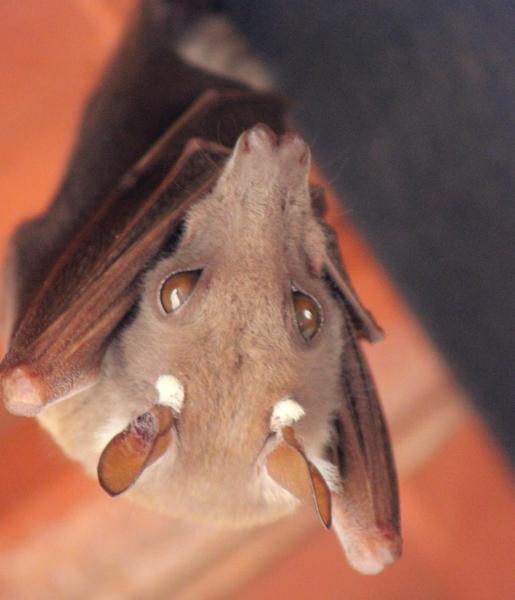
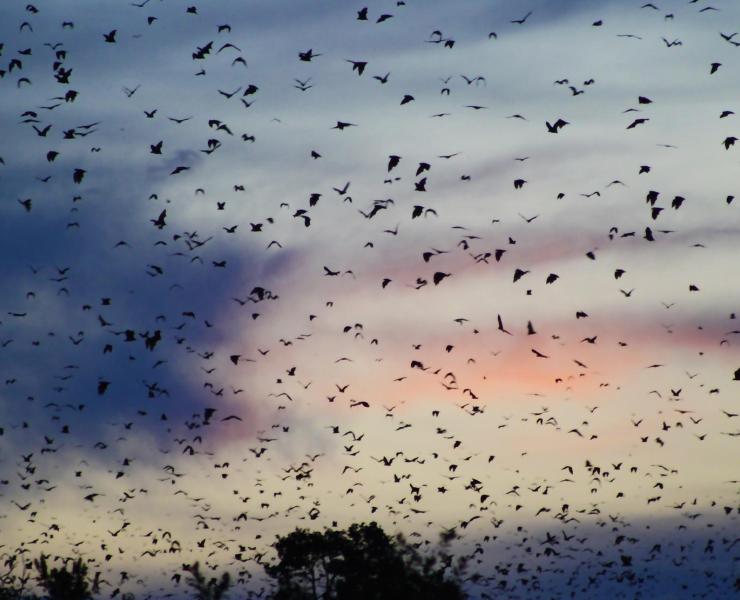
With few exceptions, they are nocturnal and emerge from their daytime roosts only when the light of day is fading. During the day, fruit bats often roost hanging upside down in the exposed branches of trees. Other species also roost upside down in large colonies that may number in the millions, in dark caves. They also live in smaller colonies in crevices, hollow trees, and around houses.
Bats have exceptionally developed senses.
Fruit bats have an acute sense of smell and large eyes that give them good night vision, both of which help them locate fruit and nectar. Insect-eating bats find their way in total darkness by emitting high-pitched squeaks through the nose or mouth as they fly. These sounds bounce off of objects and echo back to their ears. This method of echolocation, or bat sonar, allows them to locate, capture, and eat insects in midair while still detecting and avoiding objects as fine as a human hair. However, to send and receive these location signals, they have developed unique ears and noses.
They like to hang out with their mothers.
Usually, one bat is born a year to an adult female. The mother nurses the young for up to four months. In some species, the mother carries around the infant for five or six weeks, but in others, the mothers leave them in “nurseries” while they go out to feed. Even though a young bat is two-thirds grown at six weeks, it will not become sexually mature until two years of age.
Diet
Bats’ food preferences are denoted by their names.
Fruit bats feast largely on fruit. They have large cheek pouches, enabling them to take food to be eaten at another perch, away from disturbances. They are known for their noisy eating habits. To obtain water, bats munch on soft wood and bark. They usually eat overripe and unmarketable fruits, and they may even help reduce fungi and fruit flies in commercial plantations. Insect-eating bats are natural pesticides, eating mosquitos and other varieties of insects.
They also play an important role in the environment. Many plants are dependant on bats for both pollination and seed dispersal. Every November, more than eight million bats migrate from Zambia forming the largest mammal migration in the world. Migration occurs when food sources become low.
Habitats
Where do African bats live?
They are found throughout Africa, primarily residing in forests and savannas. They roost together in colonies in tall trees.


