
What is a cheetah?
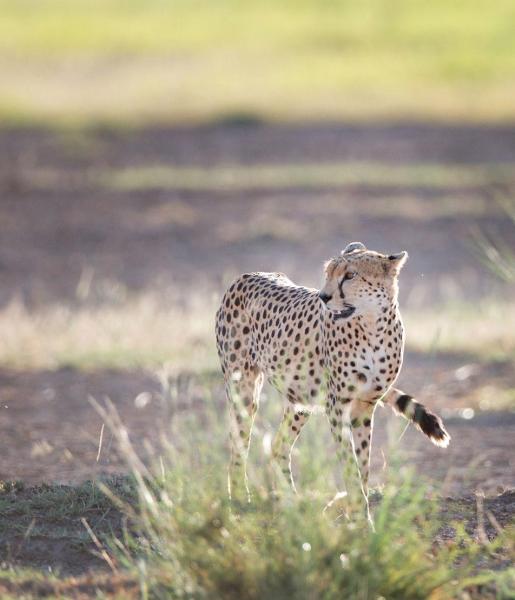
There are five subspecies of this big cat. It is slim and has muscular, long legs — in relation to its body size when compared to other cats — a small, rounded head that is set on a long neck, a flexible spine, a deep chest, special pads on its feet for traction, and a long tail for balance. It is also the only cat that cannot retract its claws, an adaptation to help maintain traction like a soccer player’s cleats. It also bears distinctive black “tear tracks” running from the inside corner of each eye to the mouth that may serve as an anti-glare mechanism for daytime hunting.
Acinonyx jubatus
20 to 72 kilograms (45 to 160 pounds)
1 to 1.5 meters in length (45 to 60 inches) 76 centimeters at the shoulder (30 inches)
Maximum recording of a female living 14 years and 5 months in the wild and about 10 years for a males.
Wide range of habitats—from dry forests and thick scrubs through grasslands and Sahara deserts.
Carnivores
About 3 months
Eagles, humans, hyenas, lions

Challenges
Human-wildlife conflict threatens their survival.
Cheetahs tend to encounter conflict with farmers when the decline of their natural prey leads them to attack livestock, resulting in farmers killing them in retaliation.
Habitat loss also presents a major threat to cheetahs.
As human populations grow and expand, agriculture, roads, and settlements destroy the open grasslands that this big cat calls home. Total cheetah populations have been estimated to be 6,674 adults and adolescents. There is a low density of the cat across its range, meaning it needs larges areas of connected habitat for their survival. The majority of known cheetah range (76 percent) exists on unprotected lands. This leaves populations to be extremely fragmented, which is cause for concern for their future.
Illegal trade is threatening wild populations.
Live cheetahs are caught and traded illegally to the exotic pet trade and they are also poached for their skin. The East African region is where illegal live trade is most likely to have the greatest negative impact on wild populations. Although the exact origin of the trade is unclear, information from interdictions and interviews with traders suggests that cheetahs are opportunistically collected from Somali regions, including parts of Ethiopia and Kenya, and occasionally beyond.
Solutions
Our solutions to protecting the iconic cheetah before it becomes endangered:
We engage communities to create sustainable solutions for agricultural and settlement growth by providing incentives and training on best practices. This allows for both cheetahs and farmers to have space in which to live without encroaching on one another.
AWF provides both proactive and reactive strategies to prevent human-wildlife conflict. We work with local communities to construct bomas—enclosures for livestock that protect them from big cats like cheetahs. We also provide consolation funding to farmers who have lost livestock to carnivore predation. This allows farmers to replace lost livestock, with the assurance they will not retaliate against big cats and other carnivores.
Behaviors
Cheetahs tend to be introverted
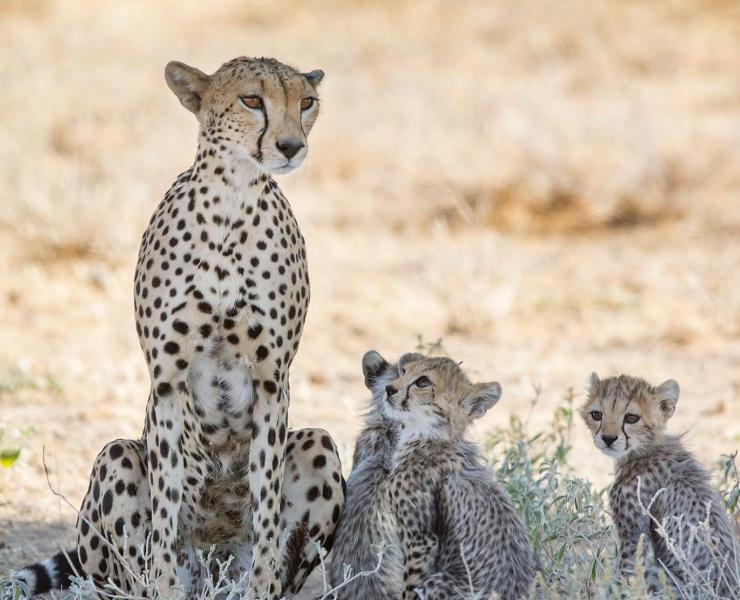
This cat is a solitary animal. Males have been seen living in coalitions, where they appear extremely tolerant of close proximity to other males. The related members of the coalition will even take part in play and physical contact such as grooming, whereas the unrelated males will generally stick to themselves while remaining in the coalition. Like all females, there are some males who stick to themselves who do not belong to a coalition. They never stay in one place for long and are referred to as nomads. At times, a male will accompany a female for a short while after mating, but most often the female is alone with the cheetah cubs. Mothers spend a long time teaching their young how to hunt. Small, live antelopes are brought back to cheetah cubs so they can learn to chase and catch them.
Diet
Cheetahs can run fast, but they are timid predators.
They usually prey on small antelopes such as Thomson’s gazelles and impalas but also hunt small mammals and birds. It gets as close to the prey as possible; then in a burst of speed, it tries to outrun its quarry. These big cats are the fastest of all land mammals. These cats can run as fast as 95 to 120 km/h (60-75 mph). Once the cat closes in, it knocks the prey to the ground with its paw and suffocates the animal with a bite to the neck. Once it has made a kill, it eats quickly and keeps an eye out for scavengers–lions, leopards, hyenas, vultures, and jackals will steal from this timid predator. Unfortunately, the cat's speed can’t be maintained for more than a few hundred meters before the individual overheats. The majority of hunts result in failure.
Habitats
Where do cheetahs live?
The historic distribution of this species is very wide. But in the 1970s, European settlers saw these big cats as vermin to be eradicated, and populations were widely reduced. Currently, they only inhabit about 10 percent of their historic range. Their range occurs widely but is extremely sparse and fragmented in the regions they still inhabit. Southern and Eastern Africa are strongholds for cheetah populations.


