
What is a gerenuk?
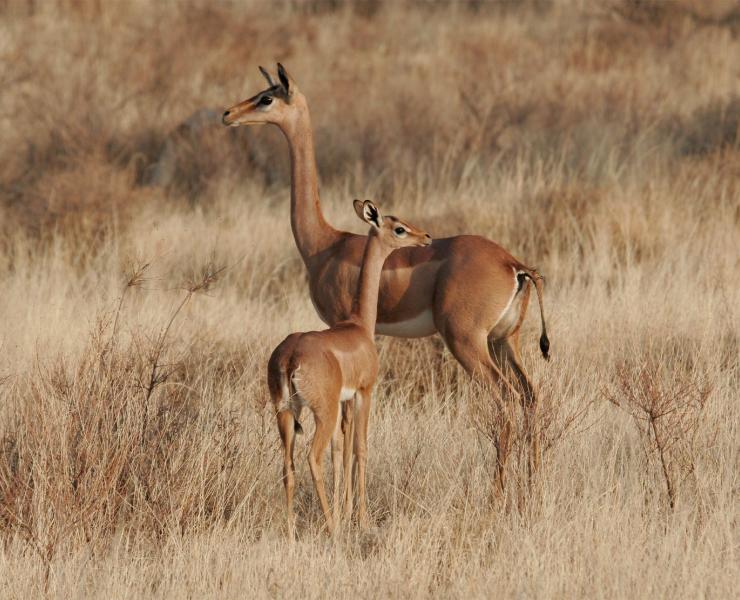
The gerenuk, whose name means “giraffe-necked” in Somali, is an exceptionally long-necked antelope. Their head is small for their size, but their eyes and ears are large. Only the males have horns, which are stout and heavily ringed, and they have a more heavily muscled neck than the females do. They have a coat that is brown on the upper back and lighter on the sides. The short tail looks longer as it ends in a tuft of black hair. Like many other gazelles, these large antelopes have preorbital glands in front of the eyes that emit a tar-like, scent-bearing substance they deposit on twigs and bushes to mark their territory. They also have scent glands on their knees that are covered by tufts of hair and between their split hooves.
Litocranius walleri
29 to 58 kilograms (63 to 128 pounds)
140 to 160 centimeters (55 to 63 inches)
10 to 12 years in the wild, up to 13 years in captivity
Woodland forest to open plains
Herbivorous
Average 5 to 6 months
Humans, wild dogs, cheetahs, leopards, lions, jackals, servals, honey badger, caracals

Challenges
Habitat loss and fragmentation are the biggest threats to gerenuk populations.
They are able to withstand hunting pressures to some degree, which is what has enabled them to survive widely in unprotected regions. However, as human populations grow, they expand settlements, roads, and agriculture, causing in lost or segmented habitats for this species and other wildlife. This makes it more difficult for them to find food and shelter themselves from predators. Due to these threats, populations have declined by 25 percent over the last 14 years (three generations) and is now estimated to be close to meeting the threshold for uplisting to vulnerable.
Solutions
Our solutions to conserving the gerenuk:
African Wildlife Foundation engages with government entities to help plan and propose alternative solutions to habitat fragmentation by providing our scientists and researchers as resources to assist in proper planning to ensure a balance between modernization and conservation.
AWF brings together private investors and communities to construct tourism lodges, like Satao Elerai, a luxury lodge situated on 5,000 acres in Kenya. The land is protected, so gerenuks and other wildlife can roam safely and freely, and the revenue is reinvested into the community and into local wildlife conservation.
Behaviors
They live in small groups.
Gerenuks social groups may consist of related females and their young or bachelor groups of males. Sometimes males will live alone. The latter are thought to be territorial, but as their ranges are large and populations are usually sparse, it has been difficult for scientists to determine if they defend these territories. Female groups wander over a home range of 1 to 2 sq. mi., passing in and out of male territories.
Gerenuk fawns are kept hidden from sight.
When ready to give birth, the female leaves the group and goes to a secluded spot. Unlike many other grazing animals, gerenuks bear young at any time instead of just before the rainy season. During the first weeks of its life, the baby spends its time hidden in the bush while its mother feeds. She returns to suckle the fawn three to four times a day and carefully cleans or eats its waste to leave no trace of scent.
They are very vocal.
Gerenuks use several vocalizations, including a buzzing sound when alarmed, a whistle when annoyed, a loud bleat when in extreme danger, and a soft bleat when females communicate with their young.
Diet
The gerenuk eats standing on two legs.
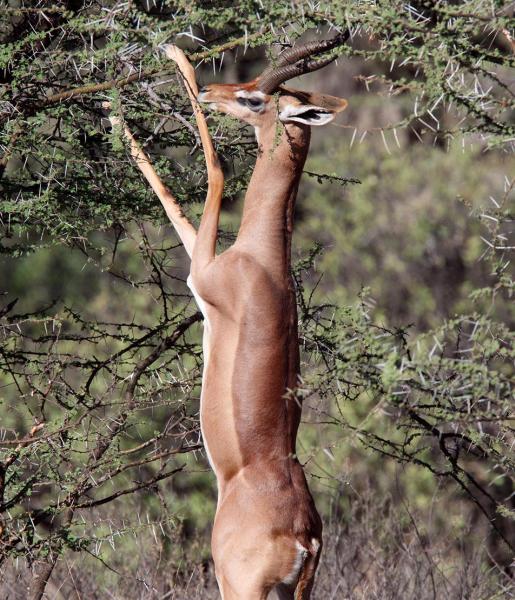
They feed at higher reaches than most other gazelles and antelopes. They stand erect on their hind legs, with their long necks extended, to browse on tall bushes. By using their front legs to pull down higher branches, they can reach leaves six to eight feet off the ground. They are one of the most exclusive browsers and largely prefer succulent plants. Although approximately 80 different species of plants make up their diet; including tender leaves and shoots of prickly bushes along with a nutritious mix of buds, flowers, fruit, and climbing plants. They do not eat grass and do not require water. They can get enough moisture from the plant life they eat and can survive in dry thornbush country and even in the desert.
Habitats
Where do gerenuks live?
They are highly adaptable and typically found in habitats with woody vegetation, especially dry, flat thornbush and thickets. It avoids very dense woodlands and very open habitats.


