
What are giraffes?
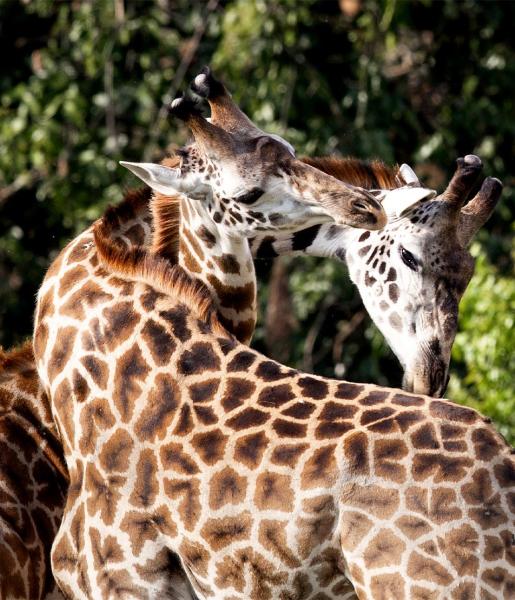
They are the world’s tallest mammals. They are uniquely adapted to reach vegetation inaccessible to other herbivores. Unusually elastic blood vessels and uniquely adapted valves help offset the sudden buildup of blood (to prevent fainting) when giraffes’ heads are raised, lowered, or swung quickly. Their "horns" are actually knobs covered with skin and hair above the eyes that protect the head from injury. Their necks contain the same amount of vertebrae as we do (seven) except their bones are extremely elongated making their neck a long length of 2.4 meters.
Giraffa camelopardalis
Males: 1,930 kilograms (4,254 pounds) Females: 1,180 kilograms (2,601 pounds)
5.7 meters tall from the ground to their horns (18.7 feet)
Average 10 to 15 years in the wild; recorded a maximum of 30 years
Dense forest to open plains
Herbivorous
Between 13 and 15 months
Humans, lions, leopards, hyenas, crocodiles

Challenges
Humans hunt giraffes for their hides, meat, and body parts.
Giraffe tails are highly prized by many African cultures and are used in good-luck bracelets, fly whisks, and even thread for sewing or stringing beads. The world's tallest land animal has lost 40 percent of its population in just 30 years, and recent reports show poaching and wildlife trafficking are contributing to this decline. Giraffes are easily killed and poaching (now more often for their meat and hide) continues today.
Giraffes are quickly losing their living spaces.
The number of giraffes in the wild is shrinking as their habitats shrink. In the late 19th and 20th centuries herds of 20 to 30 animals were recorded, now on average herd sizes contain fewer than six individuals. The IUCN lists four main threats to this species: habitat loss, civil unrest, illegal hunting, and ecological changes (climate change and habitat conversion). As human populations grow and increase agricultural activities, expand settlements, and construct roads, the giraffe is losing its beloved acacia trees, which are its main source of food.
Solutions
Our solutions to saving the world's tallest land animal from extinction:
AWF has reforested acacia trees in West Africa to provide more food for the giraffe and allow it to expand its habitat.
We educate communities living near giraffes on the importance of sustainable practices for agricultural and settlement growth by providing training on sustainable — and more productive — agricultural practices and incentivizing conservation agriculture when appropriate.
Behaviors
Young giraffes are self-sufficient but vulnerable.
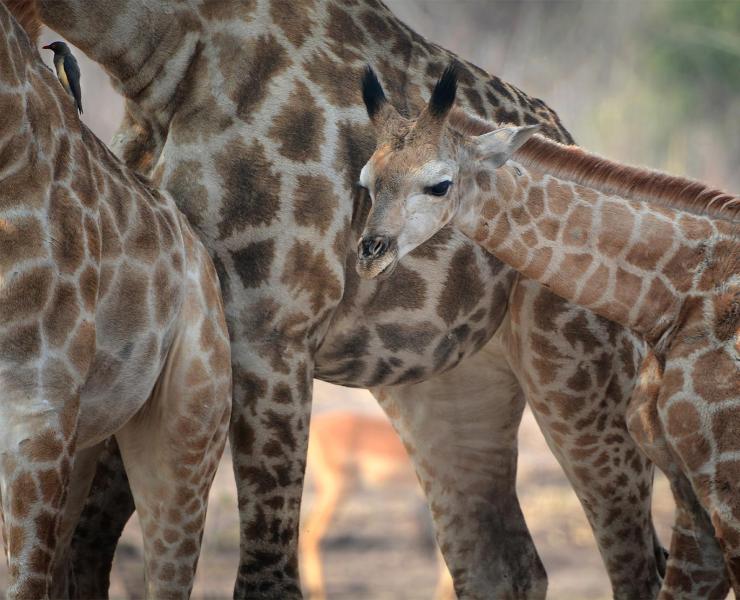
Calves are about two meters tall and grow rapidly as much as two and a half centimeters a day. By two months, the calf will start eating leaves and at six months is fairly independent of its mother. A young giraffe can even survive early weaning at two or three months. Although few predators attack adults, lions, hyenas, and leopards take their toll on the young. Scientists report that only one-quarter of infants survive to adulthood due to the high rates of predation.
Diet
Giraffes are extremely picky eaters.
They feed 16 to 20 hours a day, but may only consume about 30 kilograms (about 30 pounds) of foliage during that time. These two-ton mammals can survive on as little as seven kilograms (15 pounds) of foliage per day. While these browsers’ diverse diets have been reported to contain up to 93 different plant species, acacia trees have been found to be their favorite food source.
They are not heavy drinkers.
Giraffes drink water when it is available, but they don’t need to drink water on a daily basis, which allows them to survive in areas with scarce water.
Habitats
Where do giraffes live?
They have adapted to a variety of habitats and can be found in desert landscapes to woodland and savanna environments south of the Sahara, wherever trees occur.


