
What is a springhare?
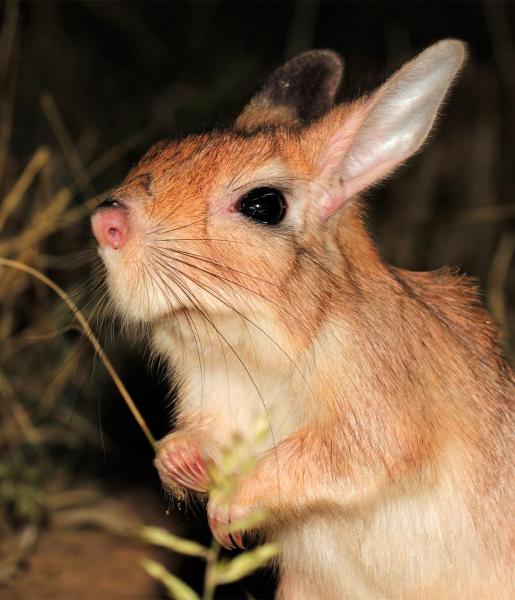
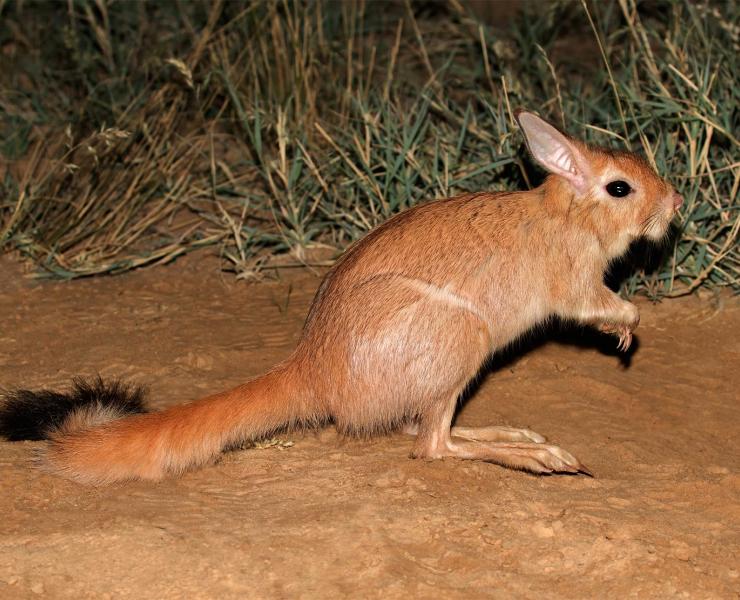
This unusual rodent species, which appears to be a cross between a kangaroo and a rabbit, has caused scientists much confusion. Springhares were once grouped with jerboas (jumping rodents), then with porcupines, then with scaly-tailed squirrels, until finally they were allotted their own family.
Their large back legs enable them to make gigantic leaps, using their long tail for balance. Their much smaller forelimbs have very sharp claws, which they use to dig. The springhare also possesses a flap of skin at the base of the ear that can be completely closed to prevent sand from getting into the inner ear.
Pedetes capensis
3 to 4 kilograms (6 to 9 pounds)
35 to 45 centimeters in length (13 to 18 inches)
Up to 13 years in captivity
Dry savannas
2 to 3 months
Serval cats, caracals, wild cats, genets, mongooses, ratels, jackals, large owls

Challenges
The springhare is losing living space.
Human settlement, ranching, and fencing of land results in the loss of critical habitat for the hares.
They are often killed as pests.
As human settlement and agriculture expand and encroach on springhares’ habitats, hares may take to crop raiding and eat sweet potatoes, groundnuts, pumpkins, and the shoots of maize and wheat. In those cases, snaring and shooting can cause localized population depletion.
Solutions
Our solutions to protecting the springhare:
African Wildlife Foundation engages communities living near wildlife to create sustainable practices for agricultural and settlement growth by providing training on best practices and incentivizing conservation agriculture when appropriate. This helps increase agricultural and economic productivity while minimizing the land used for agriculture, giving wildlife more space to live.
AWF uses technology to identify critical landscapes in need of intervention and then set sustainable development plans that will both improve the lives of people and protect wildlife. In the Democratic Republic of Congo (DRC), we used Geographic Information System (GIS) technology and satellite images to determine what forest areas have been disturbed due to human activity.
Behaviors
They are territorial.
Springhares usually live in burrows, the entrance of which they plug up with sand once inside. Little is known about the social life of these unique hares. Each burrow is inhabited by one animal, a female with her young or, at most, a pair with their young. Sometimes, fairly large concentrations of 30 to 40 individuals are found in an area, and their burrows may be linked.
Springhares are big babies.
Three babies are usually born to a female every year. An infant at birth is well-developed, fully furred, and weighs about one-third the weight of an adult. Newborns can sit on their hind legs immediately and can even run on the second day. Even so, the young are rarely seen when small and remain in the burrow until about half grown.
The sprinhare can be awkward.
They have a strange resting posture. Springhares sit with their hind legs stretching forward and bodies bent between them, with the flat top of the head and ears in direct contact with the ground. This position seems to enable them to detect vibrations.
Diet
They are homebodies.
Springhares eat the stems, roots, and sprouts of many plants as well as herbs and fruit. Normally, they do not roam more than 25 to 250 meters from their burrows; during periods of severe drought, they have been reported to travel 10 to 20 kilometers a night in search of food and water.
Habitats
Where do springhares live?
Springhares are found locally in the semiarid steppes and dry savannas of Kenya and Tanzania as well as in Southwestern Africa. Their distribution is scattered and limited to open areas free of rocks and large bushes (which would interfere with their leaping) and with sandy soil.


