
What is a Thomson’s gazelle?
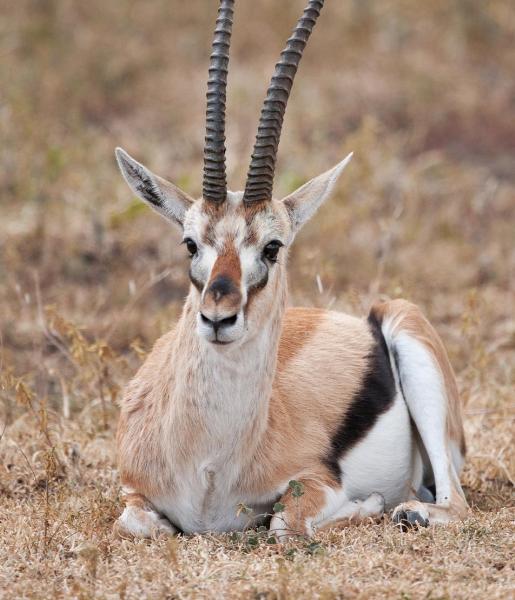
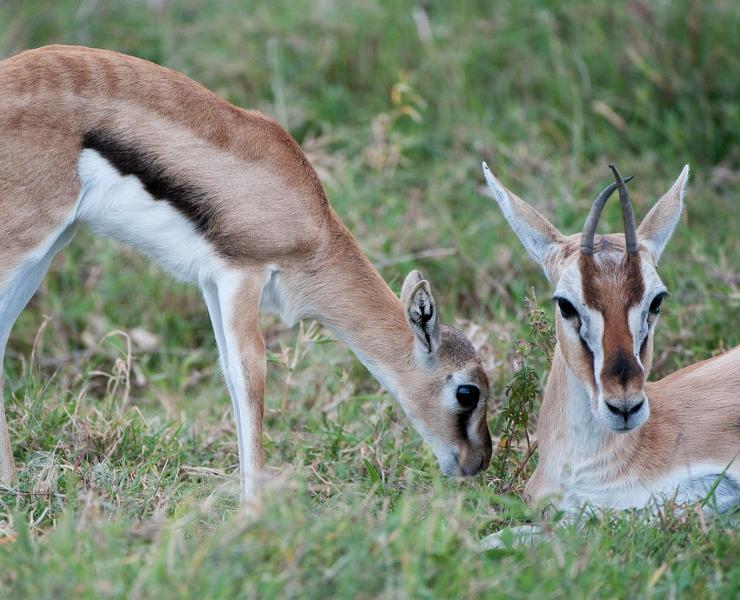
These small gazelles, named for researcher Joseph Thomson, have light-brown coats with dark stripes running down their sides, a white patch on their rumps extending underneath the tail, and ridged horns that curve backward. Females may have shorter, smoother, and slimmer horns than males or none at all. Grant’s gazelles are sometimes confused with Thomson’s. However, Thomson’s is distinguished from Grant’s by its smaller size and the white patch on its rump. On Grant’s gazelles, the patch always extends above the tail.
Gazella thomsonii
15 to 35 kilograms (33 to 77 pounds)
55 to 82 centimeters at the shoulder (21 to 32 inches)
About 10.5 years in the wild
Open plains and grassland
6 months

Challenges
Thomson’s gazelles are victims of hunting.
They are often found on ranches and farmlands after many animals have left, feeding on the short grasses exposed by cattle. Here, they are an easy target and are often shot or snared for food.
Humans are encroaching on their living spaces.
The Thomson’s gazelle’s habitat is decreasing as human populations grow and agriculture, settlements, and roads expand.
Solutions
Our solutions to protecting the Thomson’s gazelle:
African Wildlife Foundation works with governments and villages to designate wildlife corridors — large swaths of land that wildlife use to roam freely and safely from one park, or country, to another. Corridors link protected areas and allow species to follow rains or travel to their calving grounds.
AWF engages communities living near wildlife to create sustainable practices for agricultural and settlement growth by providing training on best practices and incentivizing conservation agriculture when appropriate. These techniques maximize revenue while ensuring agriculture minimizes its impact on Thomson’s gazelles and other wildlife.
Behaviors
They have no true hierarchy or leaders.
The strongest of Thomson’s gazelle males set up territories in home ranges using an exaggerated display posture and scent gland secretions to mark their boundaries. Females and offspring form groups of five to 50 and wander through male territories. However, the groups change members and numbers by the hour, so no obvious patterns of hierarchy or leadership emerge.
They balance their vulnerability with exceptionally keen senses.
They are extremely alert to sounds and movements, relying on visual awareness of one another to stay in contact. Their strong senses of hearing, sight, and smell balance its vulnerability and small size on the open plains.
They play hide-and-seek with their young.
Births usually peak right after the rainy seasons. After giving birth, the mother hides the newborn in the grass and returns several times a day to nurse it. Nevertheless, predation on the young is heavy, and many predators are able to feed solely on newborns during the calving peaks.
Diet
They enjoy a fairly basic diet.
In the dry season, grasses make up about 90 percent of their diets. They will also eat seeds and browse on shrubs. They will congregate with larger ungulates, such as wildebeest and zebra, which trample and graze on tall grass, making it easier for them to feed on short grass.
Habitats
Where do Thomson’s gazelles live?
Thomson’s gazelles prefer savannas and grassland habitats, particularly in the Serengeti region of Kenya and Tanzania.


