
What is a vervet monkey?
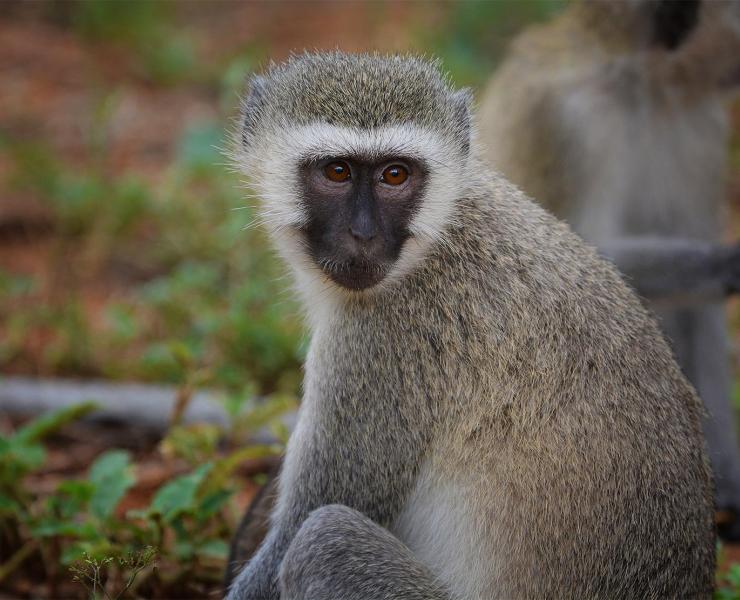
The vervet is a small, black-faced monkey, common in East Africa. There are several subspecies of vervet monkeys, but, generally, the body is a greenish-olive or silvery-gray. The face, ears, hands, feet, and the tip of the tail are black, but a conspicuous white band on the forehead blends in with the short whiskers. The males are slightly larger than the females and easily recognized by a turquoise-blue scrotum and red penis. The vervet is classified as a medium- to a large-sized monkey. The tail is usually held up, with the tip curving downward, and the arms and legs are approximately equal lengths.
Cercopithecus aethiops
3 to 5 kilograms (6 to 11 pounds)
400 to 600 millimeters in length (15 to 24 inches); with tails about 300 to 500 millimeters in length (11 to 20 inches)
Up to 30 years
Woodland, savanna, high bush
Omnivorous
About 5.5 months
Leopards, eagles, humans

Challenges
Vervet monkeys are sometimes viewed as pests.
Vervets living near areas inhabited by people can become pests, stealing food and other items and raiding crops. This leads to a heavy annual slaughter by poison, traps, and guns.
They have become valuable to research.
In recent years, vervet monkeys have been considered a valuable research animal, making live trapping prevalent as well.
Solutions
Our solutions to protecting the vervet monkey:
African Wildlife Foundation works with communities living in close proximity to wildlife to incentivize conservation. In exchange for refraining from retaliatory killing or hunting for bushmeat, communities receive training in sustainable, and more productive, agriculture techniques that lead to enhanced food and economic security.
Conservation schools are another way that we are protecting wildlife and assisting communities. Conservation schools allow AWF to build outstanding schools in rural areas with the agreement that the people living in the community will set aside land for wildlife to live undisturbed. Conservation is also built into the school’s curriculum, creating a new generation of people informed on, and committed to conservation.

Behaviors
Vervets adhere to a strict hierarchy.
The small monkey’s society is built on complex but stable social groups (called troops) of ten to 50 individuals — mainly adult females and their offspring. There is a strict social hierarchy among troop members. Males transfer troops at least once in their lifetime, beginning at puberty. This is a dangerous process, not only because of the predators they may encounter in transit but also because troops dislike immigrants.
The hierarchical system controls feeding, mating, fighting, friendships, survival, and even grooming — an important part of the vervet’s life. They spend several hours each day removing parasites, dirt, and other materials from one another’s fur. In the hierarchy, dominant individuals receive the most grooming.
Infants are cherished in vervet society.
Newborns have black hair and a pink face, and it takes three or four months before they acquire adult coloration. Infants spend the first week of life clinging to their mother's stomach. After about the third week, they begin to move about by themselves and attempt to play with other young monkeys. Infants are of great interest to the other monkeys in the troop; subadult females do everything possible to be allowed to groom or hold a new infant. Researchers report that usually a female's close family members will have the most unrestricted access to the babies. As the infants grow, they play not only with monkeys but also with other young animals.
Diet
Vervet monkeys enjoy a mostly vegetarian diet.
Leaves and young shoots are most important in their diet, but bark, flowers, fruit, bulbs, roots, and grass seeds are also consumed. Their mainly vegetarian diet is supplemented with insects, grubs, eggs, baby birds, and sometimes rodents and hares. Vervets rarely drink water.
Habitats
Where do vervet monkeys live?
In East Africa, vervet monkeys can live in mountain areas up to about 4,000 meters (13,000 feet), but they do not inhabit rainforests or deserts. Their preferred habitat is acacia woodland along streams, rivers, and lakes.


