
What are African bush elephants?
They are the world’s largest terrestrial mammal. There are two recognized subspecies of this iconic animal: bush (or savanna) and forest. African bush elephants are the larger of the two and their tusks curve out, while their forest-dwelling cousins are darker and have tusks that are straighter and that point downward.
Loxodonta africana
2,000 to 6,100 kilograms (about 2 to 7 tons)
Up to 4 meters (13 feet)
60 to 70 years
Open and closed savanna, grasslands, and arid deserts
Herbivorous
About 22 months
Humans and occasionally lions or hyenas

Challenges
Elephant poaching and demand for ivory are driving this mammal toward extinction.
The large ivory tusks on either side of their face—used for foraging for food and water—have long been desired by people. The ivory trade is driven by consumer demand for products made from tusks and supplied by a sophisticated international network of traffickers. Poachers kill this iconic species for its ivory tusks, which are then sold and made into anything from jewelry and crafts to musical instruments to religious objects. At current poaching rates, populations may disappear in the wild within our lifetimes.
Elephant gestation and reproduction is a slow process.
They have longer pregnancies than almost any other mammal. Calves are carried for about 22 months, with cows usually bearing only one calf every three to six years. Their regeneration rate averages 5 to 6 percent annually, compared to the 8 to 9 percent poaching rates, resulting in a net loss in population numbers. Extinction is a very real threat if poaching continues unabated.
Solutions
Our solutions to protecting and conserving this iconic endangered African species:
Wildlife corridors are large sections of land that allow wildlife to move from one national park to another—and even from one country to another. African Wildlife Foundation works with people on all levels— from governments to communities—to set land aside specifically for wildlife use, and in some cases, purchase land to set it aside for conservation. Habitat loss poses a long-term threat to African elephant populations. AWF is working in countries like Zambia to create protected spaces for this beloved species. We worked with Zambia’s Sekute Chiefdom to create the Sekute Conservation Area, and in exchange for protecting wild spaces for wildlife, AWF rebuilt the Lupani School.
AWF works with communities who live in close quarters with wildlife, to recruit, train, and equip wildlife scouts. These wildlife scouts monitor wildlife and can prevent them from destroying crops, thereby preventing farmers from viewing them as pests, Scouts are also instrumental in deterring poachers. As a result, AWF can ensure enhanced protection of wildlife in these regions, like the Osupuko and Kitome Conservancies in Kenya, as well as provide additional employment opportunities to local communities. 10 of the 14 of the elephant populations AWF works with are now stable or increasing.
AWF is fighting the demand for ivory in China and across the world, educating consumers about the real cost of ivory products and working with governments to close ivory markets. Since 2012, AWF and partner WildAID have developed celebrity-driven public awareness campaigns that shed light on the ivory trade’s impact on populations and demonstrate the true horrors of poaching. We have worked with celebrity ambassadors like former NBA star, Yao Ming, actor Jackie Chan, actor Li Bingbing, and Virgin Group founder Sir Richard Branson. Since our campaigns first launched, public awareness around the ivory trade has increased and tolerance for ivory products is decreasing. China’s 2018 domestic ivory ban will also contribute to curbing poaching and the illegal trade in wildlife products.
Behaviors
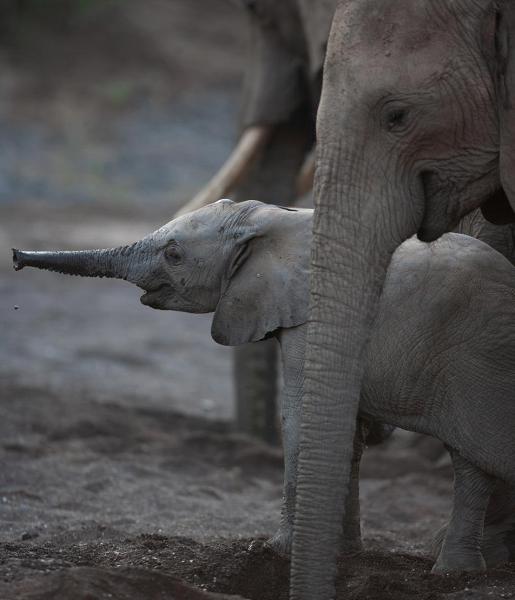
Elephants have a very long nose, which also doubles as an arm.
Their trunk is a long nose that is used for breathing, smelling, drinking, trumpeting, and grabbing objects. Their trunks are also a grooming tool. Grooming consists of using their trunks to cover themselves with mud or water to maintain hydration. They have two fingerlike extensions on the tips of their trunks that are used for holding onto small objects. They also use their trunks to exhibit affection, by frequently touching and caressing one another.
They are friendly.
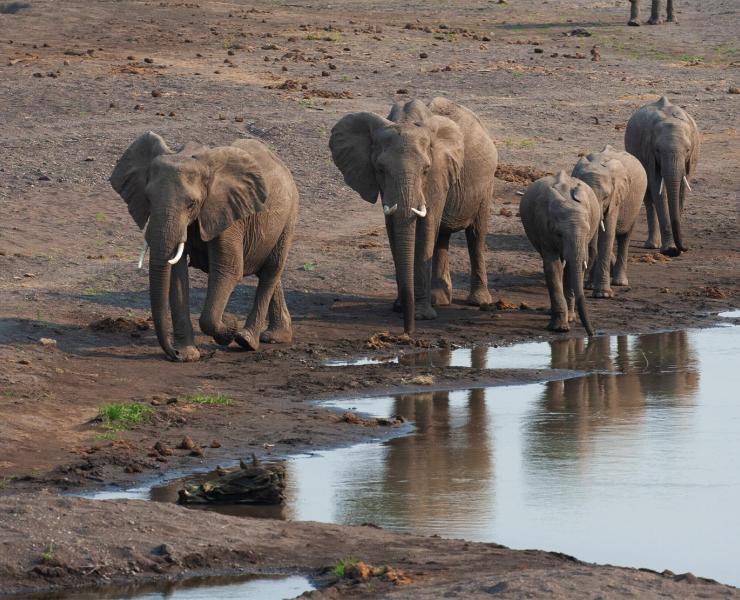
Much like humans, these mammals are social creatures that live in small family groups that usually consist of an older matriarch and several generations of female relatives. Males are typically solitary once matured but may live in small groups of three or four bulls. They take care of weak or injured members and even appear to grieve over dead companions.
Diet
They spend a lot of time eating.
It’s no great surprise these large animals love to eat. Elephants spend the majority of their day roaming across large distances to forage for grasses, fruits, roots, and bark. They can eat up to 136 kilograms (300 pounds) of food and drink 113 to 190 liters (30 to 50 gallons) of water in one day.
Habitats
Where do African bush elephants live?
They will live in almost any habitat that provides plentiful food and water. Their populations are scattered throughout the savannas of sub-Saharan Africa. About 70 percent of their range exists in protected land.


