
What are rhinos?
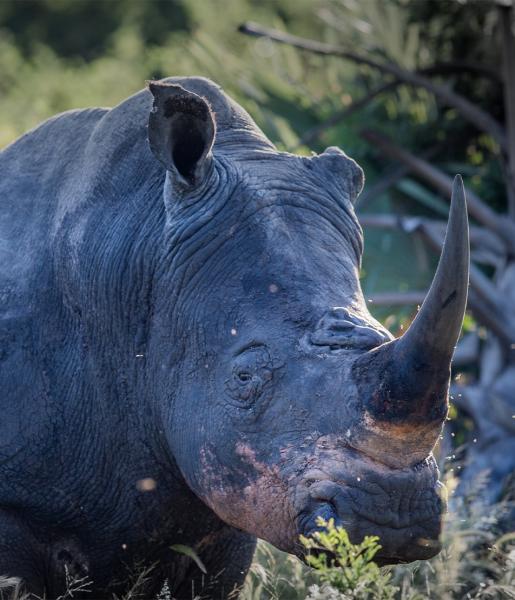
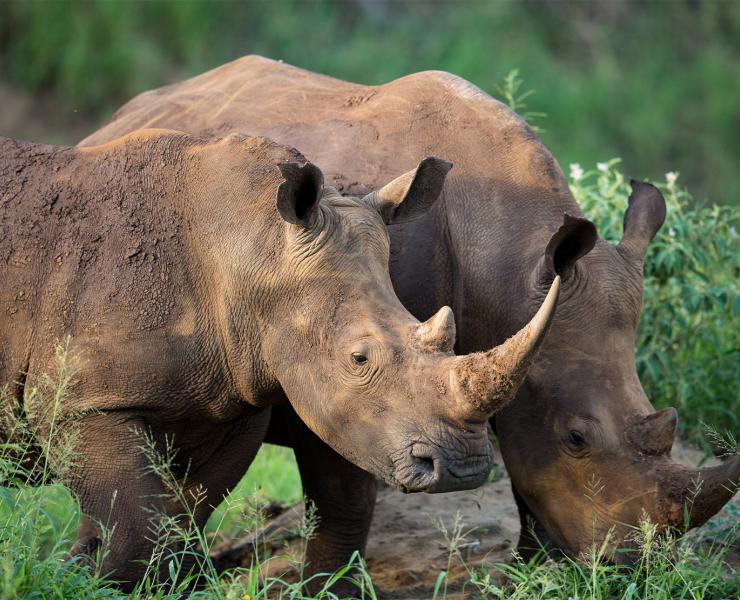
Rhinos may look like prehistoric creatures, and they do date back millions of years to the Miocene era, but they are also mammals like us. There are two species of African rhinos, the white rhino and black rhino, and each is distinct in its own way. The white, or square-lipped, rhino derives its name from the Dutch word “weit,” meaning wide. It is actually gray in color and has a hump on its neck and a long face. The black, or hooked-lipped, rhino has a thick, hairless gray hide. Both rhinos have two horns.
White: Ceratotherium simum
White: More than 2 tn. (4,000+ lb.)

Challenges
Rhinos have become victims of organized crime.
In the wild, the adult black or white rhino has no predators except for humans. Rhinos are hunted and killed for their horns. The major demand for rhino horn is in Asia, where it is used in ornamental carvings and traditional medicine. Rhino horn is touted as a cure for hangovers, cancer, and impotence. Their horns are not true horns; they are actually made of keratin—the same material that makes up our hair and nails. Truly, rhino horn is as effective at curing cancer as chewing on your fingernails.
Habitat loss is also a major threat to rhinos.
As human populations rise and cities grow, logging, agriculture, roads, and settlements destroy rhino habitats.
Solutions
Our solutions to saving the rhino from extinction:
African Wildlife Foundation is working with other conservation organizations and governments to spread public awareness about the illegal rhino horn trade, the horrors of poaching, and dwindling rhino populations. For example, we launched a campaign with WildAid in 2012 featuring former NBA star Yao Ming and targeting Chinese audiences to bring attention to the atrocities of rhino poaching and dispel myths about rhino horn. You can also help spread the word.
AWF constructed Nguila Rhino Sanctuary in Tsavo East National Park in Kenya. Although fencing in wildlife is a last resort, AWF supported the sanctuary’s establishment due to the rhinos’ critical status. We provided funding to the sanctuary, ensured park staff had necessary equipment (vehicles, radio sets, etc.), and created housing for rangers and staff. Most recently, AWF provided the sanctuary with camera traps, which once caught potential poachers on camera, to monitor rhinos. At Nguila, rhinos have a protected, fenced-in space to live in.
AWF recruits, trains, and equips wildlife scouts who protect the rhino from poachers. Wildlife scouts are familiar with landscapes, wildlife, and community members. As insiders, they are able to quickly identify any suspicious activity. They monitor rhinos—and other wildlife—and work with local authorities, like Kenya Wildlife Service (KWS), to help them apprehend poachers and even identify would-be poachers.
In 2012, AWF hosted a Rhino Summit—an emergency response to the rhino-poaching crisis—to create a comprehensive plan to protect rhinos. The plan called for increasing surveillance on the ground, strengthening law enforcement, curbing demand and trade, and reaching out to influence policy makers and legal entities. Later the same year, we, along with KWS, hosted an Illegal Wildlife Trafficking Luncheon that brought together the top legal minds to discuss harsher penalties for wildlife-related crimes.
Behaviors
Some rhinos are more introverted than others.
Rhinos live in home ranges that can sometimes overlap with each other, and their feeding grounds, wallows, and water holes may be shared. The black rhino is usually solitary, while the white rhino tends to be more social.
They can’t see very well.
Rhinos have poor eyesight, which may explain why they will sometimes charge for no reason. However, their sense of smell and hearing are very good.
Diet
Rhinos tend to live where they like to eat.
The black rhino is a browser. Its triangular-shaped upper lip, which ends in a grasping point, is used to eat a large variety of vegetation—including leaves; buds; and shoots of plants, bushes, and trees. It can be found in various habitats that have dense, woody vegetation. The white rhino lives in savannas, which have water holes, mud wallows, shade trees, and the grasses they graze on.
Habitats
The African rhino is divided into two species, the black rhino and the white rhino. White rhinos mainly live in South Africa, but they have also been reintroduced to Botswana, Namibia, Swaziland, and Zimbabwe. Southern white rhinos have been introduced to Kenya, Zambia, and Cote d’Ivoire. The majority of the black rhino population—98%—is concentrated in four countries: South Africa, Namibia, Zimbabwe, and Kenya. South Africa houses 40% of the total black rhino population. There are some black rhinos in the region spread between Cameroon and Kenya.


