
What is a Grevy’s zebra?
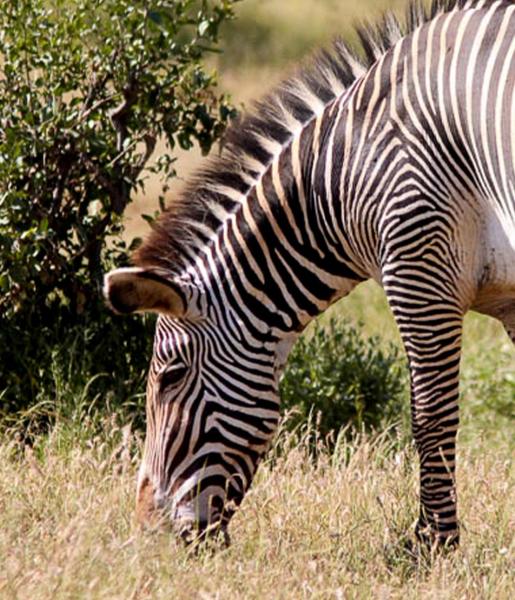
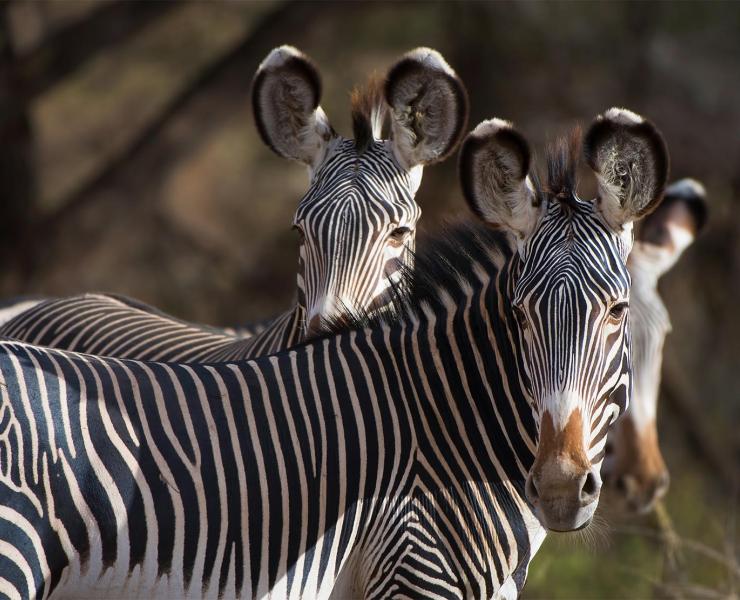
The long-legged, endangered Grevy’s zebra is the largest of the wild equids. It is distinguished by its unique stripes, which are as distinctive as human fingerprints. Foals are brown with reddish-brown stripes, and gradually their coats darken to black. The Grevy’s are more closely related to the wild ass than the horse, while the plains zebra is more closely related to the horse. Grevy’s also are taller, have larger ears, and have narrower stripes than plains zebras. They are the largest of the zebra species.
Equus grevyi
350 to 450 kilograms (770-994 pounds)
125 to 150 centimeters in length (50-60 inches)
12 to 13 years
Grasslands and savannas
Herbivorous
13 months
Lions, cheetahs, hyenas, hunting dogs, African wild dogs, leopards, humans

Challenges
Grevy’s zebras have undergone one of the most substantial reductions of range of any African mammal.
Habitat loss in an already restricted range is a serious threat to the Grevy’s survival. They have to compete for resources with other grazers, as well as cattle and livestock. Due to overgrazing and competition for water, Grevy’s juveniles have a low survival rate. Over the past three generations (30 years) there was a population reduction of 54 percent from an estimated population of 5,800 in the 1980s. The population of Grevy’s today is about 2,800, and the Grevy's is listed as endangered on the Red List of Threatened Species.
Hunting for endangered Grevy’s zebras persists.
In Ethiopia, hunting is the primary cause of the decline of Grevy’s zebras. They are primarily hunted for their striking skins, but will occasionally be killed for food and, in some regions, medicinal uses continue. In addition to illegal hunting, Grevy’s also face threats from disease outbreaks, drought, habitat loss, and fragmented populations.
Solutions
Our solutions to protecting the Grevy’s zebra:
African Wildlife Foundation worked with Kenya Wildlife Service to fit Grevy’s with collars, in Buffalo Spring National Reserve. The GPS-GSM collars provide scientists with critical information concerning their movement patterns and whereabouts. By gaining an understanding of their patterns, scientists are better able to protect the zebras.
AWF works with communities who live in close quarters with wildlife and equips scouts with essential tools, such as GPS monitoring devices and vehicles. As a result, AWF is able to ensure enhanced protection of wildlife in these regions, as well as provide additional employment opportunities to local communities.
Behaviors
They have social structures.
Grevy’s zebra live in herds but are loosely social animals that do not have concrete social systems. A stallion’s attachment to his land and a mare’s attachment to her young are the most stable relationships. Within the herd, dominance is relatively nonexistent, except for the right a territorial male has to a breeding female. If no females are around, the resident male will associate with bachelor males in a friendly manner.
Grevy's zebra foals can run less than an hour after birth.
Newborn foals can stand after six minutes, walk after 20 minutes, and they can run after an hour. They are dependent on their mothers for milk until they reach about six to eight months of age. Females usually stay with their mother for about 13 to 18 months, and the males often stay with their mother for up to three years. Peak birth periods for the Grevy’s are usually July through August, and mature females breed in two-year intervals.
Diet
They are grazers.
Grevy’s zebras are extremely mobile grazers, and they can digest many types, and parts, of plants that cattle cannot. Despite their mobility, Grevy’s are water dependent and will migrate to grazing lands only within reach of water.
Habitats
Where do Grevy’s zebras live?
Grevy’s zebras inhabit semi-arid grasslands where they have access to a permanent water source. Historically, the Grevy’s inhabited the semi-arid scrublands and plains of Somalia, Ethiopia, Eritrea, Djibouti, and Kenya in East Africa. However, due to rapid declines in their population, they are now confined to the Horn of Africa — primarily southern Ethiopia and northern Kenya.


