
What is a bongo?
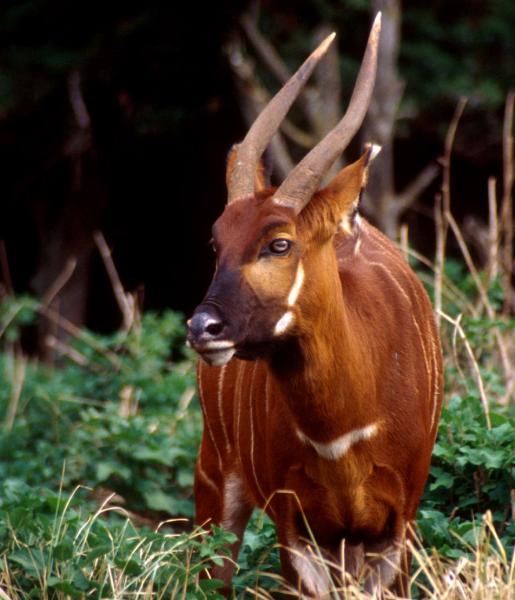
There are two currently recognized subspecies — the mountain or eastern bongo and the lowland or western bongo. This antelope is the largest, heaviest, and most colorful African forest antelope. It has an auburn or chestnut coat with 10 to 15 vertical whitish-yellow stripes running down its sides.
Females are usually more brightly colored than males. Both males and females have spiraled lyre-shaped horns. The large ears are believed to sharpen hearing, and the distinctive coloration may help bongos identify one another in their dark forest habitats. They have no special secretion glands and so rely less on scent to find one another than do other similar antelopes.
Tragelaphus eurycerus
225 kilograms to 410 kilograms (500 to 900 pounds)
1.2 meters at the shoulder (50 inches)
Up to 21 years in captivity. No data for in the wild.
Rainforests, dense forests, and forest-savannas
Herbivorous
About 9 months
Humans, hyenas, leopards, lions

Challenges
Natural predators take their toll on bongo populations.
Young bongos are vulnerable to pythons, leopards, and hyenas. Lions have also been reported to kill bongos.
Today, the bongo’s biggest threat is humans.
Even though there are taboos against eating bongo meat by locals, the lowland bongo are still subject to snare hunting due to expanding commercial forestry exploitation. They are the primary target of tourist safari hunting in central Africa, and the demand has been increasing during the past decade. Large-scale and continuous hunting has completely eliminated this species in some areas.
Solutions
Our solutions to protecting the bongo:
African Wildlife Foundation works with governments and villages to designate wildlife corridors — large swaths of land that bongos can use to roam freely and safely from one park, or country, to another. Corridors link protected areas and allow wildlife to follow rains or travel to their calving grounds without disturbing human settlements.
AWF engages communities living near wildlife to create sustainable practices for agricultural and settlement growth by providing training on best practices and incentivizing conservation agriculture in exchange for community members allowing local wildlife to live peacefully near their communities without encroaching on their territories.
Behaviors
The bongo scares easily.
The largest forest antelope are quite timid and are easily frightened. They will run away after a scare — at considerable speed — and seek cover, where they stand still and alert with their backs to the disturbance. Their hindquarters are less conspicuous than the forequarters, and from this position, the animal can quickly flee.
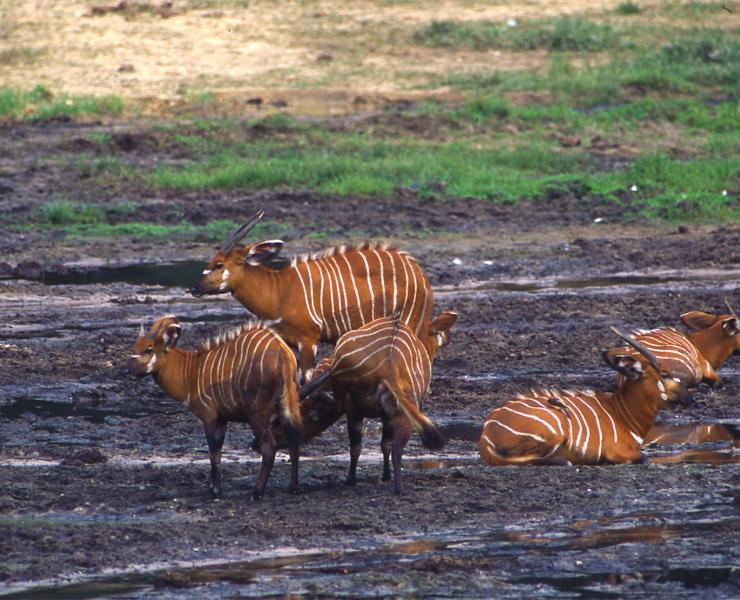
Bongo are mostly solitary.
Adult males of a similar size or age seem to try to avoid one another. Even though they are relatively non-territorial, they will meet and spar with their horns in a ritualized manner. Sometimes, serious fights will take place but they are usually discouraged by visual displays, in which the males bulge their necks, roll their eyes, and hold their horns in a vertical position while slowly pacing back and forth in front of the other male. Younger mature males most often remain solitary, although they sometimes join up with an older male. They seek out females only at mating time. When they are with a herd of females, males do not coerce them or try to restrict their movements, as do other antelopes.
Female bongos bear calves in specific areas.
Females use traditional calving grounds restricted to certain areas. The newborn calf lies out in hiding for a week or more, receiving short visits by the mother to suckle it. Calves grow rapidly and are quickly able to accompany their mothers in the nursery herds.
Diet
Bongo have a craving for salt.
Like other antelopes, they are herbivorous browsers that feed on leaves, bushes, vines, bark, grasses, roots, cereals, shrubs, flowers, and fruits. They also require salt in their diet and will visit natural salt/mineral licks during the night.
Habitats
Where do bongos live?
They are only found in rainforests with dense undergrowth across tropical Africa. Specifically, they are found in the lowland rainforests of West Africa and the Congo Basin to the Central African Republic and southern Sudan. They thrive at the forest edge and in new growth areas that occur after disturbances.


