
What is an elephant shrew?
Elephant shrews are not, in fact, shrews. Recent evidence suggests that they are more closely related to a group of African mammals that includes elephants, sea cows, and aardvarks. Elephant shrews (also called sengis) are represented by a single family, the Macroscelididae, including four genera and 19 living species.
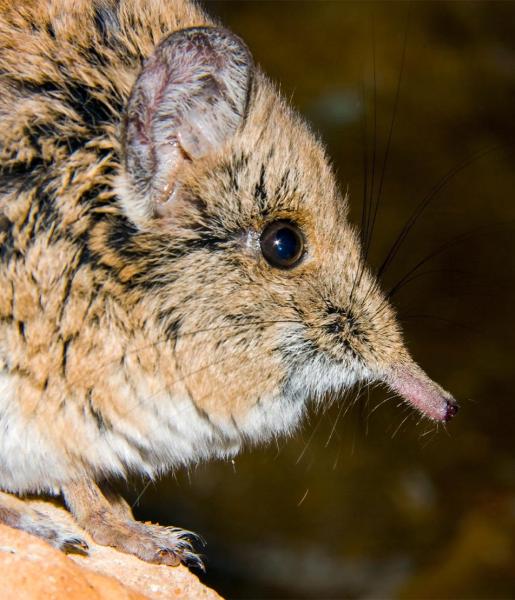
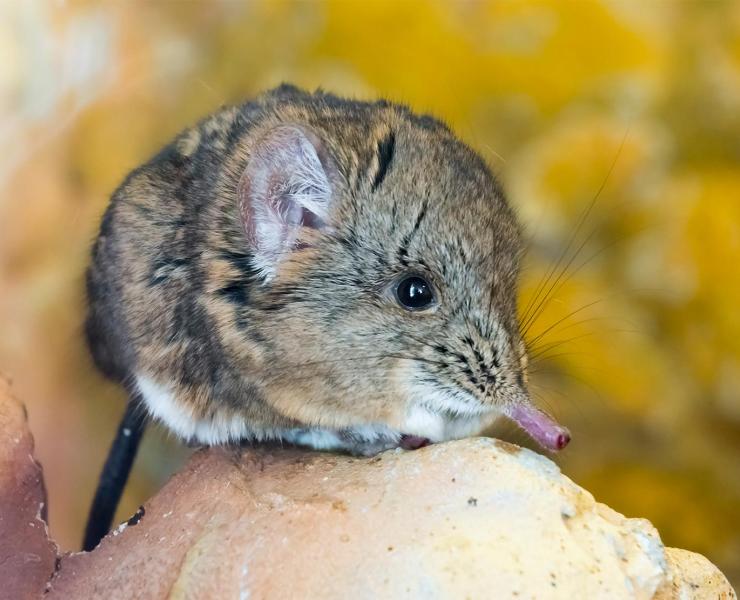
They take their name from their long pointed head and very long, mobile, trunk-like nose. They have rather long, legs for their size, which move in a hopping fashion like rabbits. They have a hunchbacked posture and a long, scaly tail. A gland on the underside of the tail produces a strong scent used to mark territories. This musky smell serves as a deterrent against many carnivores.
Rhynchocyon cirnei
25 to 700 grams depending on the species (1 to 24 ounces)
22 to 30 centimeters long, not including tail (9 to 12 inches)
2 to 4 years
Dense forest to open plains
Insectivorous
45 to 60 days
Snakes, birds of prey, various carnivores

Challenges
Habitat fragmentation is the biggest threat to elephant shrews’ survival.
Elephant shrews distribution is limited to highly fragmented forests, which limits their access to available resources and makes finding a mate more difficult, resulting in restricted populations. Specifically, the black and rufous sengi has experienced a significant percentage of forest loss resulting in a population decline of about 20 to 30 percent in the past ten years. Drought-driven fires and increased human-induced fires have also contributed to population declines for this species.
Solutions
Our solutions to protecting the elephant shrew:
African Wildlife Foundation engages government entities to help plan and propose alternative solutions to habitat fragmentation by providing our scientists and researchers as resources to assist in proper planning and ultimately ensuring there is a balance between modernization and conservation.
AWF uses science and technology to identify critical landscapes in need of intervention and then to set effective and sustainable development plans that will both improve the lives of people and protect wildlife. In the DRC, we used Geographic Information System (GIS) technology and satellite images to determine what forest areas have been disturbed due to human activity.
Behaviors
They live in couples.
Elephant shrews form monogamous pairs that live in common territory of several acres, but they are seldom together. They do, however, keep track of each other’s whereabouts through scent markings.
They are not friendly toward strangers.
They are intolerant of close neighbors, and should one trespass into the territory it will be violently evicted. Aggressive encounters involve screaming, sparring, snapping, and kicking, all of which can happen so rapidly that it appears to be a blur of animals tumbling on the forest floor.
The young are most vulnerable when leaving their parents.
Elephant shrews give birth four or five times a year. The fully haired newborn remains hidden for the first three weeks and then follows the mother for about a week. After weaning and becoming independent, the offspring remain in the parent’s territory for another six weeks. By that time, it is almost adult size and leaves to establish its territory.
Diet
Elephant shrews like bugs.
The elephant shrew eats “leaf litter invertebrates” such as ants, termites, beetles, spiders, millipedes, and earthworms. Unlike many other small mammals, the elephant shrew feeds during daylight. They play a significant role in maintaining natural checks of insect populations.
Habitats
Where do elephant shrews live?
The species as a whole is widely distributed throughout Africa, excluding western Africa and the Sahara region, but despite their wide distribution range, sightings are still rare. The four-toed elephant shrew is one of the most widespread of the species, occurring from Central and Eastern Africa to the Northeastern corner of South Africa. The four species of giant elephant shrew prefer to live in forests, closed-canopy woodlands, and thickets, usually with a floor densely covered by leaf litter. The checkered elephant shrew is found in Central Africa; the golden-rumped elephant shrew is endemic to Kenya; the grey-faced shrew is confined to two forests in Tanzania, and the black and rufous elephant shrew is found in East Africa. Smaller elephant shrew species can be found in the uplands of southern, eastern, and northwestern Africa, in dry forests, scrub, savannas, and open country covered by sparse shrubs of grass.


