
What is a hartebeest?
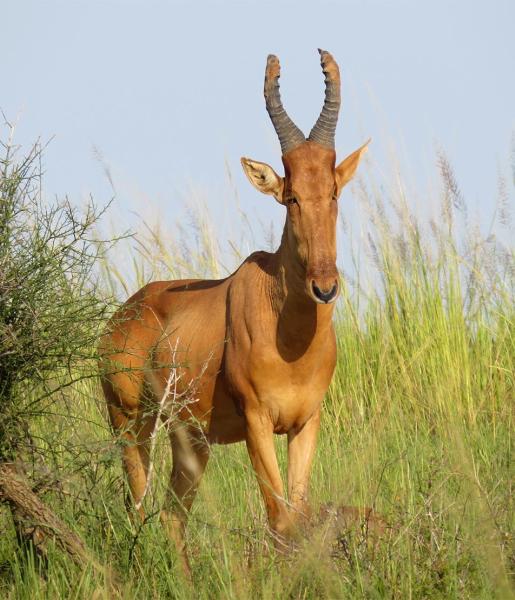
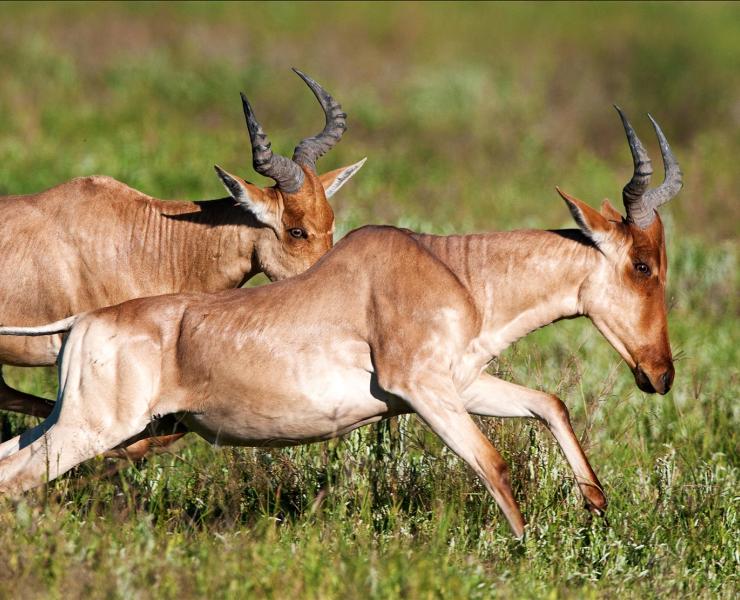
The hartebeest is a large, fawn-colored antelope. Their most distinctive characteristics are a steeply sloping back, long legs, and elongated snout. Despite their ungainly appearance, they are as elegant, if not more than, other antelopes. They are one of the most recent and highly evolved ungulates and are far from clumsy. In fact, they are one of the fastest antelopes and most enduring runners — capable of reaching speeds of up to 70 km/h. These qualities gave rise to their name, which means “tough ox.” Their sedentary lifestyle seems to inhibit the mixing of populations and gene flow, and as a result, there are several subspecies of hartebeest.
Alcelaphus buselaphus
75 to 200 kilograms (165 to 440 pounds)
1.5 to 2.45 meters in length (5 to 8 feet) 1 to 1.5 meters at the shoulder (3 to 5 feet)
12 to 15 years
Open plains and grassland
Herbivorous
7 to 8 months
Cheetahs, jackals, lions, hyenas, leopards, hunting dogs, humans

Challenges
The hartebeest is competing with cattle for food.
As human populations are growing and cattle raising expands, hartebeests have found themselves competing for the grasses they love to eat.
Hartebeests are easily hunted.
Humans are hunting the hartebeest. These large antelopes are fairly sedentary and, as such, are easy hunting targets.
Solutions
Our solutions to protecting the hartebeest:
African Wildlife Foundation works with governments and villages to designate wildlife corridors — large swaths of land that hartebeest use to roam freely and safely from one park, or country, to another. Corridors link protected areas and allow wildlife to follow rains or travel to their calving grounds in safety.
AWF financed The Linking Livestock Markets to Conservation initiative in Kenya. With this project, pastoralists have improved their livelihoods through a partnership with Ol Pejeta Conservancy, which links pastoralists to premium livestock markets and provides high prices to those who adhere to conservation criteria, thereby reducing overstocking, rangeland degradation, and resource competition for wildlife while simultaneously increasing revenue for pastoralists.
Behaviors
Hartebeests are mama’s boys — and girls.
They are quite social animals and live in organized herds of up to 300 animals — they also have been known to aggregate in groups of up to 10,000 animals. The social organization of the hartebeest is somewhat different than that of other antelopes. Adult females do not form permanent associations with other adults. Instead, they are often accompanied by up to four generations of their young. Female offspring may remain with their mothers for as long as three years, an unusually long bonding period. As groups of females move in and out of male territories, the males sometimes chase away the older offspring. Their mothers become defensive and protect them from the males. Although bachelor herds of young males are also formed, they are less structured than those of some antelopes, and age classes are not as conspicuous.
Female hartebeest prefer privacy when calving.
Young are born throughout the year, but conception and breeding peaks may be influenced by the availability of food. When females give birth, she isolates herself in the scrub areas and leaves the young calf hidden for a fortnight, only visiting it briefly to suckle.
Diet
The hartebeest is not a very picky eater.
These large antelopes feed almost entirely on grass and are not very selective and quite tolerant of poor-quality food. They have suffered from the expansion of cattle raising, forcing them to compete for the same food.
Habitats
Where do hartebeests live?
Hartebeest formerly ranged from North Africa and the Middle East through the savannas and grasslands of sub-Saharan Africa and south-central Africa down to the southern Africa tip. But now their range has been drastically reduced and primarily exists only in sub-Saharan Africa. These antelopes are mainly found in medium and tall grasslands, including savannas. They are more tolerant of high grass and woods than other alcelaphines (archetypical plains antelopes).


