
What is a hyrax?
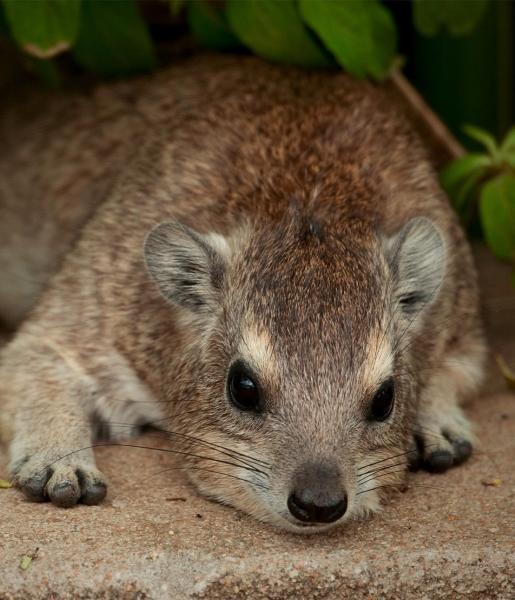
The hyrax is also called rock rabbit or dassie, is a small furry mammal. It looks like a robust, oversized guinea pig, or a rabbit with rounded ears and no tail. Hyraxes have stumpy toes with hoof-like nails; and four toes on each front foot and three on each back foot. The longer, claw-like nails on the inside toes and the back feet are used for grooming and scratching. The bottoms of the feet have a rubbery texture to assist in climbing steep rock surfaces and trees.
Of the three hyrax species, two are known as rock (or bush) hyrax, and the third as tree hyrax. In the field, it is sometimes difficult to differentiate among them.
The rock hyrax has the widest distribution in East Africa. Its coat is yellowish — or grayish-brown — and the dorsal spot (a bare scent gland on the back covered with longer hair) is covered with black or yellow hair. Its head is more rounded than other types of hyraxes, and the nose is blunt.
The yellow-spotted hyrax, or rock rabbit, is smaller in size and has a more pointed, rodent-like nose. Generally, it has a conspicuous white patch over the eye, and its dorsal spot is whitish or yellowish. It is sometimes seen in the company of other types of hyrax, but species do not interbreed.
Tree hyraxes, unsurprisingly, spend a lot of time in trees. In some areas, they are hunted for their thick, soft, long hair. They have a white or yellow dorsal spot.
Rock hyrax (Procavia capensis), Yellow-spotted hyrax (Heterohyrax brucei), Tree hyrax (Dendrohyrax dorsalis), Bush hyrax (Heterohyrax brucei)
About 4 to 5 kilograms (8 to 11 pounds)
Up to 12 years in the wild; average 8.5 years
Dry savanna to dense rainforest to rocky outcrops
Herbivorous
7 to 8 months
Leopards, lions, hyenas, pythons, large birds, servals, jackals, parasites

Challenges
Humans are encroaching on hyraxes’ habitats.
As human populations are growing, people are expanding roads, settlements, and agriculture — an activity that is moving into wildlife’s living spaces. This habitat loss and habitat fragmentation make it more difficult for hyraxes to find mates, food, and shelters.
Solutions
Our solutions to protecting the hyrax:
African Wildlife Foundation works with government entities to help propose and plan sustainable solutions that can foster growth while offsetting habitat fragmentation. AWF provides its scientists and researchers as resources to assist in proper planning to ensure a balance between modernization and conservation to avoid destruction of key wildlife habitats.
Tourism improves livelihoods for people and encourages conservation. AWF works with communities and private investors to develop tourism. In Botswana, with AWF’s help, the local community was able to take over management of Santawani Lodge. Proceeds from the lodge allowed local people to improve their livelihoods and community services. In addition, the lodge serves as an incentive for the community to invest in conservation of local wildlife, like the hyrax. The lodge’s existence is tied to the conservation of about 20,000 acres of land.
Behaviors
Rock hyraxes are more outgoing than tree hyraxes.
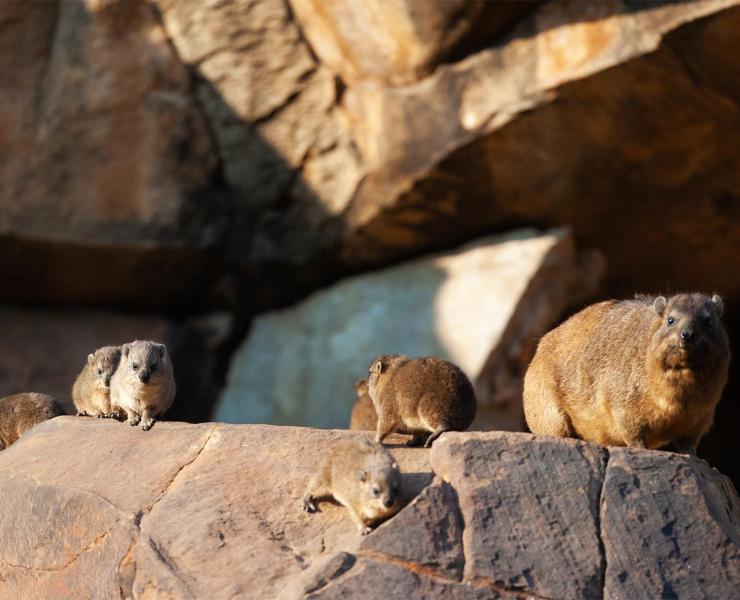
Rock hyraxes do not dig burrows. They live in colonies of about 50 in the natural crevices of rocks or boulders. These groups typically consist of one territorial male and about 20 females and their young. Rocky hyraxes are active in the daytime and can be seen feeding or sunning themselves near the entrances to their shelters. The tree hyrax, on the other hand, is nocturnal and not as social as the rock hyrax. They are often found in pairs and will not form much larger groups.
They are potty-trained.
Hyraxes regularly use “latrines,” in the areas they inhabit, conspicuous white deposits from their urine form on rock faces.
They have an extraordinarily long pregnancy.
Hyraxes have a gestation period of seven or eight months, which is unusually long for an animal of its size. Infants are born so fully developed they can run and jump an hour after birth. Although suckled until they are 3-months-old, the young begin to eat vegetation by their second day. Rock hyraxes bear two or three young, while tree hyraxes have one, two at most.
Diet
They are nervous eaters.
Rock hyraxes spend several hours sunbathing in the mornings, followed by short feeding excursion. They eat quickly with the family group facing out from a circle to watch for potential predators, feeding on grasses, herbage, leaves, fruit, insects, lizards, and bird eggs. After biting off a mouthful of grass or leaves, the hyrax looks up and cautiously checks the vicinity. If the territorial male gives the shrill shriek of alarm, then the hyraxes jump or scuttle to cover where they remain frozen, without moving, until the danger has passed. They can go a long time without water, obtaining enough moisture from their food. Tree hyraxes feed primarily on leaves and fruits.
Habitats
Where do hyraxes live?
Hyraxes are very adaptable. In East Africa, they are found at sea level and at altitudes of more than 4,000 meters (14,000 feet). Their habitats range from dry savanna to dense rainforest to cold Afro-alpine moorland.


