
What is a kob?
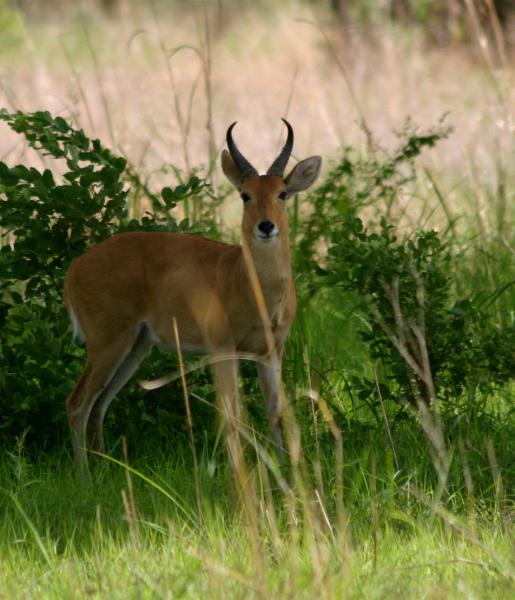
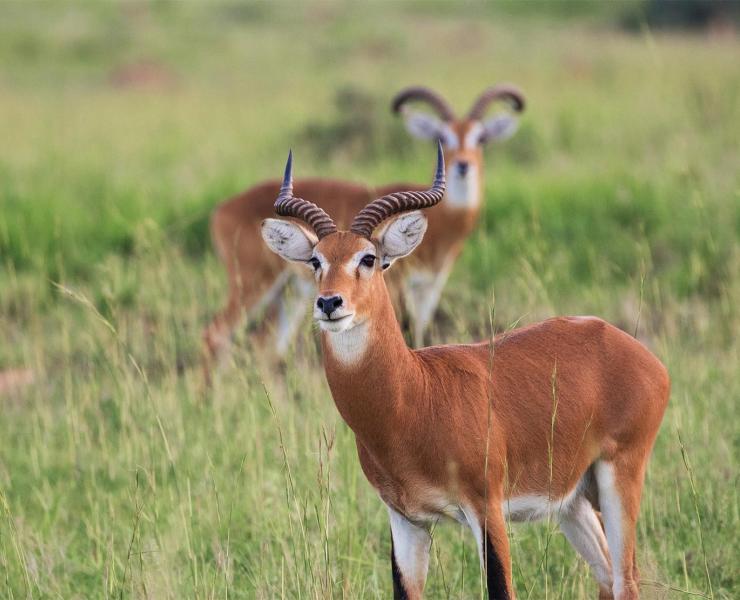
This antelope is similar in appearance to the impala, but the two species are not related. The Ugandan kob generally is reddish-brown, but other subspecies range from light brown to almost black. The underside of the body is white, a white ring appears around each eye, and a white patch or chevron appears on the throat; a black stripe runs down the front of each foreleg. Horns occur only in males and though lyre-shaped, they are shorter, thicker, and ringed almost to the tip.
Kobus kob
90 to 120 kilograms (190 to 265 pounds)
92 centimeter at the shoulder (36 inches)
About 17 years in captivity
Grasslands, floodplains, or savanna woodlands
Herbivorous
8 to 9 months
Large carnivores, humans

Challenges
Kobs are competing for land with humans.
These antelopes are ecologically restricted, preferring low-lying flats or gently rolling country, free of seasonal extremes and close to permanent water. These also happen to be favorable conditions for farming, and they often find themselves in competition with humans who are using these lands for agriculture.
Solutions
Our solutions to protecting the kob:
African Wildlife Foundation works with governments and local communities to designate wildlife corridors — large swaths of land that kobs can use to roam freely and safely from one park, or country, to another. Corridors link protected areas and allow wildlife to follow rains or travel to and from their calving grounds.
AWF has a long history of working with pastoralist communities to improve sustainable livelihoods. In Tanzania and Kenya, AWF, with funding from U.S. Agency for International Development (USAID), launched the Livestock for Livelihoods Program. The program aims to eradicate poverty among pastoralist communities while simultaneously protecting landscapes and wildlife. The economic boost from the program reduces pressure on the landscape by reducing the need for farming and charcoal burning, thereby freeing more space for wildlife, like the kob.
Behaviors
Unlike other antelopes, kob males practice the art of courtship.
The premating and postmating behavior of kobs is different from that of other antelopes. The male is not as rough with the female and does not attempt to force her to stay within his territory — rather, he appears to try gently to convince her. He makes soft noises during courtship play, repeatedly whistling through his nostrils after mating. The sound carries across the breeding grounds and may be echoed by the other territorial males.
Kobs hold strongly to social traditions.
The social structure of these antelopes is based on small herds that come together into larger groups of up to 1,000 animals. Unlike most other antelopes, they have permanent breeding grounds, called leks, where almost all mating takes place — some of these have been in continuous use for at least 50 years. Lekking grounds, usually located on a knoll or elevated area near water, are roughly circular in shape and are 18 to 90 meters (20-100 yards) in diameter. When females come into heat, they are attracted by the concentrated deposits of hormone-rich urine that accumulates in the leks. Competition for the innermost territories is fierce, and males hold their territories for only a day or two before turnover.
Diet
Kobs are dependent on larger animals for prime grazing conditions.
They graze on short grass and are dependent on larger animals such as hippos, elephants, buffalo, topis, and hartebeests to create those grazing conditions. Like reedbucks and waterbucks, they develop attachments to particular localities, returning to the same grazing areas and watering places day after day, season after season.
Habitats
Where do kobs live?
Although still numerous in Western Uganda, these antelopes are far less common now in other areas of East Africa. They were once found in Western Kenya and Northern Tanzania but have not been seen there in recent years. They do still range across sub-Saharan Africa. They prefer low-lying flats or gently rolling country, free of seasonal extremes and close to permanent water.


