Seeing the Unseen: How EarthRanger Is Transforming Wildlife Protection in Bili-Uélé
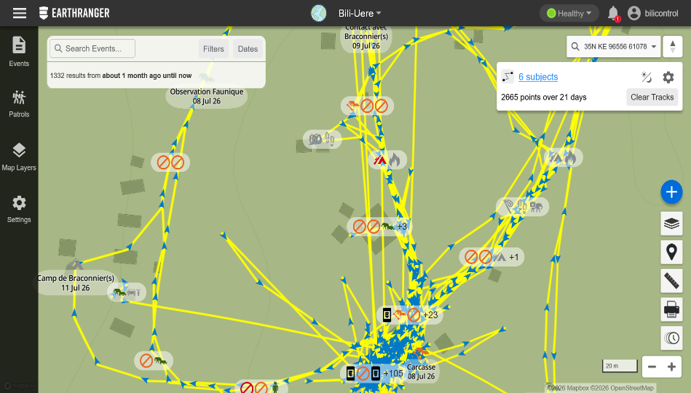
EarthRanger Tracking System.
From remote forest patrols to modern control rooms, AWF and its partners are harnessing real-time technology to strengthen conservation management in Bili-Uélé, with support from the European Union through the NaturAfrica programme.
Several kilometres from the nearest conservation outpost, beneath the dense canopy of the Bili-Uélé landscape, eco-guards move steadily through the forest. Every observation by these guards matters: elephant tracks, wildlife sightings, signs of illegal logging, or even evidence of poaching activity.
For years, this information was recorded manually, but often only reached managers days after patrols returned from the field.
Today, that is changing.
With the deployment of EarthRanger, observations made in the field can now be geolocated, documented, verified, and transmitted to a centralized system that provides conservation managers with an almost real-time picture of events unfolding across landscapes.
Implemented by the African Wildlife Foundation (AWF) with financial support from the European Union through the NaturAfrica programme, EarthRanger is transforming how one of the Congo Basin's most important landscapes is monitored, protected, and managed.
Located in the far north of the Democratic Republic of the Congo, the Bili-Uéré Hunting Domain spans more than 3.2 million hectares of forest and savanna, an area larger than Belgium, and is home to chimpanzees, forest elephants, and other threatened species.
Bringing the Field Closer to Decision-Makers
At the heart of this transformation is a newly established control room in Bili. Large screens display patrol movements, wildlife observations, field reports, and alerts generated by different monitoring systems.
For Simon Muchatibara, AWF's Manager for Wildlife Law Enforcement and Field Operations, this direct connection between field teams and managers is what makes the platform revolutionary.
"You are in the office, but you can see exactly what is happening in the field."
Instead of waiting days for information to arrive, managers can now access a dynamic operational picture of activities across the landscape.
"With EarthRanger, everything happening in the field appears in the control room. We obtain real-time data, and our data is verifiable," says Guillaume Mpia, Site Manager of the Bili-Uéré Hunting Domain.
The platform consolidates information from multiple sources, including GPS devices, mobile applications, sensors, camera traps and satellite-enabled equipment, helping teams make faster and more informed decisions.
Overcoming Challenges in a Remote Landscape
Deploying advanced technology in one of the most remote corners of the Congo Basin came with significant challenges.
Transporting equipment from Kinshasa to Bili-Uélé required extensive planning due to the region's isolation and limited transport infrastructure. Moreover, ensuring enough energy to power the system continuously was an additional challenge. To address this, AWF and its partners have supported the installation of a standalone 8 kVA solar power system, enabling 24/7 operation of the control room and ensuring uninterrupted monitoring despite limited access to electricity.
Reliable infrastructure is critical because effective conservation technology depends not only on software, but also on the ability to operate consistently in challenging environments.
A New Generation of Conservation Monitoring
EarthRanger is fundamentally changing the way eco-guards collect and use information.
When patrol teams encounter wildlife signs, discover poachers' camps, detect illegal activities or identify emerging threats, observations can be recorded instantly using digital tools.
"We can trace every piece of information back to its source and verify whether it is true. These are no longer just numbers. Every record has a location, a time, a device and sometimes even a photograph attached to it," Simon explains.
Even in areas without connectivity, information can be stored securely and automatically synchronized when a connection becomes available.
The result is more accurate, reliable, and actionable information.
Turning Data into Action
EarthRanger does more than collect data. It helps conservation teams respond more effectively to threats and emergencies by combining multiple data inputs and alerts into a single live map, giving managers a comprehensive operational view of the landscape.
One of the most important benefits of this function is improved ranger safety.
If a patrol encounters an emergency, managers can quickly identify its location and coordinate assistance. Response teams can be directed precisely where they are needed, reducing response times and improving the efficiency of field operations.
The platform also has significant potential for managing human-wildlife conflict. Through geofencing capabilities, conservation teams can monitor collared animals approaching community boundaries and deploy rapid response teams before incidents occur, helping protect both people and wildlife.
Early Results Already Demonstrate Impact
Although EarthRanger was only recently released, the system is already generating valuable operational insights.
Since 24 July 2026, patrol teams travelling on foot and by motorbike have covered a total of 1,088.82 kilometres across the remote landscape they monitor.
During the same period, they recorded 120 wildlife sightings, all of which were transmitted directly to the control room and integrated into the monitoring system.
These figures illustrate the platform's capacity to collect, centralize, and verify information rapidly, providing managers with unprecedented visibility into wildlife activity and field operations.
Investing in People Behind the Technology
Technology alone cannot deliver conservation results.
Recognizing this, AWF placed strong emphasis on capacity building throughout the deployment process.
To date, 48 individuals, including 45 men and 3 women, have been trained in:
- Control room operations and management
- Digital field data collection and management
- Data analysis and reporting
- Information management and decision support
By strengthening local capacity, AWF is helping ensure the long-term effectiveness and ownership of this new system.
Building on Years of Conservation Progress

Devices integrated into the EarthRanger platform.
EarthRanger builds upon a strong foundation of conservation achievements already realized through collaboration among AWF, eco-guards, communities and government partners.
Recent ecological monitoring has documented an 85.8% increase in wildlife populations across the landscape.
At the same time, the perception of security within the landscape has reached 68%, indicating growing confidence in the systems established to protect both natural resources and local communities.
Community engagement has also improved. Today, 77.7% of communities understand their role in the sustainable management of wildlife landscapes, reflecting the success of awareness-raising efforts and participatory conservation approaches.
These results demonstrate that conservation success is driven not only by technology, but by people, partnerships, and shared commitment.
Building for the Future
EarthRanger relies on satellite connectivity to transmit information from remote patrol teams to the control room, making ongoing operational funding essential for sustaining real-time monitoring capabilities. Thus, continued investment in the platform is essential to scale effective work.
By combining technology, renewable energy infrastructure, capacity building and long-term partnerships, AWF and its partners are creating a model for smarter, more effective conservation management.
In Bili-Uélé, EarthRanger is helping make the invisible visible. Every patrol, every observation and every data point contributes to a clearer understanding of the landscape and a stronger response to the threats facing wildlife.
With support from the European Union through NaturAfrica, AWF is helping ensure that the future of conservation in Bili-Uélé is not imagined, but built in real time.