Elie Bwira's Journey Through the AWF-Wall Fellowship, Leading Change from the Ground Up
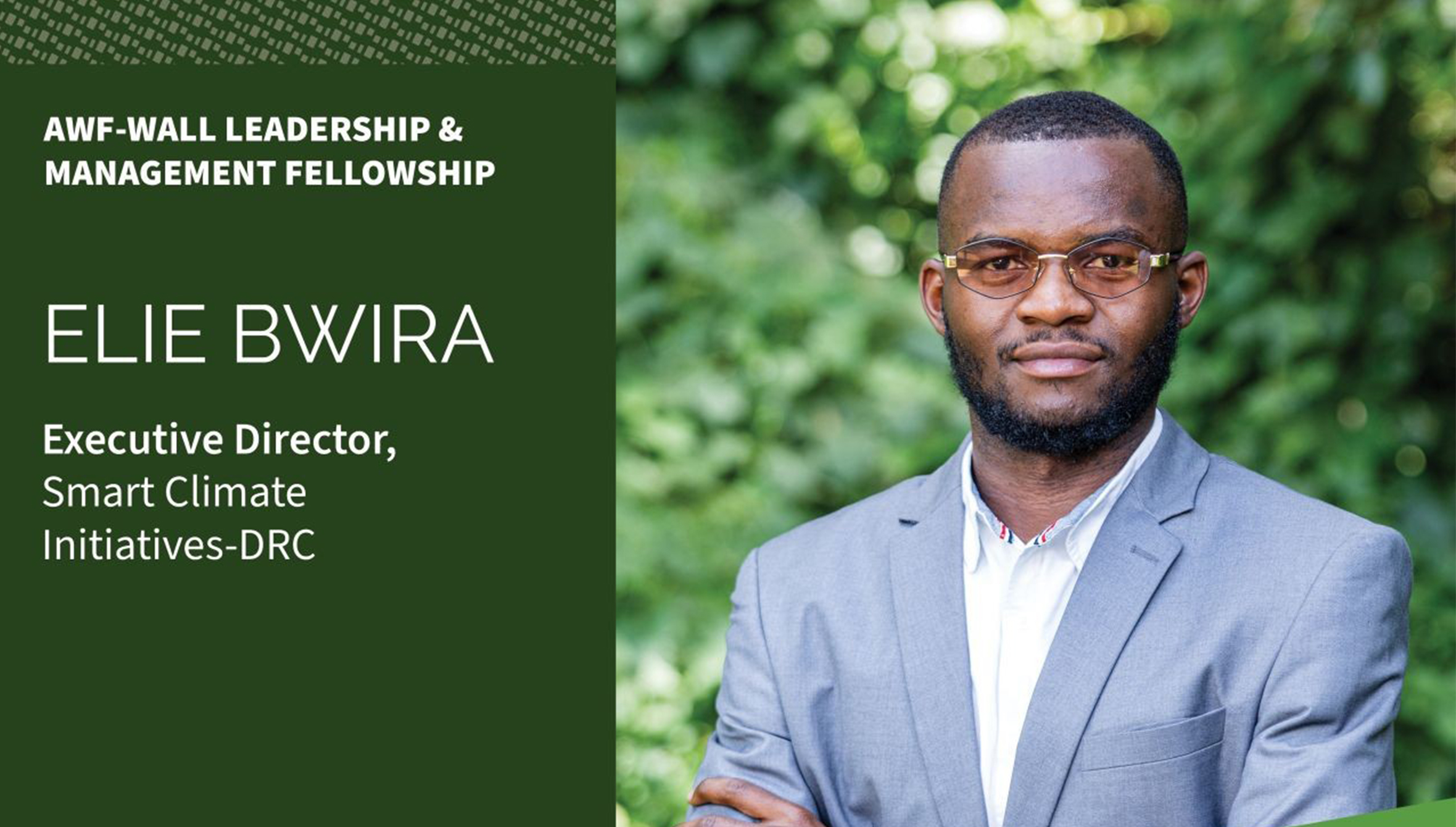
Elie Bwira, a Charles R. Wall Conservation Leadership and Management fellow. © AWF
For many young people, Goma is synonymous with conflict, displacement, and uncertainty. For Elie Bwira, however, it was also the place where he first discovered the extraordinary power of nature and the urgent need to protect it.
Raised on the edge of the iconic Virunga National Park, one of Africa’s most biodiverse landscapes, Elie grew up witnessing two realities unfolding side by side. On one side stood the breathtaking forests, wildlife, and ecosystems that make Virunga globally significant. On the other were communities struggling with poverty, food insecurity, environmental degradation, and decades of instability.
While many young people dreamed of leaving these challenges behind, Elie began asking a different question: “How can communities improve their lives without destroying the ecosystems they depend on for survival?”
Driven by a desire to find sustainable answers, Elie pursued studies in Agriculture and Community Development at Bishop Stuart University in Uganda. There, he understood that agriculture is far more than food production; it is a tool for restoring dignity, strengthening resilience, and creating a lasting balance between people and nature.
Discovering the AWF-Wall Fellowship
Back in eastern Democratic Republic of Congo, Elie dedicated himself to community development and environmental action through Smart Climate Initiatives (SCI), a youth-led organization focused on climate and conservation challenges. Like many emerging leaders working in fragile contexts, he faced formidable obstacles. Despite his determination, Elie knew passion alone would not be enough. He needed new tools, new perspectives, and a stronger leadership foundation to transform local ideas into a lasting impact.
In 2015, through a LinkedIn announcement, Elie discovered the African Wildlife Foundation (AWF) Wall Fellowship—a leadership journey designed specifically for young African conservation leaders who understand the continent's realities and were determined to create solutions rooted in local contexts.

Practical exercise during the Fellowship at AWF Headquarters in Nairobi. © AWF
The fellowship brought together emerging changemakers from across Africa and equipped them with skills in leadership, conservation science, innovation, system thinking, and human-centered design.
One of the most defining experiences of the fellowship took place in Tanzania, where participants were immersed in the principles of design thinking. Through the process of empathizing, defining, ideating, prototyping, and testing, Elie discovered a powerful lesson—real solutions begin by listening.
Rather than designing projects based on assumptions, he learned to place communities at the center of every intervention—understanding their needs, aspirations, and lived experiences before proposing solutions. The fellowship also created a powerful network of African conservation leaders facing similar challenges across different ecosystems.
Learning Leadership Through Design Thinking

Elie assesses soil water retention after the installation of a new irrigation system. © ACV
Before the fellowship, Elie saw leadership primarily through the lens of technical expertise. His experience challenged that perception. He began to understand that effective leadership is not about having all the answers; it is about creating environments where people can build solutions together.
Following the fellowship, Elie translated lessons into action by reimagining his organization. What began as Smart Climate Initiatives evolved into Africa Community Village (ACV), a dynamic youth-led organization dedicated to empowering communities through sustainable development and conservation.
Today, ACV works at the intersection of conservation, livelihoods, education, health, and youth empowerment, building resilience in some of the Congo Basin's most fragile landscapes.
ACV adopted design thinking as a core organizational principle. Every initiative now begins with listening, understanding, and co-creating solutions alongside communities before implementation begins. This approach has fundamentally changed the organization's relationship with local stakeholders. Young people are no longer passive observers; they are changemakers.
A Legacy of the AWF-Wall Fellowship

Elie and his colleague add ash to organic compost to regulate its pH in their field in Goma, DRC. © ACV
Elie is now working to contextualize and implement this model across schools surrounding Goma and the Virunga landscape, helping young people understand both the value of conservation and their role in protecting one of Africa's most important ecosystems.
Despite operating in one of the world's most challenging environments, ACV has already trained more than 120 young leaders, implemented multiple climate education and ecosystem conservation projects, and built strategic partnerships supporting community health and sustainable agriculture initiatives across North Kivu.
This momentum has also opened doors for broader recognition. Elie's recent integration into the UNESCO MAB Youth Network in the Democratic Republic of Congo reflects his growing influence within national and international conservation spaces.
Yet for him, success is measured differently. It is found in farmers adopting sustainable practices. In the students discovering a passion for environmental stewardship. In the trees planted today, that will benefit future generations.
As he puts it, “Every farmer trained, every student inspired, and every tree planted is proof that hope can grow even in the most difficult circumstances.”
The fellowship did more than strengthen his technical skills; it transformed his approach to leadership, teaching him to listen first, lead empathy, and design solutions alongside the communities he serves.
Today, that leadership is creating ripple effects across eastern Democratic Republic of Congo. Through Africa Community Village, young people are becoming conservation advocates, communities are building more sustainable livelihoods, and local solutions are helping protect one of Africa's most important ecosystems.
Elie's story reflects the lasting impact of investing in African leadership. By equipping emerging conservation leaders with the skills, networks, and confidence to lead, the AWF-Wall Fellowship is helping build a new generation of changemakers who are proving that Africa's conservation future is strongest when it is led by Africans.