A Community-Owned Model for Sustainable Livelihoods in Congo’s Forests
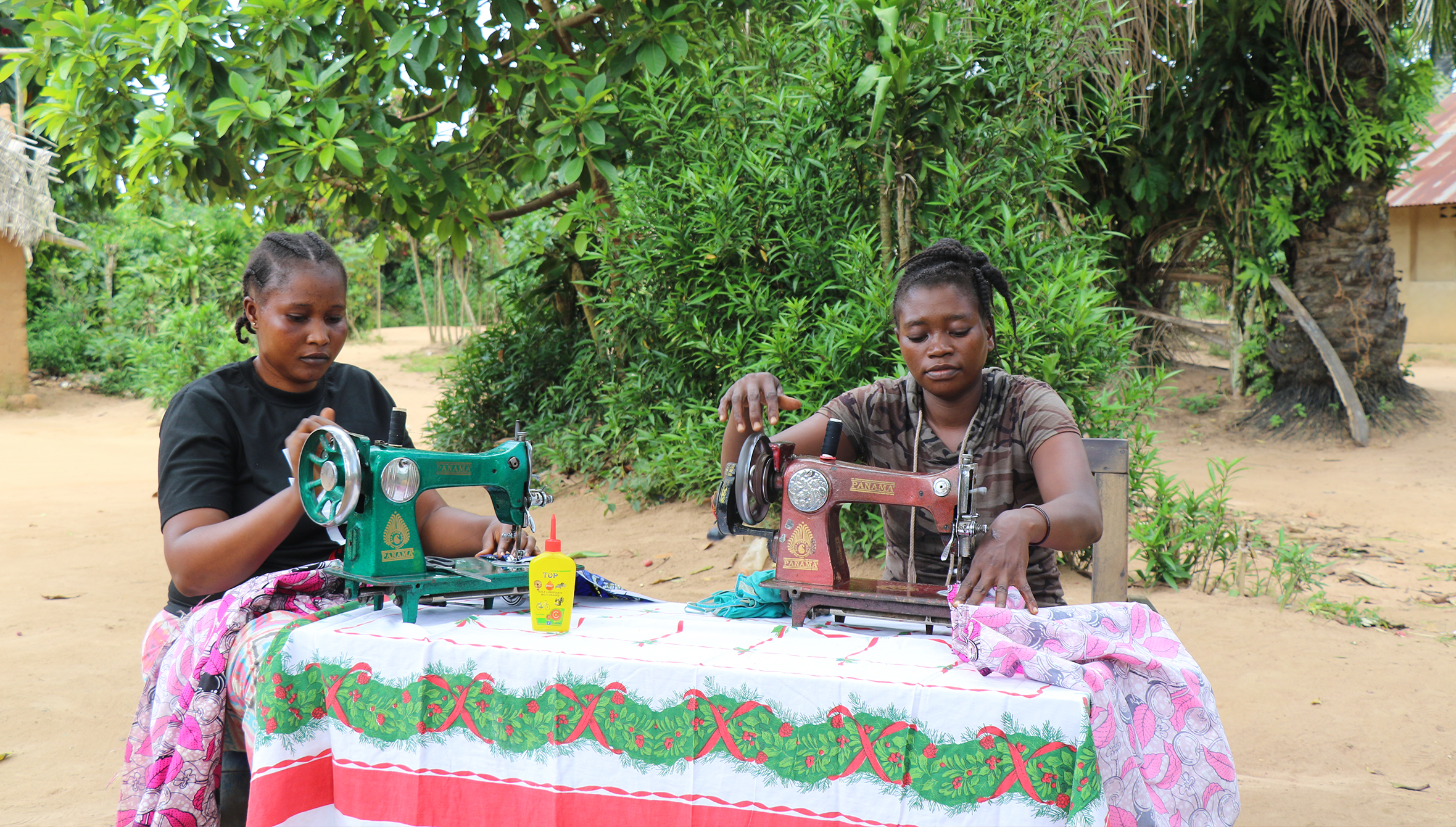
Two cousins practicing their sewing skills in their aunt’s compound, where she works as a trainer in Bongandanga.
Louise Wanga Boondo is discovering a skill that could one day open opportunities for her future. In a tailoring workshop in Bongandanga, in the Maringa-Lopori-Wamba (MLW) landscape, she enjoys spending time with her mother, Solange Ifaso Bolumbu, 48, observing and learning the basics of tailoring. For Louise, each lesson is about building confidence, creativity, and a skill she hopes to use as an adult.
“I want to learn well, become strong like my mother, and have my own workshop,” Louise says.
Solange, a mother of seven, was trained through the African Wildlife Foundation’s (AWF) sustainable livelihoods program. Today, she earns an income from tailoring while encouraging her daughter to develop practical skills for the future. Their story reflects AWF’s approach to conservation: when families have sustainable and reliable livelihoods, they are better equipped to support themselves while reducing pressure on the surrounding forest.
Since 2015, AWF has supported communities in the Maringa-Lopori-Wamba landscape, in the Democratic Republic of the Congo, by developing sustainable economic alternatives. The goal is to reduce pressure on forests by addressing one of its root causes: limited livelihood options.
Through value chains such as tailoring, soap-making, microfinance, poultry farming, and agroforestry, hundreds of people—most of them women—have gained practical skills and greater economic independence.
“Today, people understand that protecting the forest can also improve their lives. Before, that connection was not obvious,” explains José Lokombe Lofeyi.
Sustainable Livelihoods That Reduce Forest Pressure
The results show how investment in people can strengthen conservation outcomes.
In Basankusu, more than 400 people have been trained in tailoring, with many now operating independently. Similar progress is being seen in soap-making, microfinance, and poultry farming. In Bongandanga, hundreds of beneficiaries are also engaged in livelihood activities, with high levels of autonomy.
These trainings help families meet real needs, from education and healthcare to daily household expenses. They also provide alternatives to activities that place pressure on forests and wildlife.
“Before, I used to sell bushmeat just to survive. Today, thanks to tailoring, I am autonomous. I can work, earn a living, train other women, and pass on what I have learned to my own children,” says Solange Ifaso Bolumbu.
A Community-Led Model Ready to Scale
One of the strongest outcomes of the program is community ownership.
In Basankusu, communities have established more than 90 production and training workshops. In Djolu, Bongandanga, and Befale, the same approach is expanding through dozens of active incubators. With strong results, including widespread economic independence and more than 190 community-led incubators, the model is now owned by communities and ready to scale.
Beneficiaries are no longer just receiving training. They are producing, organizing, training others, and passing knowledge through their own networks.
“We have learned how to make a living from our activities, but now we want to grow them and seek funding ourselves,” says Belinda Loboko, a soap-making trainer in Bongandanga.
That ambition points to the next phase. The model works, but many trained beneficiaries still lack the equipment needed to fully apply their skills, grow their businesses, and train more people.
Investing now would help turn a proven local success into wider impact. It would strengthen household incomes, expand women-led enterprise, and deepen community participation in forest protection.
In Maringa-Lopori-Wamba, change is already visible in workshops, household incomes, and the future being built by young people like Louise. Since 2015, AWF has shown that investing in communities is one of the most effective ways to protect forests sustainably.
As Antoine Tabu, AWF Country Coordinator, puts it, “Today, the priority is clear: accelerate, consolidate, and scale this model. Because behind every workshop that opens lies a sustainable solution for the forest.”