Rooted in the Wild: Fungi Dube on Art, Nature, and the African Visual Imagination
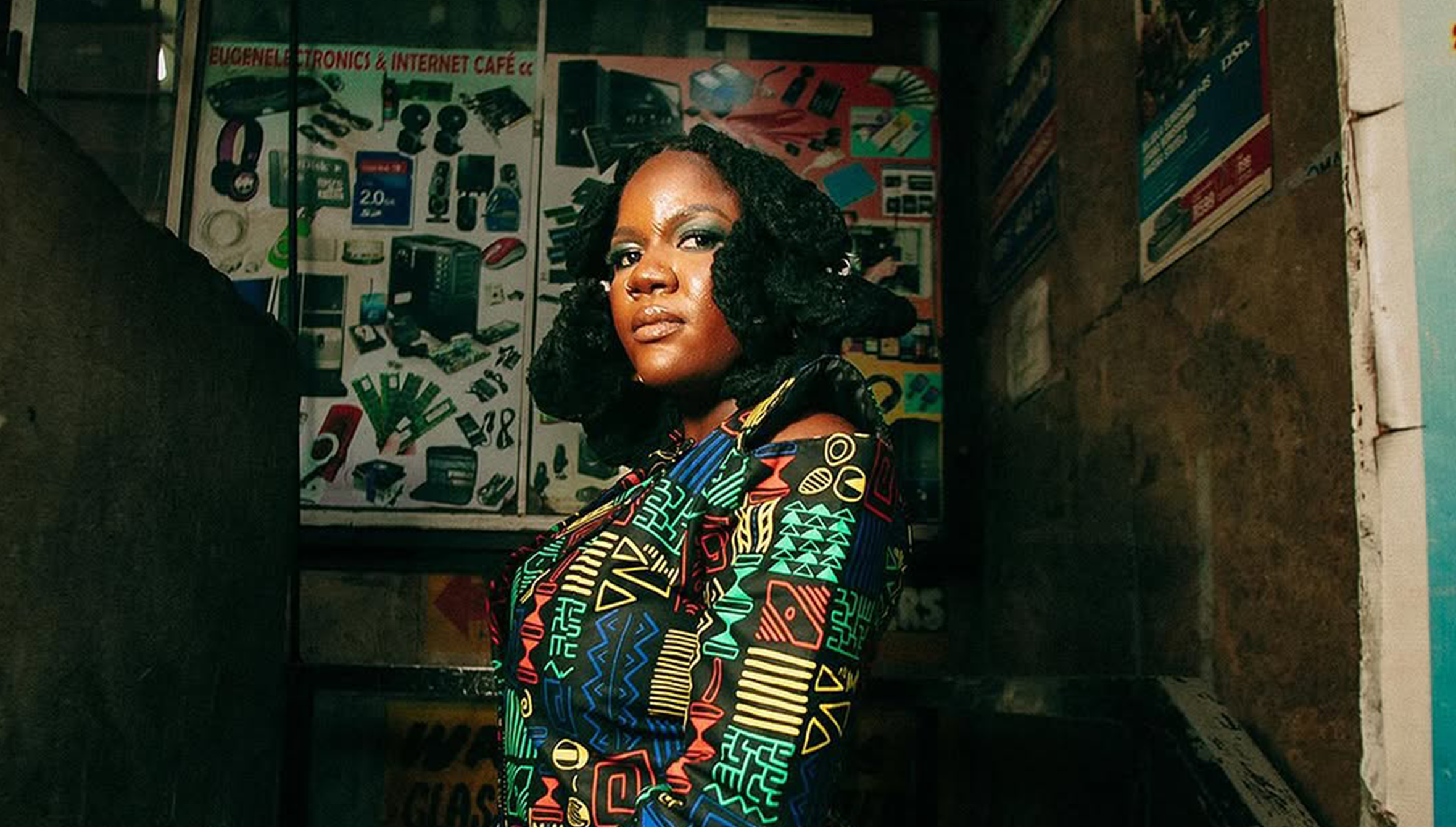
Fungi Dube, a Zimbabwean artist.
About the Artist
Fungi Dube is a Zimbabwean brand designer and illustrator whose work sits at the intersection of African cultural identity, nature, and contemporary visual language. She is, by her own account, a scientist first—holding a double major in Human Anatomy, Physiology, and Biochemistry—who stumbled into design through a YouTube rabbit hole and never looked back.
Her work carries a quality that is rare in digital illustration—it feels grounded, almost touchable. Textures drawn from stone, earth, and carved surfaces sit inside geometric forms that are clean but never cold. Patterns carry meaning. Color is considered. And underneath all of it runs a current shaped by a childhood spent in the Zimbabwean outdoors, surrounded by wildlife.
In 2025, that lived intimacy with the natural world translated into one of her most significant commissions: the cover of the African Wildlife Foundation's Annual Report—a piece that she describes as feeling less like a professional milestone and more like a homecoming. We sat down with Fungi to talk about her journey, her practice, and what it means to make art that asks people to see themselves in the wild.
On Her Journey
Your path to design is anything but linear—a science degree, a teaching job, and a YouTube video that changed everything. How did it all begin?
My path is very different from most. I studied a double major in Human Anatomy and Physiology and Biochemistry, and I graduated in 2014. The job hunt was incredibly frustrating, and I needed something to do with that energy. I don't know what else to call it other than divine order—I came across a Photoshop tutorial on my YouTube recommendations one random day and clicked into it purely out of curiosity. I thought, What is this? Why is it on my page?
But I clicked in, and it dawned on me that people use their computers to create art and turn it into careers. That had never occurred to me before. I eventually got a full-time job at a primary school and stayed there for six years. But the design bug had bitten me so badly that every single night after work, I was burning the midnight oil—running software on a jet engine of a laptop that made 27 different sounds when I started it—just trying to learn new techniques. That is where it all began, and over time I started exploring design more broadly, but over time I found myself drawn to work that sits at the intersection of identity, heritage, and narrative. As a Zimbabwean creative, I’ve always been surrounded by rich visual traditions, whether in craft, sculpture, or everyday life, and that naturally influenced my direction.
My current practice is really about translating those influences into contemporary forms. I’m interested in how we can honor where we come from, while still creating something that feels modern, relevant, and globally resonant.
You didn't just become a designer—you became a very particular kind of designer. When did the Afrocentric dimension of your practice come into focus?
There was a point where I felt deeply detached from the work I was producing. The lens I was learning from was very YouTube-oriented—which essentially means a very Western eye. And there is absolutely nothing wrong with that kind of design; I find a lot of it genuinely beautiful. But it didn't feel like it belonged to my world.
So, I had a period where I stepped back entirely, because I needed to figure out what was missing. And then one day—these things always seem to happen randomly—I just woke up, and it became clear. I couldn't see myself in the work. My global context, my historical context, my geographical context—none of it was reflected back at me.
I started thinking about what I actually see around me. I see textures. I see patterns. I see color. I see graphic traditions from Zimbabwe, from neighboring countries, from the continent at large, and I thought, Wait. This is what is missing. How can I take all of that and make it globally relevant, give it a contemporary flair, while still honoring the stories and inspirations behind it? That realization is what my practice is now built on.
On Nature and Creativity
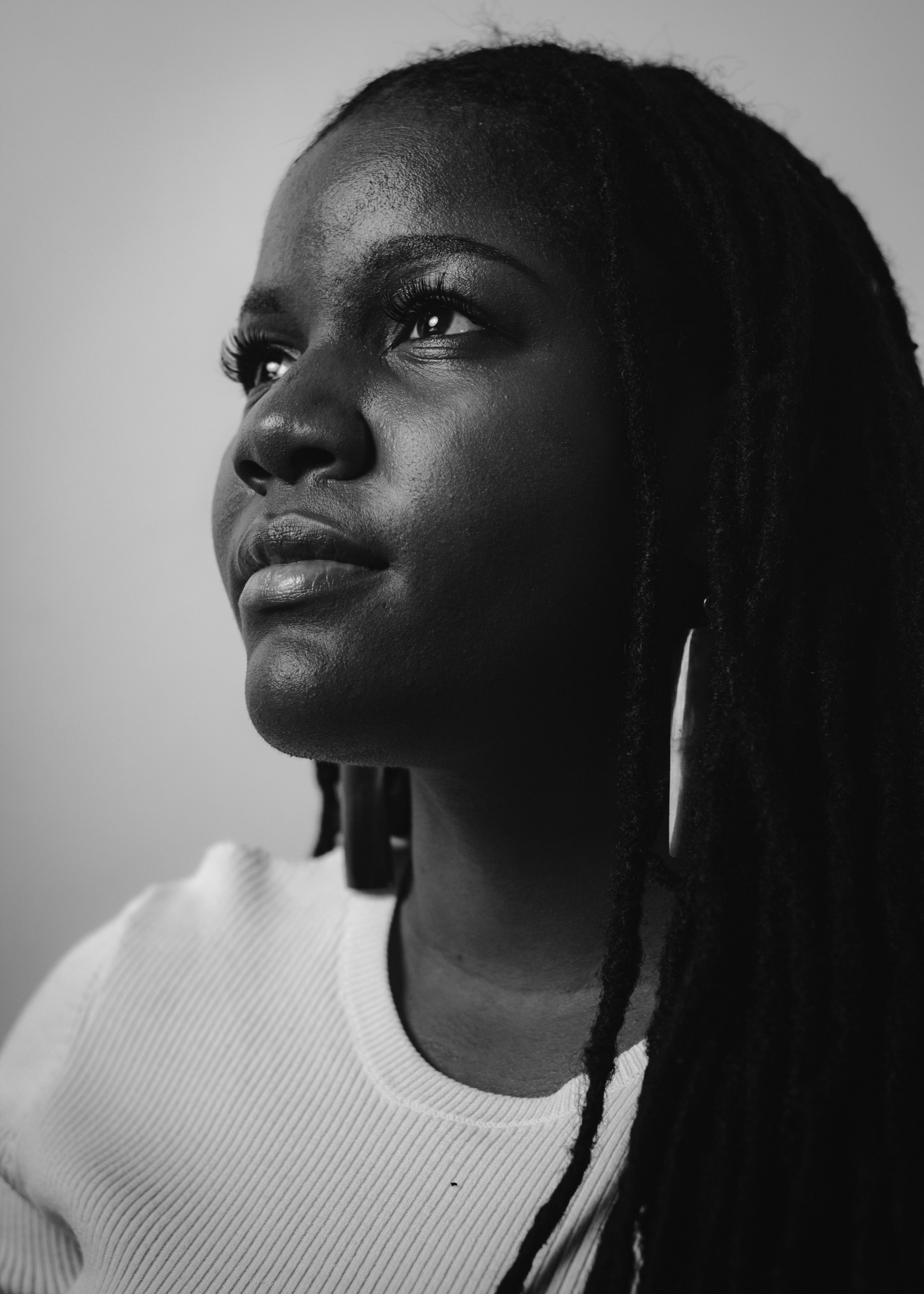
For Fungi Dube, conservation was a part of everyday life.
Your work often engages deeply with nature, materiality, and identity. How do these themes show up in your creative process?
Nature is the purest form of creativity for me. When I look at how everything has been put together—the different layers and shades in trees, the way colors combine in a bird's plumage, the structure of a leaf held up to the light—it points to something deeply intentional. Everything in nature is considered. Nothing is arbitrary.
In my process, that translates into how I think about composition, rhythm, and balance. It shapes the way I work with layering and embedding. I am also genuinely an outdoorsy person—I need to be outside, to be able to touch and feel and see. Those direct interactions with the natural world are what make the work deeply considered.
Even in digital illustration, I am constantly referencing physical materials: stone, earth, carved surfaces, and the texture of soil after rain. That is where the tactile quality comes from. I want the work to feel grounded—almost like it could be touched—even when it only exists on a screen. And all of that really comes from how nature itself is so deeply, profoundly layered and complex.
Your illustrations have a strong organic, almost tactile quality—it feels like you could run your hand across the surface. How do you achieve that in digital work?
I think in layers—not just visually, but conceptually. I'm always asking how different elements can sit within and alongside each other to create depth and meaning. Textures and patterns in my work are never purely decorative; they function as a form of visual communication. They carry subtle cues about context, culture, and material.
There's usually a balance I'm trying to strike between structure and softness. I'll work with clean, geometric shapes, but then introduce slight irregularities or layered details, so the work doesn't feel overly rigid or cold. I want it to breathe.
And then the cultural dimension becomes really important. Something as simple as the arrangement of my grandmother's plates in her round-hut kitchen—the pattern, the placement, the logic of it—those everyday references carry history. Drawing from those influences creates a design language that feels both personal and culturally grounded, while still existing in a contemporary space.
On Art and Conservation
Conservation discourse is largely science-led: numbers, statistics, policy frameworks. Where does art fit into that conversation—or does it challenge it?
Science and data are essential. I can relate to this from both sides—I was trained in the sciences, and I know that understanding the numbers matters. Knowing that we are down to 5,000 of a species, and that we need to act, is powerful.
But art comes into play because it creates connections. It translates those realities into something that people can actually see themselves in. And I think that adds another layer to ensuring that the message gets home.
One of my favorite passion projects explores exactly this: Big Five Coffee Co. It came out of spending time with conservation statistics and asking myself how design could make them feel approachable. I built the whole concept around coffee—something familiar, something everyday—as a vehicle for sparking conversation around the Big Five. The idea was that design could act as a bridge—drawing people in through something that feels accessible and then inviting them deeper into the story.
I see art as both a complement to science and a gentle challenger. It complements by making complex ideas emotionally resonant. But it also has the power to challenge dominant narratives—especially in African contexts where conservation has sometimes been framed in ways that exclude local voices and lived relationships with the land. Ultimately, I think art allows people to pause and engage with conservation not just as an issue, but as something that is part of their story.
On Growing Up Wild
Your parents are both veterinary surgeons. What was it actually like growing up in a household where wildlife was, essentially, the family business?
It was formative in ways I only fully understand now. I grew up with a deep, practical awareness of wildlife and of the role conservation plays in protecting it. It was never abstract, never something in a textbook. It was part of everyday life.
And I will be honest—it wasn't always reverent in the way you might expect. I got into a lot of naughty things—stealing ostrich eggs, for one. There were many such adventures. But underneath all of that, there was a genuine respect developing. I am the sort of person who, if you say, "Don't make noise because you'll disturb the lions," will take that very seriously. Don't litter. Don't disrupt. These are things I hold with real reverence.
That early exposure made me more conscious in a very practical sense. It shaped how I move through natural spaces—whether I'm on safari, traveling, or just in my everyday environment. And it absolutely feeds into how I approach the work—with a sense of care, respect, and a desire to represent these environments thoughtfully.
On the AWF Cover
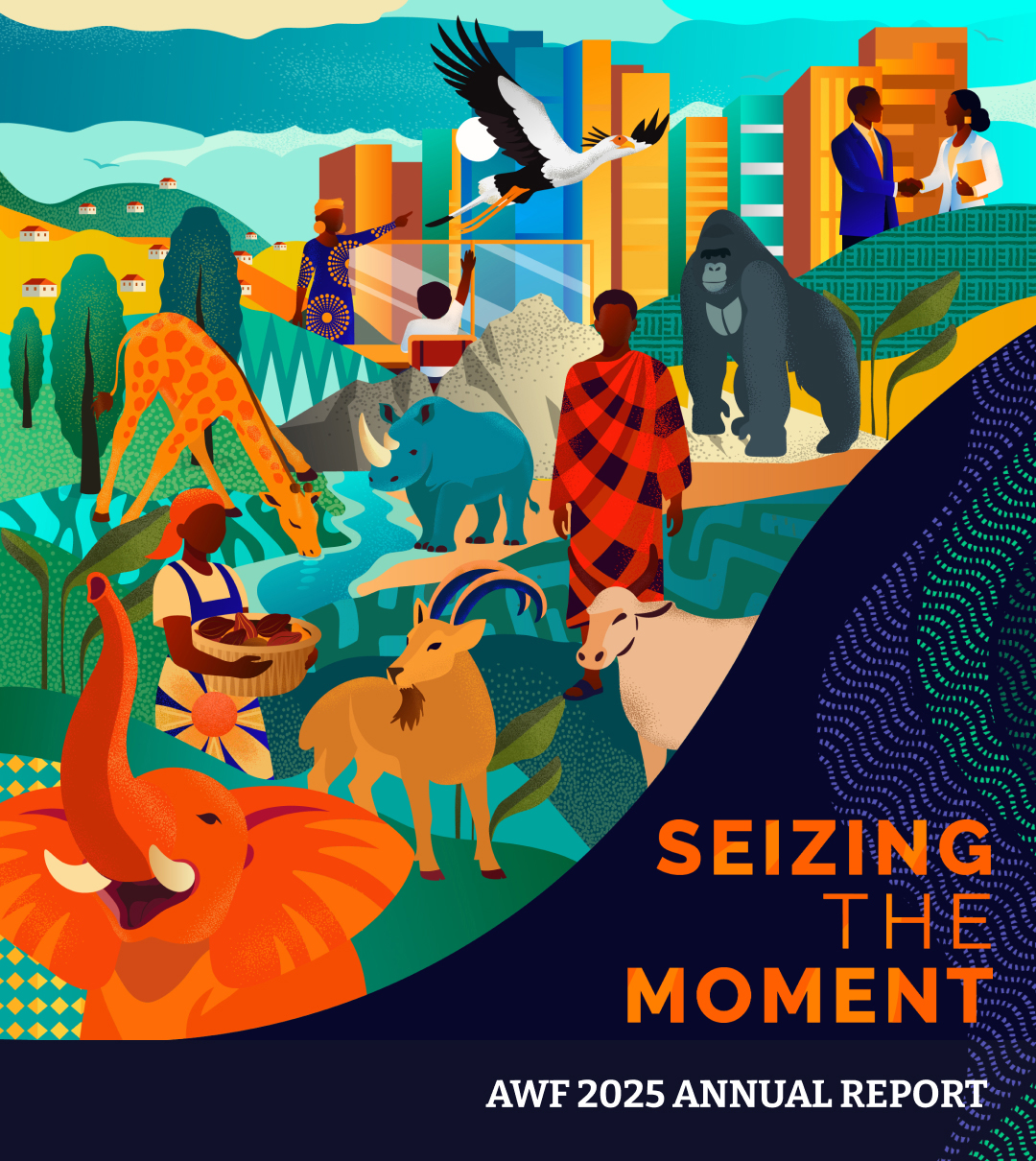
You were selected as the cover artist for AWF's 2025 Impact Report—a major commission. What was that experience like from the moment you got the brief to the final image?
I will be honest, when I first saw that opportunity in my inbox, I was screaming to myself. I told myself, If I get it, that will be amazing. If I don't, just the fact that my name was in the room for this is exciting enough. So, from the very start, it felt significant.
Working with the AWF team was genuinely wonderful, and the final piece is very much a collaboration of minds. But the core idea that drove the work was about merging worlds—showing that we cannot separate our environment from who we are as people, because we exist alongside each other, not apart from each other.
As I worked on it and kept tweaking the illustrations, it became clearer and clearer that it needed to feel as natural and as emotive as possible. The giraffe bending down to drink, the elephant with its trunk raised, the ibex glancing sideways as if it's looking at you—these weren't in my original drafts. But sitting with the piece, they became essential. I wanted someone to look at the cover and feel like they were inside that frame, interacting with everything in it.
On a personal level, this collaboration felt very close to home. As the daughter of two veterinary surgeons, conservation was never something distant. So being able to translate that world into a visual narrative for AWF felt like a moment where my personal history and my creative practice came together in a way that was both purposeful and deeply reflective.
What do you hope people feel when they encounter your work—and does it matter to you that they feel the right thing, or just that they feel something?
I think it's everything, actually. I want people to feel personally connected—to sense that this is a style they can resonate with. But I also want to spark curiosity. Who did this? Who are they? Where are they from? Because all of those questions are what make the work meaningful for me beyond the moment of viewing it.
I've always said to myself that I am perfectly satisfied if the work resonates with just one person. It doesn't have to reach everyone. But if it sparks something—whether that's an appreciation for the technicalities, or the excitement of a color combination, or the curiosity to learn more about the influences behind it—then it has done what it needed to do.
For me, the ultimate aim is to propel positive sentiment around African visual traditions. There are many stereotypes attached to what design in an African context is supposed to look like. The thing that makes my heart beat the most is telling those stories in such a way that they are still relevant, still hold their meaning, but live comfortably in a contemporary space. I want someone to think it looks beautiful. But if it also causes them to question something, to feel something they weren't expecting—that is what I really strive for.
On the Future
What message or feeling do you hope audiences take away when they encounter your work in this context?
I hope people feel a sense of connection. Not just to wildlife or landscapes, but to the idea that we are part of these ecosystems, not separate from them. If the work can make someone pause and see that relationship differently, even for a moment, then it has done what it needed to do.
Looking ahead—where do you want to take your practice, especially within conservation and environmental themes?
This commission has opened up a deep desire in me to work with more organizations doing this kind of work—whether that's AWF or others aligned with conservation and environmental storytelling—but at a larger campaign scale. I want to explore different mediums as well. I'm already in the process of self-teaching in a new art style, building towards something I can only describe as a mixed media something—I haven't defined it yet, but I know roughly how I want it to feel, even if it doesn't look that way yet.
Ultimately, what I am most interested in is continuing to use design and illustration to tell stories that matter. Especially stories rooted in African contexts but built for global relevance. The continent gives you an extraordinary color palette—in nature, in culture, in everyday life—and I feel like we have barely begun to fully express what that palette is capable of.
Rapid Fire
One word you associate with nature: Interconnected.
A material you cannot work without: Texture and pattern. I cannot separate them—they are essentially one thing for me.
A place that inspires you most: Africa—and I am aware that Africa is not a single place. That's exactly the point. I find inspiration from so many local and regional communities across the continent that I refuse to flatten it into just one. The inspiration is in the specificity, not the generalization.