Camera Traps as Silent Witnesses to Species
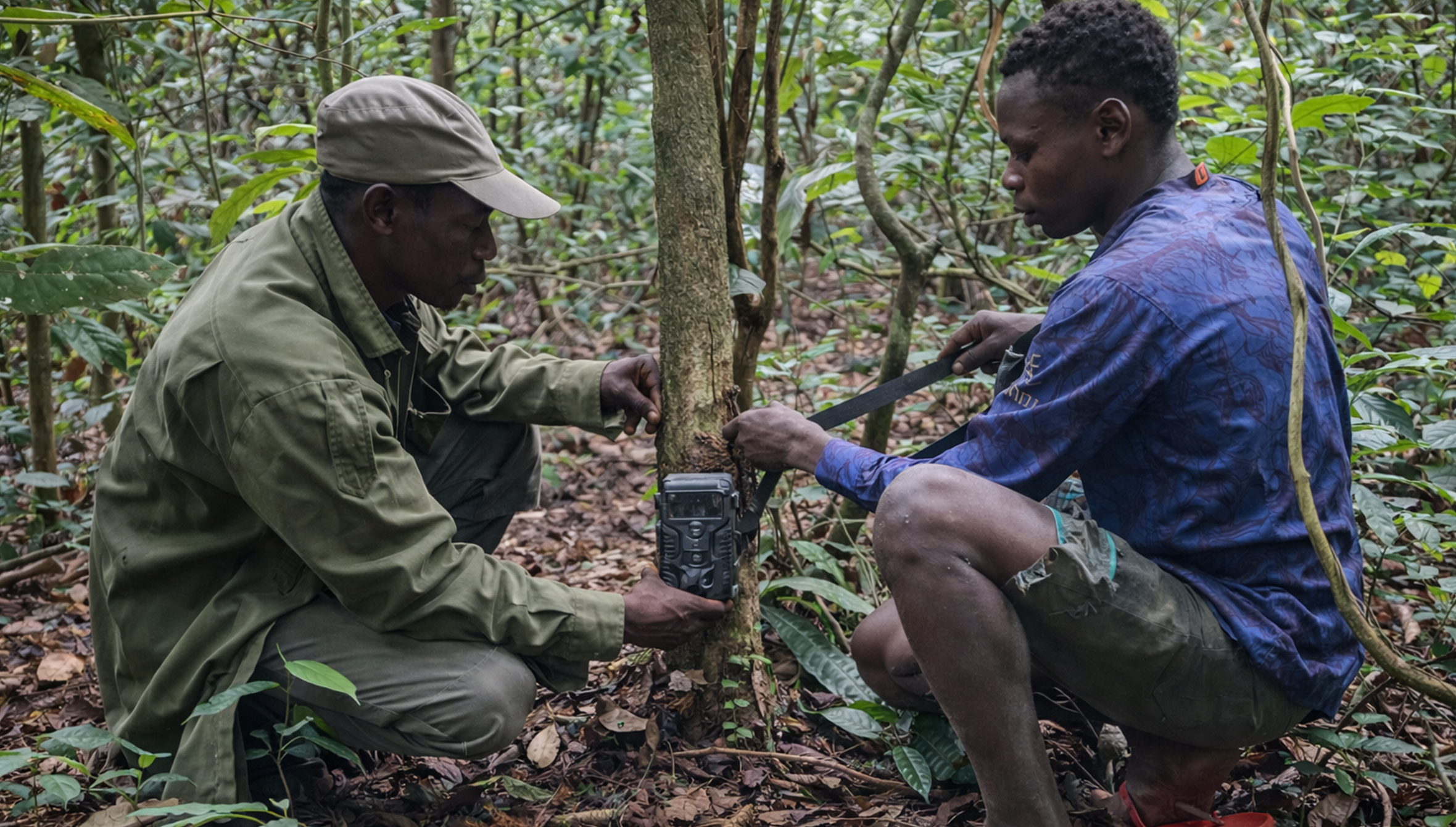
A camera trap set deep in the forest near the village of Baday, in the Bili-Uélé landscape, by an eco-guard and a member of the local community.
Deep within the forests of Bili-Mbomu, a remote landscape in northern DRC, camera traps serve as the unseen eyes of science. Carefully placed along the trails of Baday and Bambilo, they capture moments few humans will ever witness: a leopard moving silently through the night, a bongo stepping into a clearing, or an eastern chimpanzee—a fragile silhouette of a species under threat.
These images carry even greater weight. They are more than snapshots; they are powerful proof of endangered species’ survival. Each frame becomes a fragment of truth that drives research and shapes conservation action. Every trigger is a quiet victory against disappearance—a way of telling the world: “They are still here.”
Mosiko Langbakpio, an eco-guard and compass bearer in the Bili-Uéré hunting domain, affirms: “Installing these cameras is like placing invisible guardians. We know the forest speaks through them.”
The eastern chimpanzee (Pan troglodytes schweinfurthii), emblem of Bili-Uélé, embodies this struggle. Listed as Endangered on the IUCN Red List, it faces threats from habitat loss, poaching, and human pressures. Yet thanks to camera traps, its presence is confirmed, its territory documented, and its importance underscored. As local tracker Zapay Ganga confides, “Seeing the chimpanzee on our images is like receiving a message from the forest: It is still alive.”
Beyond scientific data, these devices tell a collective story. Local communities, eco-guards of the Congolese Institute for Nature Conservation (ICCN), and partners such as AWF take part in their installation and monitoring. Together, they transform technology into a tool of participatory science, where traditional knowledge and innovation converge to protect biodiversity.
“The cameras show us what we cannot always see. They become our eyes in the night and help us better target our patrols,” says ICCN eco-guard Kambale Katsongo.
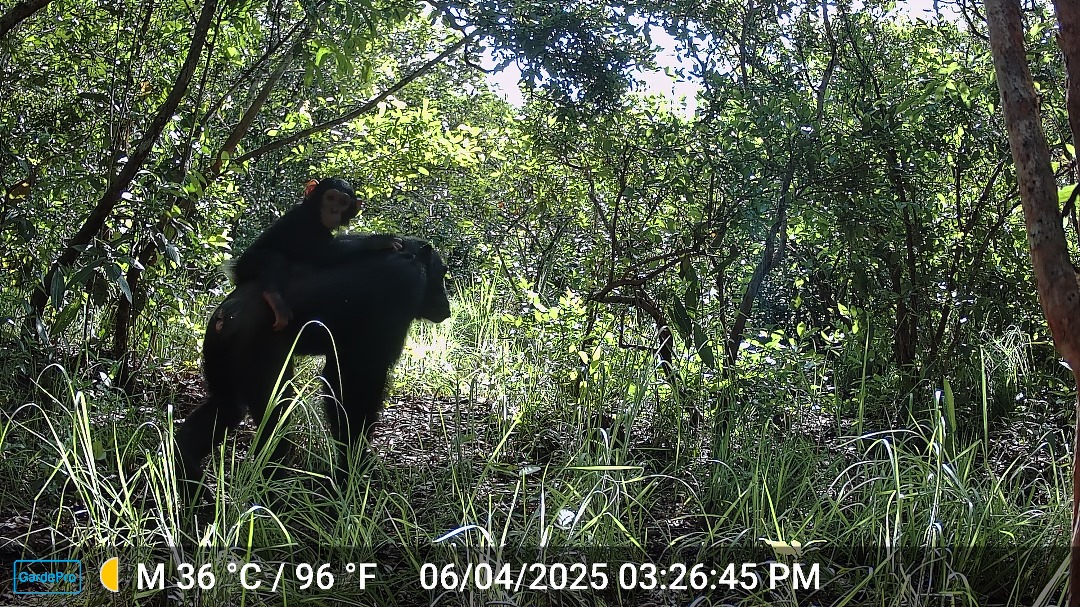
A chimpanzee mother carrying her baby on her back, captured by a camera trap in the Bili-Uélé landscape.
Preliminary results reveal more than a list of species; they confirm the presence of a unique biological treasure whose survival hangs by a thread. The eastern chimpanzee, flagship species of Bili-Uélé, is now among Africa’s most threatened great apes. Populations have collapsed in many regions, and Bili-Uélé remains one of its last viable refuges. Each image captured is a rare and precious testimony—proof that these great apes continue to resist despite poaching, deforestation, and land-use conflicts.
Faced with this urgency, the AWF is deploying an integrated strategy to protect these populations. Alongside the ICCN and local communities, AWF invests in training and equipping eco-guards, raising awareness among residents, and deploying technologies such as camera traps to document and monitor wildlife. These efforts aim to strengthen local governance, reduce direct threats, and ensure that Bili-Uélé’s chimpanzees can continue to play their essential ecological role in the forest.
Camera traps are not merely scientific tools; they are silent witnesses of biodiversity in peril and allies in the fight for its preservation. They remind us that conservation is a collective endeavor, where technology, local expertise, and community engagement unite to defend life. Each trigger is a promise to continue protecting the eastern chimpanzee and with it, an entire ecosystem whose future depends on our vigilance and solidarity.
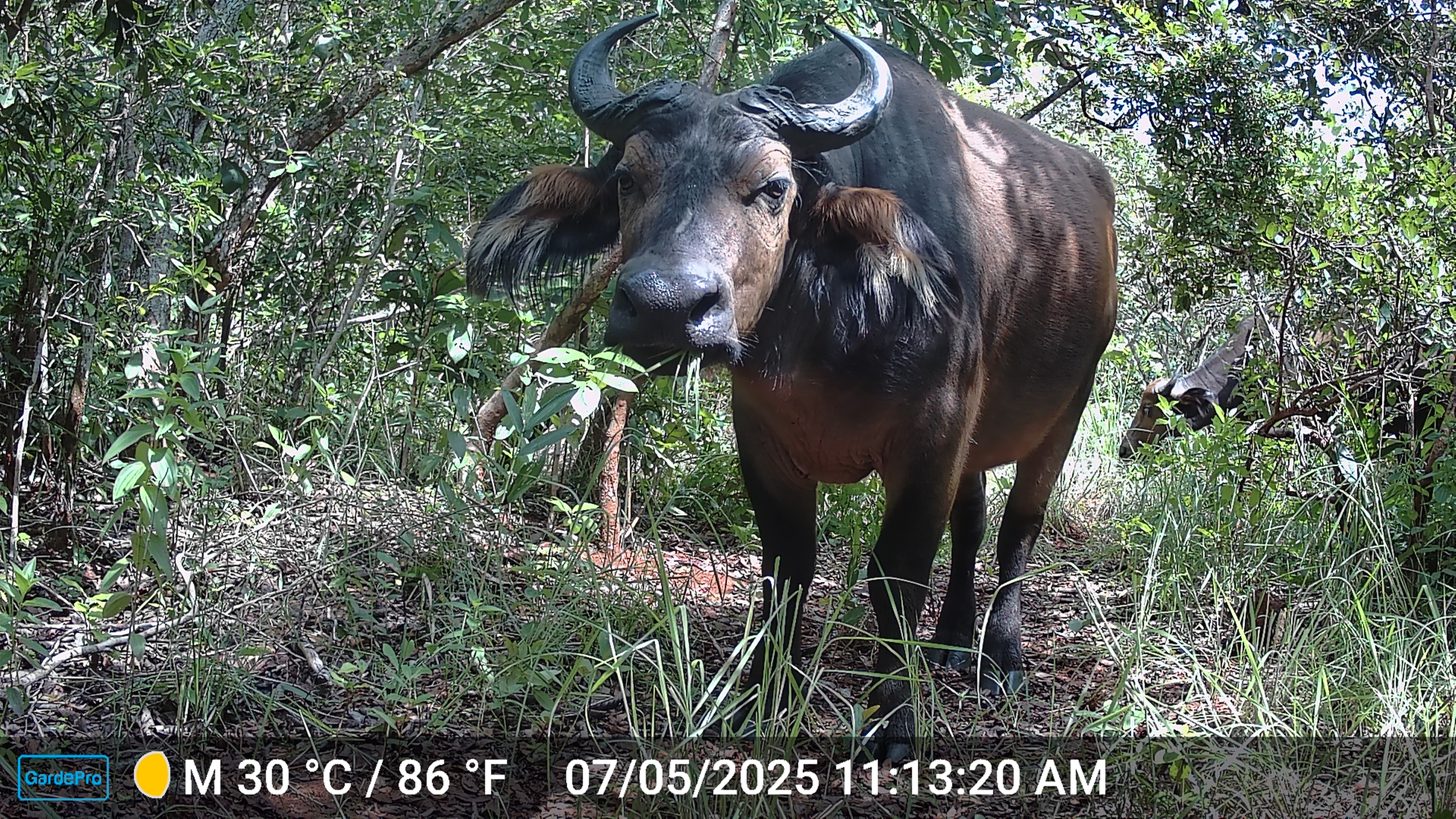
An adult forest buffalo captured by a camera trap in the Bili-Uélé landscape, with a younger individual just behind it.
Sebastien Tsakala, AWF Ecologist and Biomonitoring Officer, insists on the importance of this rigorous work: “Each photo analyzed is essential data that strengthens our arguments with communities, the Congolese state, and donors. It is painstaking work, but above all, every image of a chimpanzee represents a true scientific victory.”
This internal voice reflects the strategic value of camera traps—they do not merely document biodiversity; they become tangible proof that fuels advocacy, reinforces the legitimacy of conservation actions, and mobilizes partners around a shared goal.
The survival of Bili-Uélé’s chimpanzees is an issue that transcends borders. It embodies Africa’s responsibility to preserve its endangered species. As Antoine Tabu, AWF Country Coordinator, reminds us, “We must act together—local communities, national institutions, and international partners to build a future where endangered species are no longer relics of the past, but living witnesses of a planet we have chosen to protect.”