From Fear to the Sea: Cyndi Karel Ngnah’s Journey to Protect Cameroon’s Marine Ecosystems
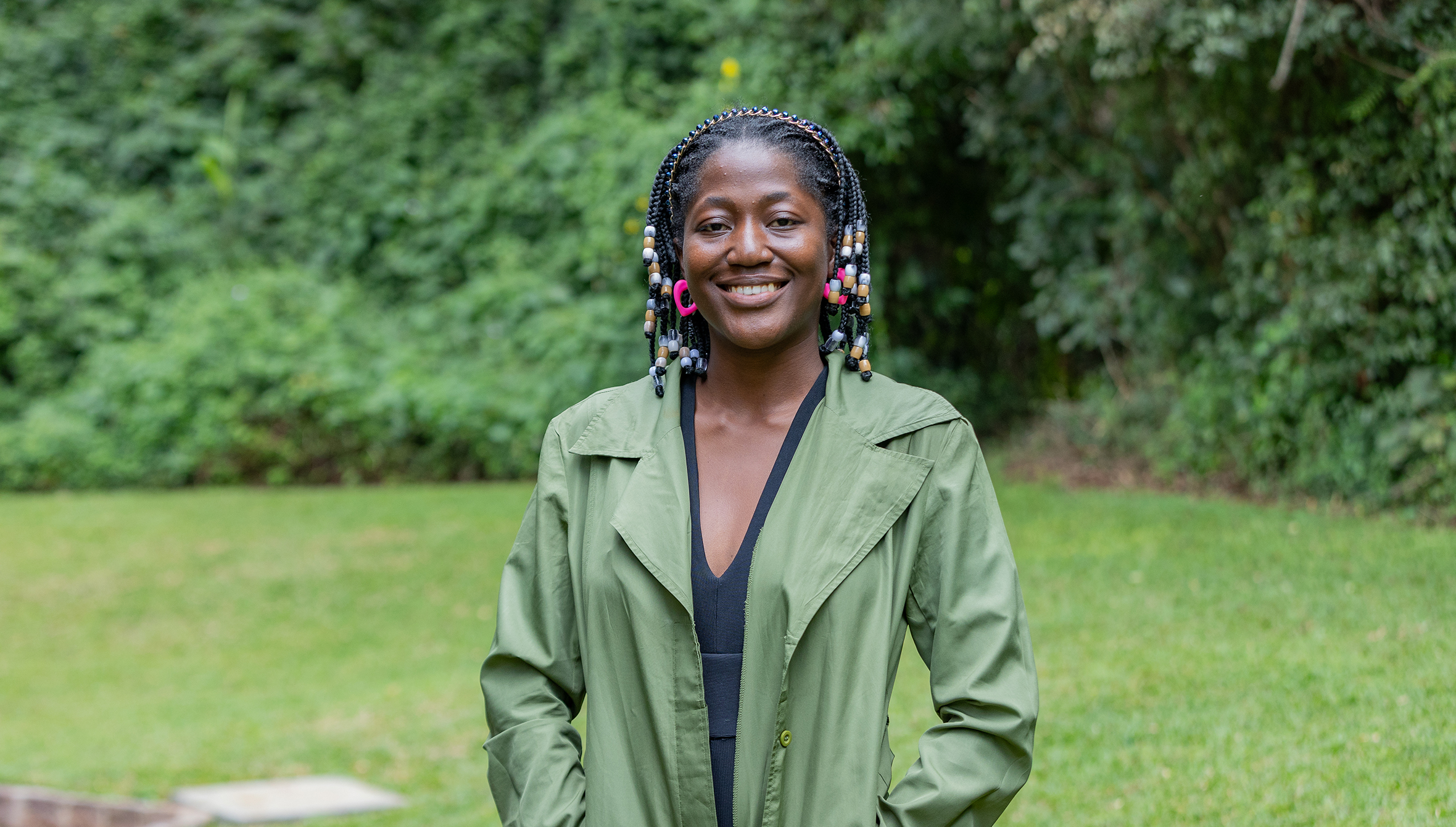
AWF-Wall Fellow Cyndi Karel Ngnah.
In Douala, the ocean first came to Cyndi Karel Ngnah as a warning. Her mother told her the sea was dangerous—a place of mermaids and mystery, not somewhere a child should go. The ocean was close enough to shape Cameroon’s coast, but distant from the life Cyndi knew in the country’s economic capital.
“I was always curious about whether mermaids really existed,” she recalls. “But in our community, the ocean was mostly feared. It was seen as a source of danger.”
On World Oceans Day, marked globally on June 8, that childhood memory carries a different meaning. The same ocean Cyndi was taught to fear is now the focus of her life’s work. As Site Coordinator for the African Marine Conservation Organization (AMCO) in Limbe, Cameroon and an African Wildlife Foundation-Wall Fellow, she is helping communities see the sea as a living system worth understanding and protecting.
A Different Route to Conservation
Cyndi’s path into marine conservation was not the one many expected. Her father was a doctor and her future seemed to lean in that direction. Instead, she enrolled at the Institute of Fisheries and Aquatic Sciences where a new question began to take hold.
“Growing up, I had only ever heard people emphasize protecting forests and trees,” she says. “I had never heard the ocean described as that important. I became very curious about how such a vital ecosystem had received so little attention.”
Even then, Cyndi had not seen the sea. That changed when she was 17, during a university field excursion to Limbe.
“I saw this vast environment and realized there was an entire world beneath the surface that I knew almost nothing about,” she says. “I had been learning about dolphins and sea turtles from books but seeing the ocean in person made it real.”
Today, Limbe is where she lives, works, and leads.
Science Beneath the Surface
At AMCO, Cyndi’s work moves between community meetings, field monitoring, education, and the sea itself.
“As a certified Scuba Diver, I lead field monitoring of marine biodiversity and the species beneath,” she says. Cyndi earned her diving certification in South Africa, where she also entered the underwater world for the first time.
“I had information from books and research but not from my own experience,” she says. “Bridging that gap and seeing the ocean with my own eyes was one of the great experiences of my life.”
That experience now informs her work in Limbe.
Community-Led Conservation in Limbe
For Cyndi, marine conservation starts with respect for people who depend on the ocean. Across Limbe’s fishing communities, she works from a simple principle: Conservation cannot succeed if it is designed around communities rather than with them.
“We work closely with the communities since they have a better understanding of the coastal region,” she says.
One tool supporting this work is the SIREN app, a citizen-science platform that allows artisanal fishers to photograph the marine species they encounter. These images help researchers map marine biodiversity along a coastline where many species remain poorly documented.
But the challenge is not only scientific. Illegal and unregulated fishing by large foreign vessels depletes fish stocks, pushing local fishers toward practices they may once have avoided, including catching juveniles or targeting vulnerable species.
“Before scientists came, culture had already done the work of conservation,” Cyndi says. “The communities we work with were not eating sharks or dolphins. But when there is no fish, they don’t have any other approach.”
Her response is to understand the pressures shaping their choices and work with them toward alternative livelihoods and sustainable practices.
“Sometimes we focus too much on what conservation needs,” she says, “and not enough on what communities need. Real impact happens when both come together.”
Making the Ocean Visible
Early in her career, a fisherman called Cyndi’s team to report a stranded sea turtle. By the time she arrived, it had died. It was the first sea turtle she had seen in person. When researchers examined it, they found plastic micro-particles in its stomach.
“People hear about plastic pollution all the time, but many never see its impact directly,” she says. “For me, seeing that turtle made the issue real.”
That moment sharpened her commitment to education and visual storytelling. She works with children and fishers to build a relationship with the ocean that she did not have growing up.
“I work with children and local fishers, helping them build a connection to the ocean and see themselves as its future guardians,” she says.
Leadership for Africa-Led Conservation
As her responsibilities expanded, Cyndi needed more than technical expertise. She was managing teams, engaging stakeholders, and representing her organization in wider conservation spaces. The AWF-Wall Youth Leadership and Management Fellowship helped strengthen that transition.
“I used to think leadership was about telling people what to do,” she says. “I’ve learned it is much more than that. It is about working with people and understanding their needs. That helps you orient your approach.”
For Cyndi, the fellowship reinforced that Africa-led conservation depends on leaders who can connect science, communities, and strategy.
On World Oceans Day, her story offers a grounded picture of marine conservation in practice: fishers documenting species, children learning the value of the sea, and a young woman from Douala turning fear into purpose.
“The ocean is not something to fear. It is something worth understanding,” she says.