New Toolkit Helps African Governments and Partners Turn Wildlife Assets Into Investable Development Sectors
General Inquiries
Tel:+254 711 063 000
Ngong Road, Karen, P.O. Box 310
00502 Nairobi, Kenya
AWF, the ALU School of Wildlife Conservation and Conservation Strategy Fund launch the Wildlife Economies Decision and Investment Support Toolkit, a practical contribution to the continent's biodiversity economy, ahead of their global presentation at the Global Wildlife Program Tool Talk Series.
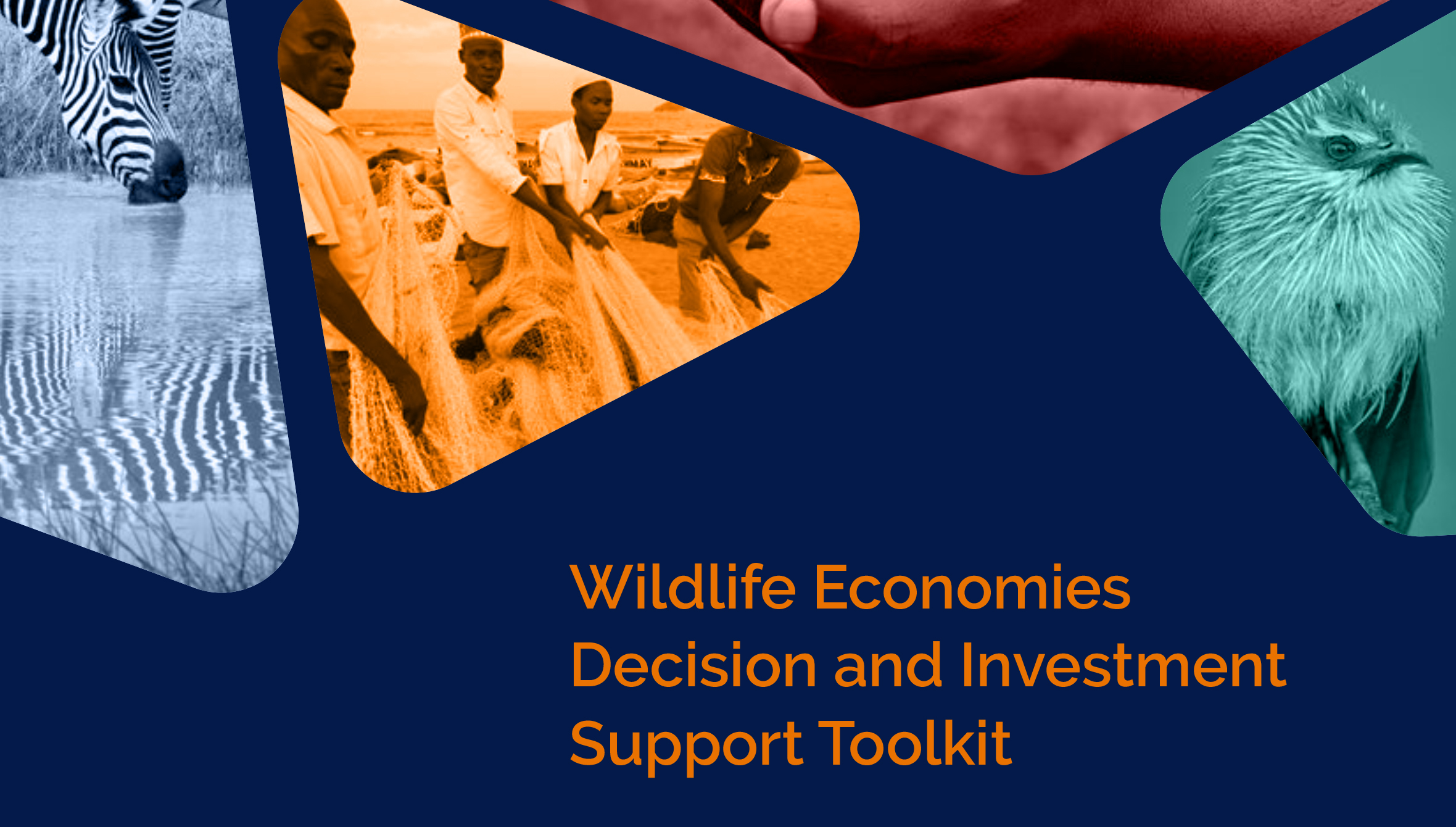
NAIROBI, Kenya / KIGALI, Rwanda — The African Wildlife Foundation (AWF), the African Leadership University School of Wildlife Conservation (ALU SOWC) and Conservation Strategy Fund (CSF) have launched the Wildlife Economies Decision and Investment Support Toolkit (Version 1, 2026). The toolkit gives governments, protected area and landscape authorities, community institutions, investors and development partners a practical framework for assessing, planning, financing and implementing wildlife economy strategies.
The toolkit is one instrument within the broader biodiversity economy work under way across Africa. It is designed to complement, not replace, existing national strategies, regional frameworks and tools, including the ALU SOWC Wildlife Economy Investment Index (WEII), natural capital accounting and the UN Biodiversity Finance Initiative (BIOFIN). Its central proposition is to shift the public narrative from nature as a fiscal cost to nature as productive capital for communities, landscapes and economies.
The toolkit launched today through a partner webinar on 3 November 2026. Following the launch, AWF and ALU SOWC will present the toolkit to a global audience at the Global Wildlife Program (GWP) Tool Talk Series on Tuesday, 10 November 2026, from 9:00 to 10:00 AM Washington, DC time.
Making Nature's Value Visible
Across Africa, wildlife and healthy ecosystems already support livelihoods, enterprise, public and community revenue, food and water security, tourism and resilience to climate shocks. Wildlife tourism alone accounts for an estimated 8.5% of Kenya's GDP. Yet much of this value remains invisible in national statistics, public budgets, investment strategies and land use decisions.
The toolkit responds to four recurring gaps that keep natural assets from becoming durable development outcomes:
- Invisible value: nature's economic and social contributions are left out of planning, accounts and budgets.
- Fragmented mandates: environment, finance, tourism, agriculture, trade and local government often work without a shared framework.
- Weak project preparation: promising concepts lack feasibility work, safeguards, revenue models and benefit-sharing arrangements.
- Weak enabling environments: uncertain tenure, unclear mandates and inequitable benefit distribution raise conflict and investor risk.
The toolkit's position is that wildlife economies should be treated as a strategic development sector at every scale, not as peripheral conservation activities or isolated tourism initiatives.
A Flexible Decision Instrument, Not Another Diagnostic Report
The toolkit organises eight interconnected modules into two phases. Phase 1: Understanding the wildlife economy, establishes the process, assesses wildlife assets and potential, examines the enabling environment and maps the finance and investor landscape. Phase 2: Growing the wildlife economy, translates that evidence into strategy and investment blueprints, policy and institutional reform, reporting and investment platforms, and awareness and capability programmes.
The toolkit is aligned with the Kunming-Montreal Global Biodiversity Framework, supporting targets 3, 5, 9, 10, 11, 13, 14, 15, 19 and 22. Users can apply it at national, subnational, landscape, protected area, community and transboundary scales. They can enter through the modules most relevant to their mandate, run activities in parallel and revisit modules as conditions change.
"Africa's wildlife economy has never lacked potential. What it has lacked is the evidence and coordination to show decision-makers what that potential is worth," said Edwin Tambara, Director, Global Leadership & Institutional Partnerships, African Wildlife Foundation. "This toolkit gives governments, communities and investors a shared basis for deciding which assets matter, which reforms are needed and which projects deserve finance. It is one contribution to the wider biodiversity economy agenda across the continent, and it is built to work alongside the strategies and tools countries already have."
The toolkit draws directly on the ALU SOWC Wildlife Economy Investment Index, which uses 280 indicators from 34 datasets and has produced baseline reports for 54 African countries. Its Wildlife Status and Investment-Enabling Environment sub-indices anchor the assessment modules.
“Integrating the WEII into the toolkit's assessment modules provides a powerful bridge between data, diagnostics and action. It enables countries to build on a consistent evidence base to assess wildlife economy performance, identify enabling environment gaps and investment opportunities, and translate these insights into more targeted strategies, policies and financing decisions” said Dr. Sue Snyman, Director of Research, ALU School of Wildlife Conservation.
The toolkit's finance and investor module helps users map public, private, community and development finance, estimate gaps by subsector, and identify suitable instruments and de-risking measures. Its outputs are designed to produce investment-ready project pipelines that can attract blended public-private finance.
"Finance plays a strong role in driving decision making, and yet many opportunities aligned with sustainable, wildlife economies are often poorly framed to attract such investment," said Mark Gerrard, Africa Director, Conservation Strategy Fund, "The toolkit closes that gap by connecting economic analysis to project preparation, safeguards and accountability. It gives decision-makers a way to unlock the opportunities nature provides without liquidating the natural assets on which future growth depends."
From Launch to Global Uptake: GWP Tool Talk Series
AWF, together with ALU SOWC, will present the toolkit at the GWP Tool Talk Series on 3 November 2026, 9:00–10:00 AM Washington, DC time (5:00–6:00 PM East Africa Time). The session moves the toolkit from launch to global visibility, uptake and application among the governments and agencies best placed to use it.
The Global Wildlife Program, managed by the World Bank and funded by the Global Environment Facility (GEF), is one of the largest global wildlife conservation partnerships. With approximately US$352 million in GEF financing, it supports projects across 38 countries, including 16 in Africa.
Registration: https://worldbankgroup.zoom.us/meeting/register/XDnMvwaKSDyzEHwPxpxi5Q#/registration
Notes to Editors
Access the Toolkit: The full toolkit and An Overview for Decision-Makers and Practitioners are available here: https://docsend.com/view/s/5yc9f9wn4it6h3kk
Suggested Citation: Tambara, E., Matsika, W., Williams, D., Shava, C., Snyman, S., Goergen, J. & Gerrard, M. (2026). Wildlife Economies Decision and Investment Support Toolkit. © African Wildlife Foundation (AWF), African Leadership University School of Wildlife Conservation (ALU SOWC) and Conservation Strategy Fund (CSF).
About the African Wildlife Foundation: AWF, Africa's oldest and largest international conservation organisation, brings a uniquely African vision to conservation—one that places people at the centre of sustainable development. Through science, policy, community engagement, business development and on-the-ground implementation, AWF works across critical landscapes and transboundary ecosystems to deliver lasting benefits for people and nature. www.awf.org
About the ALU School of Wildlife Conservation: Established in 2016 as the conservation initiative of the African Leadership Group, ALU SOWC promotes conservation as an African growth sector by developing the next generation of entrepreneurial conservation leaders through undergraduate, middle-management and executive programmes. It developed the Wildlife Economy Investment Index. sowc.alueducation.com
About Conservation Strategy Fund: For more than 25 years, CSF has bridged environmental science and economic policy, equipping decision-makers with rigorous economic analysis, capacity development and technological innovation to build nature-positive economies. www.conservation-strategy.org
Media Contacts
- AWF: Eileen Kairu, Strategic Communications Manager — [email protected]
- ALU SOWC: Kevin Ntarindwa, Marketing Operations Senior Associate — [email protected]