Chance Conservationist: Simon Mutchatibaya’s Road From Mhondoro Ngezi to Faro
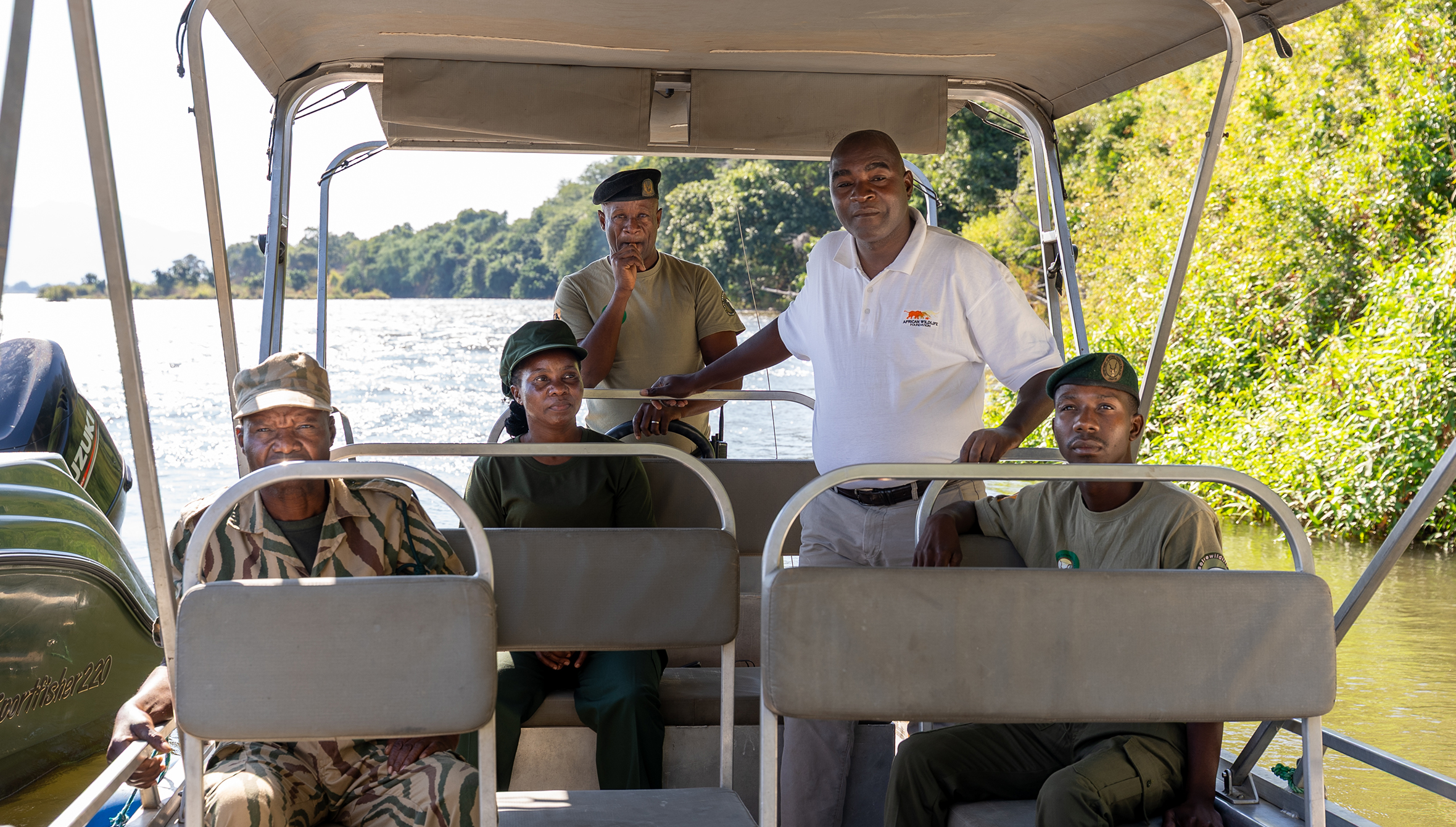
Simon Mutchatibaya (in white) with rangers in Zimbabwe. © AWF
Chance Conservationists is a series highlighting AWF staff who have embraced people-centred conservation in their professions despite coming from diverse academic fields. These remarkable individuals now espouse conservation values to propel the organisation’s vision for sustainable development and biodiversity protection.
Simon Mutchatibaya did not join the ranger service for the green uniform. He joined because of what he watched happen around him as a boy in Mhondoro Ngezi in Zimbabwe’s Mashonaland West Province. Mhondoro Ngezi is a place where wild lands and everyday life sit close together. It lies in central Zimbabwe, between Kwekwe and Kadoma, with Ngezi Recreational Park about 150 kilometres from Harare. Today he has worked, studied and learned across nine countries in Africa, from the grasslands of Kidepo to the forests of Faro, and he carries one lesson through all of them: conservation works when people are at its centre.
“The inspiration was not the green uniform but the injustices I saw growing up,” Simon says. “I saw wildlife disappearing to snares, dog hunting and rifle poaching, and powerful people getting away with it while local communities were blamed.” Law enforcement was his way onto the other side. “I wanted to be on the side that protects the voiceless.”
Simon expected the job to be patrols and arrests. The field changed his mind. “A snare is not just a wire. It is hunger, lack of opportunity, lack of awareness and a broken relationship between communities and the protected area.” That realisation became his approach, which he calls people-centred law enforcement.
“Without community trust, patrols fail. Without intelligence from communities, we walk blind. And if we do not link enforcement to livelihoods, we end up arresting the same person every year.” It also shapes how he sees the rangers beside him. “Ranger welfare is a conservation strategy,” he says. No anti-poaching effort works if a ranger is demoralised and in his experience, the parks with the fewest poaching incidents have the best welfare systems.
This year, Simon facilitated the ranger challenge in Faro, Cameroon, where AWF sponsored two teams for the first time in its history. After registering the eco-guards and community volunteers for conservation protected area complexes in September 2026, the rangers participated in their first ever virtual international ranger competition.
"Registering the MINFOF (Ministry of Forests and Wildlife) eco-guards for the Wildlife Ranger Challenge will directly provide them with vital field equipment, elite physical training, and the advanced monitoring tools needed to protect Cameroon's most vulnerable ecosystems, while also offering a unified platform to connect, share field insights and stand in solidarity with peer rangers across the continent," explained Simon.
One Continent, Many Landscapes
Simon has studied how protected areas are run in Uganda, Kenya, Tanzania, South Africa, Zambia, Zimbabwe, Botswana, the Democratic Republic of Congo and Cameroon. Moving between such different terrain, he was struck by how much the places have in common. Every country still relies on a core ranger force and everyone has moved from fortress conservation toward working with people. The models that succeed lean on the same four tools: Spatial Monitoring and Reporting Tool (SMART) or EarthRanger, camera traps and drones, canine units, and community hotlines or WhatsApp networks. Everywhere, he says, the best operations come from informers rather than random patrols and everywhere the weak link is the same. “Every country is good at arresting but weak at conviction.”
The differences, though, are just instructive. Wildlife ownership policy is the biggest divide, followed by how revenue is shared and whether communities are treated as guards, owners or partners. Countries also part ways on how they handle human-wildlife conflict, on consumptive versus non-consumptive use of wildlife, and on how militarised their operations are. One collaboration close to home stayed with him—the Gonarezhou Conservation Trust, where the Zimbabwe Parks and Wildlife Management Authority joined with the Frankfurt Zoological Society. It taught him that donor funding alone fails, but co-management with clear governance, revenue retention and community ownership works.
A Message to Young Africans
Simon saves his strongest words for the young Africans who will inherit this work. Their future, he says, lies at home, “in your soil, in your wildlife, in your forests.” He believes conservation can begin in any village with someone willing to act.
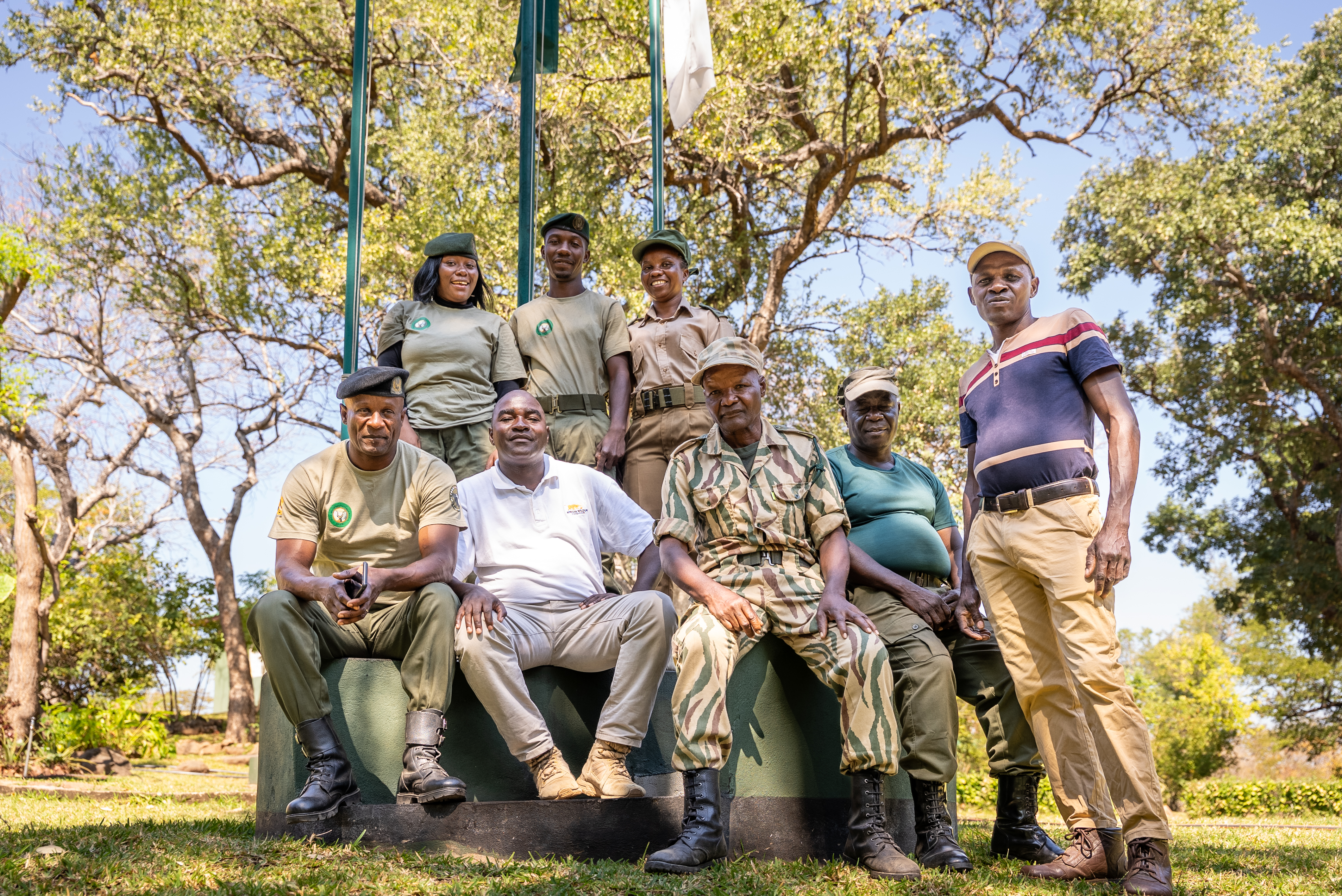
Simon with Zimbabwean park rangers—working to build a future for Africa where Africans lead conservation. © AWF
His closing thoughts turn from the future to the past. The wildlife of Kidepo, Mana Pools, Bili-Uélé, Faro and Dja, he says, does not belong to any one generation. Africans inherited it from their grandfathers and are borrowing it from their grandchildren. “If we fail to protect it, we have not just broken the law. We have broken a lineage.”
He ends with a call that he offers in English, French and Shona, to show that this work has no borders: “You and me have a task to complete.” Nous avons un travail à accomplir, toi et moi. Iwe neni tine basa.
From the boy who watched snares replace wildlife in Mhondoro Ngezi to the facilitator guiding rangers in Faro, Simon’s story shows that there is no single path into conservation. Sometimes the most valuable perspectives come from those who arrive by a road they never planned, carrying a sense of justice and the patience to learn from every landscape they meet.