Rwanda Launches eDNA Science in Volcanoes National Park
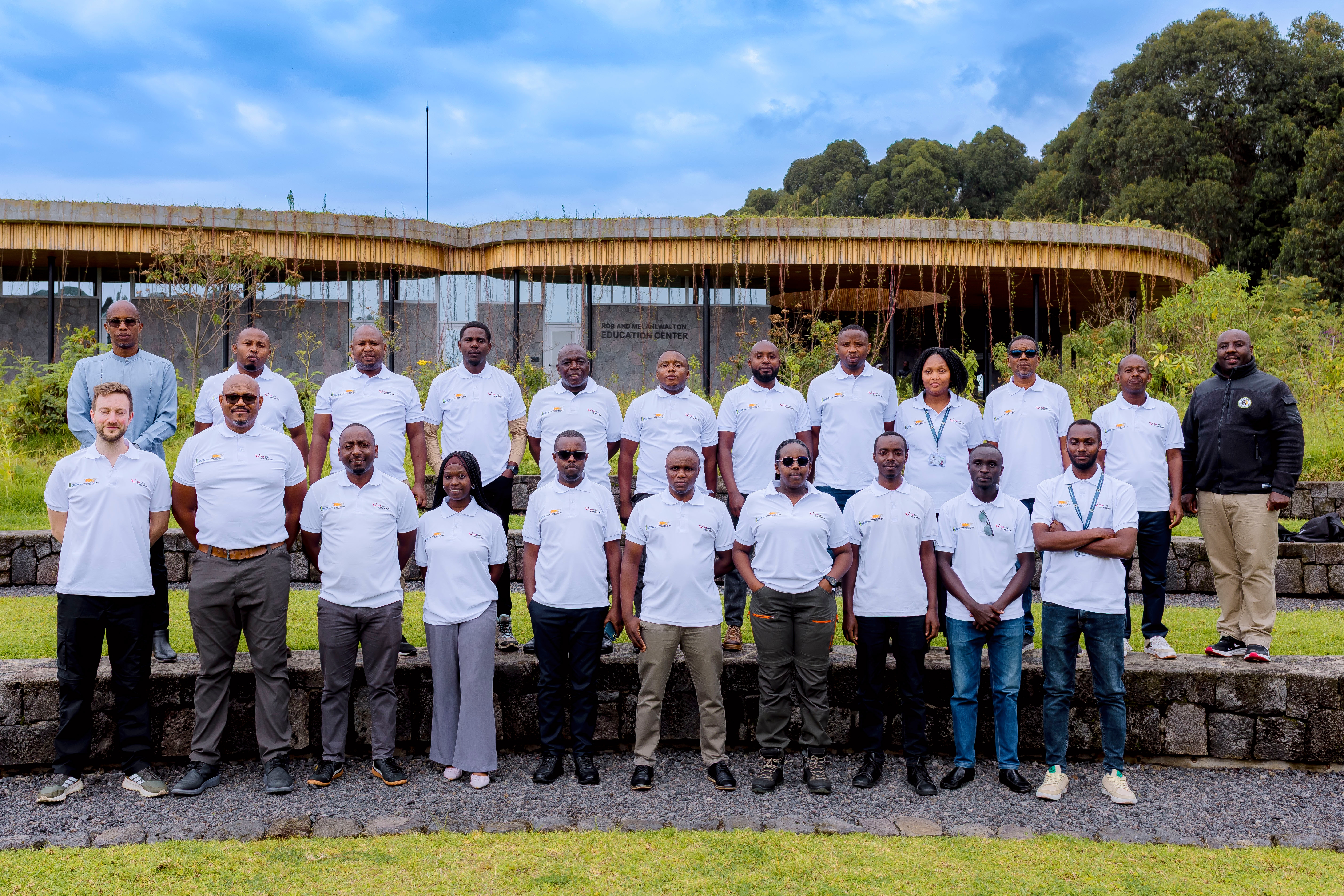
Conservation professionals gather at the Dian Fossey Gorilla Fund’s Kinigi Campus in Rwanda.
A new conservation tool is coming online in Volcanoes National Park (VNP), starting with something deceptively simple: water and soil. In early February, partners trained Rwandan conservation professionals to use Environmental DNA (eDNA), a scientific approach that detects genetic traces organisms leave behind in the environment.
Those traces—shed through skin cells, saliva, waste, or decaying matter—can reveal which species are present, even when they are rarely seen or easily missed by traditional surveys.
The rollout is being delivered through the TUI Wildlife Programme, supported by the TUI Care Foundation and implemented by the African Wildlife Foundation (AWF) in collaboration with the Rwanda Development Board (RDB) and the Dian Fossey Gorilla Fund. The goal is practical and urgent: strengthen biodiversity detection, spot early signs of ecosystem stress, and build a sharper evidence base for decisions that protect the park’s rich afro-alpine life.
“By simply analyzing water and soil, we are unlocking a new era of conservation, where Rwandan scientists lead with data to protect every species within Volcanoes National Park,” Patrick Nsabimana, AWF Rwanda Country Coordinator, says.
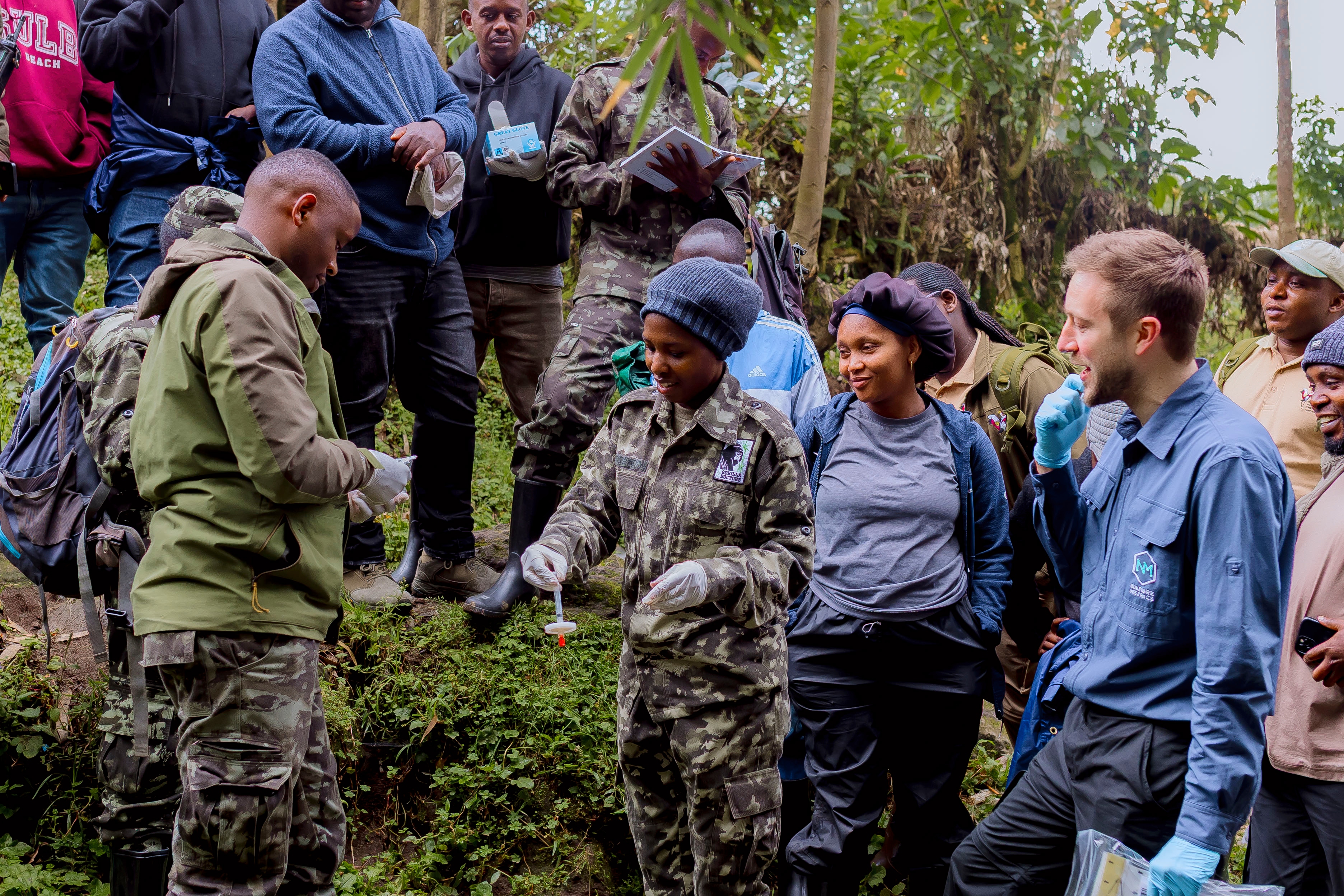
Conservation professionals collecting a water sample.
How eDNA Changes What We Can See
For decades, biodiversity monitoring has depended on direct observation: visual surveys, camera traps, and acoustic monitoring. While these methods remain essential, they can be time-intensive and still miss elusive species. eDNA adds a molecular lens—confirming presence through genetic signals and offering a non-invasive, cost-effective complement to traditional approaches.
In a landscape like VNP, where steep slopes, dense vegetation, and shifting habitat edges can mask ecological change, being able to “read” the environment through genetic traces increases the odds of detecting what might otherwise go unnoticed.
That includes the small organisms that hold ecosystems together, as well as the rarer species that are often the first to disappear when conditions begin to degrade.
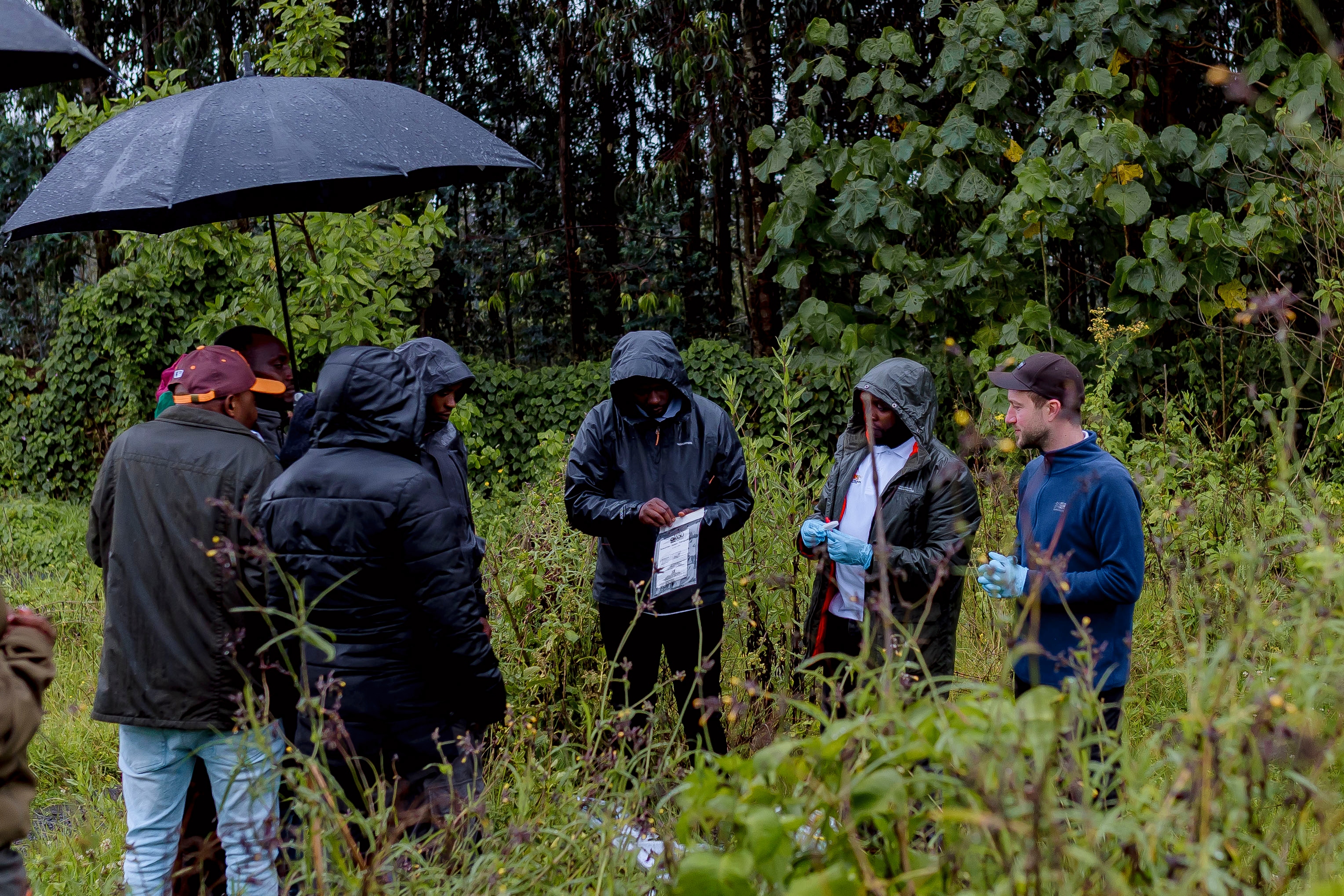
Attendees learned about the importance of microscopic organisms in maintaining ecosystem health.
Adding a Molecular Layer to Two Decades of Monitoring
VNP is not starting from scratch. For more than two decades, the Dian Fossey Gorilla Fund has led long-term research and monitoring across the park, building what partners describe as the region’s most comprehensive ecological dataset. Researchers have tracked birds, mammals, amphibians, insects, plants, wetlands, and habitat conditions—documenting ecological change over time and across elevation gradients.
The value of eDNA is not to replace existing methods, but to reinforce them. By integrating eDNA with established field and sensor-based techniques, conservation partners aim to build a fuller biodiversity baseline that strengthens adaptive management across the VNP landscape.
A 30-Site Baseline Survey Across the Park and Restoration Zones
The training, held from the 9th to the 13th of February 2026 at the Dian Fossey Gorilla Fund’s Kinigi Campus, marks the first of two seasonal training phases under the Enhancing Community-Based Ecological Monitoring in VNP project. The initiative aims to conduct a focused eDNA baseline survey across 30 strategically selected sites—16 inside the park and 14 within expansion and restoration zones.
The survey design focuses on the information water can reveal over time. Partners will prioritize permanent wetlands and rivers for year-round biodiversity signals, seasonal wetlands for insights into habitat connectivity, and expansion zones at 500m and 1000m to assess biodiversity spillover beyond the park boundary.
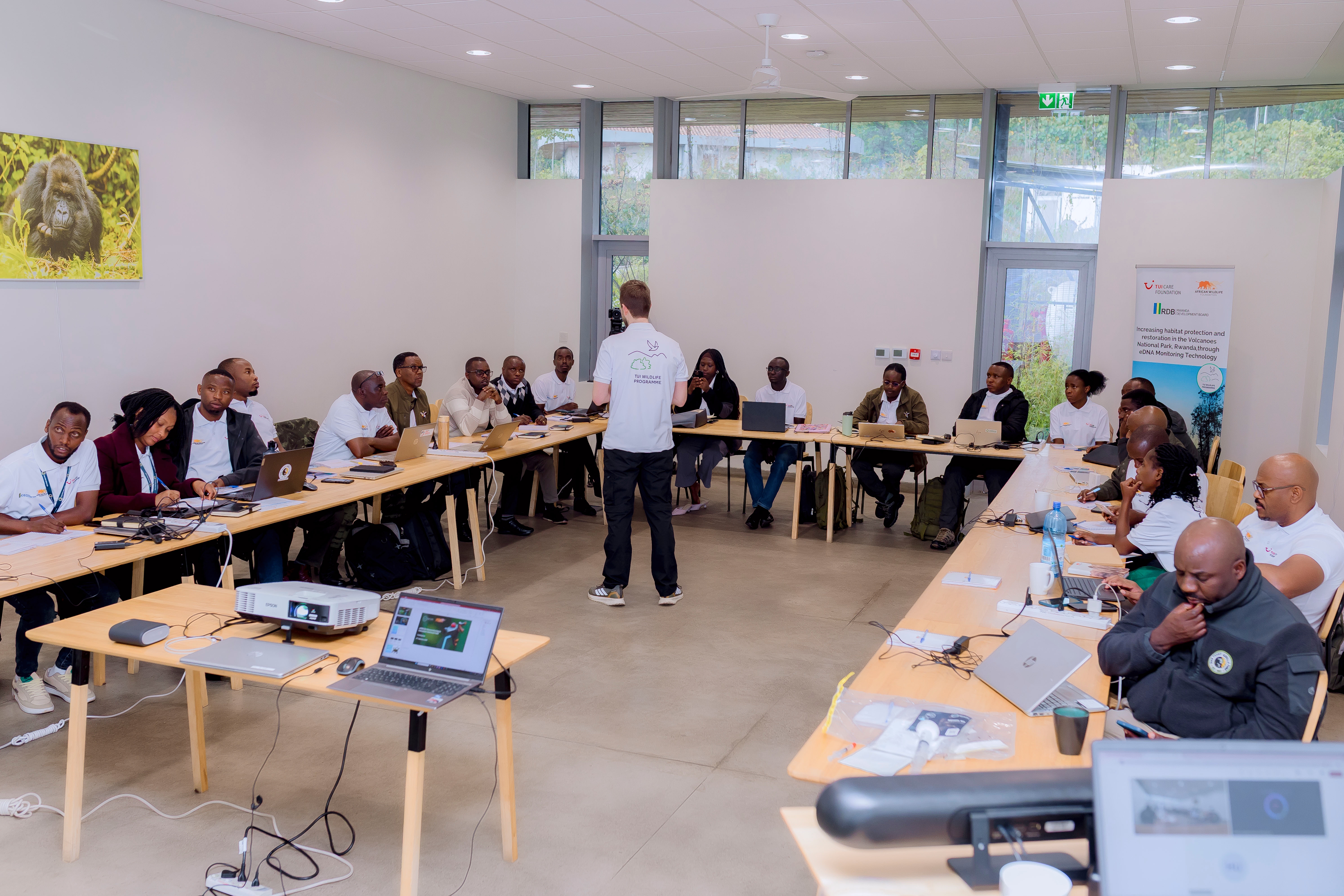
Conservation Professionals attend a seminar about Environmental DNA (eDNA).
Training Rwandan Scientists to Lead the Next Phase
Although this is a science story, it is also a people story. 20 emerging conservation professionals are taking part, drawn from institutions including AWF, RDB, the Dian Fossey Gorilla Fund, Gorilla Doctors, the University of Rwanda, REMA, the Rwanda Wildlife Conservation Association, and others.
The training blends classroom learning with field and laboratory practice, covering molecular ecology fundamentals, eDNA sampling protocols, laboratory processing, data analysis, and interpretation.
Experts will supervise the first sampling phase, while the second phase will be led by trained Rwandan staff—an intentional handover designed to build technical confidence, institutional ownership, and continuity in the monitoring system.
From gorillas and golden monkeys to the smallest organisms sustaining this delicate afro-alpine ecosystem, eDNA is expanding what conservation can measure across Volcanoes National Park’s 160 km² landscape. By combining community-based ecological monitoring with advanced molecular tools—and anchoring sequencing capacity in-country—Rwanda is investing in the scientific leadership that will define conservation’s next decade.