African Wildlife Foundation Welcomes Inaugural Cohort of the Geospatial Leaders Fellowship
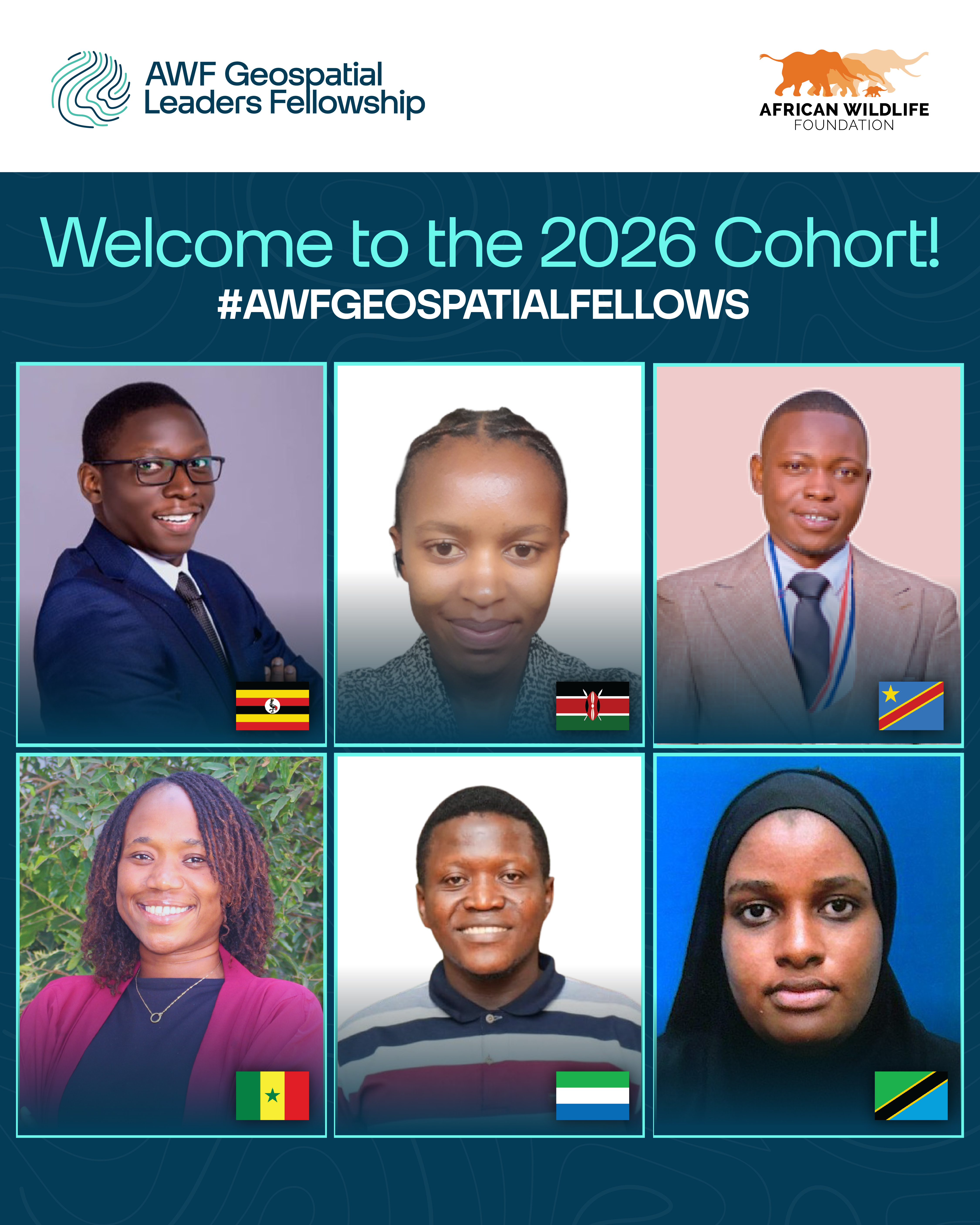
The 2026 Geospatial Leaders Fellowship cohort.
General Inquiries
Tel:+254 711 063 000
Ngong Road, Karen, P.O. Box 310
00502 Nairobi, Kenya
NAIROBI, Kenya — The African Wildlife Foundation (AWF) is proud to announce the official onboarding of six exceptional young professionals to its prestigious 2026 Geospatial Leaders Fellowship. Selected from a highly competitive pool of nearly 1,000 applicants, these six fellows represent a new generation of African conservationists poised to leverage cutting-edge technology to safeguard the continent’s biodiversity.
The successful candidates hail from six diverse nations: Kenya, Uganda, Tanzania, Sierra Leone, the Democratic Republic of the Congo, and Senegal, coming from government and non-governmental institutions.
Why does this fellowship matter? Africa holds some of Earth's last great wilderness areas, from the ancient migration routes of elephants to the mist-shrouded forests home to gorillas. However, the continent's importance extends far beyond its wildlife. The Congo Basin serves as one of Earth's "lungs," absorbing carbon, regulating climate, and generating clean air. Protecting these forests is a global imperative that supports life far beyond Africa's borders.
Africa is the fastest-developing continent on Earth; seven of the top 10 fastest-growing economies in 2025 were African. Massive infrastructure projects, including roads, dams, railways, and development corridors, are reshaping landscapes at unprecedented speed.
In this context, the AWF Geospatial Leaders Fellowship is not just a training program; it is a vital intervention. It builds on AWF’s existing leadership programs for African-led conservation, ensuring that the future of Africa’s natural heritage is protected by those who understand it best. By equipping fellows with advanced geographic information systems (GIS) and remote sensing capabilities, AWF is empowering them to transform raw spatial data into actionable intelligence, enabling everything from real-time tracking of deforestation to the strategic mapping of wildlife corridors. In this program, fellows will embark on a 10-month journey of learning and leading a capstone project to produce tangible outputs for their host organization, all supported by access to experts and modern geospatial tools.
Additionally, this fellowship also contributes to implementing global agreements, specifically target 1 of the Kunming-Montreal Global Biodiversity Framework, which underscores the need for spatial planning at different levels.
During the virtual onboarding session, the energy was palpable. As fellows introduced themselves, a vibrant exchange of ideas emerged, with each participant expressing not only their technical aspirations but their deep-seated passion for the landscapes they serve.
“You can produce the most sophisticated analysis in the world, but if you can't explain it to a government minister in three minutes, it doesn't matter. Learn to turn data into stories. Make analyses and maps that move people to action. Your job isn't to impress other GIS people—it's to empower non-GIS people to make better decisions.” David Williams, AWF’s Senior Director of Conservation Programs, emphasized during his welcome remarks.
The onboarding of this cohort marks a significant milestone in AWF’s ongoing commitment to African-led conservation. As these fellows begin their journey, they carry the responsibility of driving evidence-based decisions that will secure the health of African landscapes and the well-being of the communities that depend on them for generations to come.
About the African Wildlife Foundation
The African Wildlife Foundation (AWF) is the primary advocate for the protection of wildlife and wild lands as an essential part of a modern and prosperous Africa. Founded in 1961, AWF works to ensure that the continent’s natural heritage is protected and benefits all Africans. For more information, visit www.awf.org.