Africa’s Voice at COP17: Making Biodiversity Commitments Count
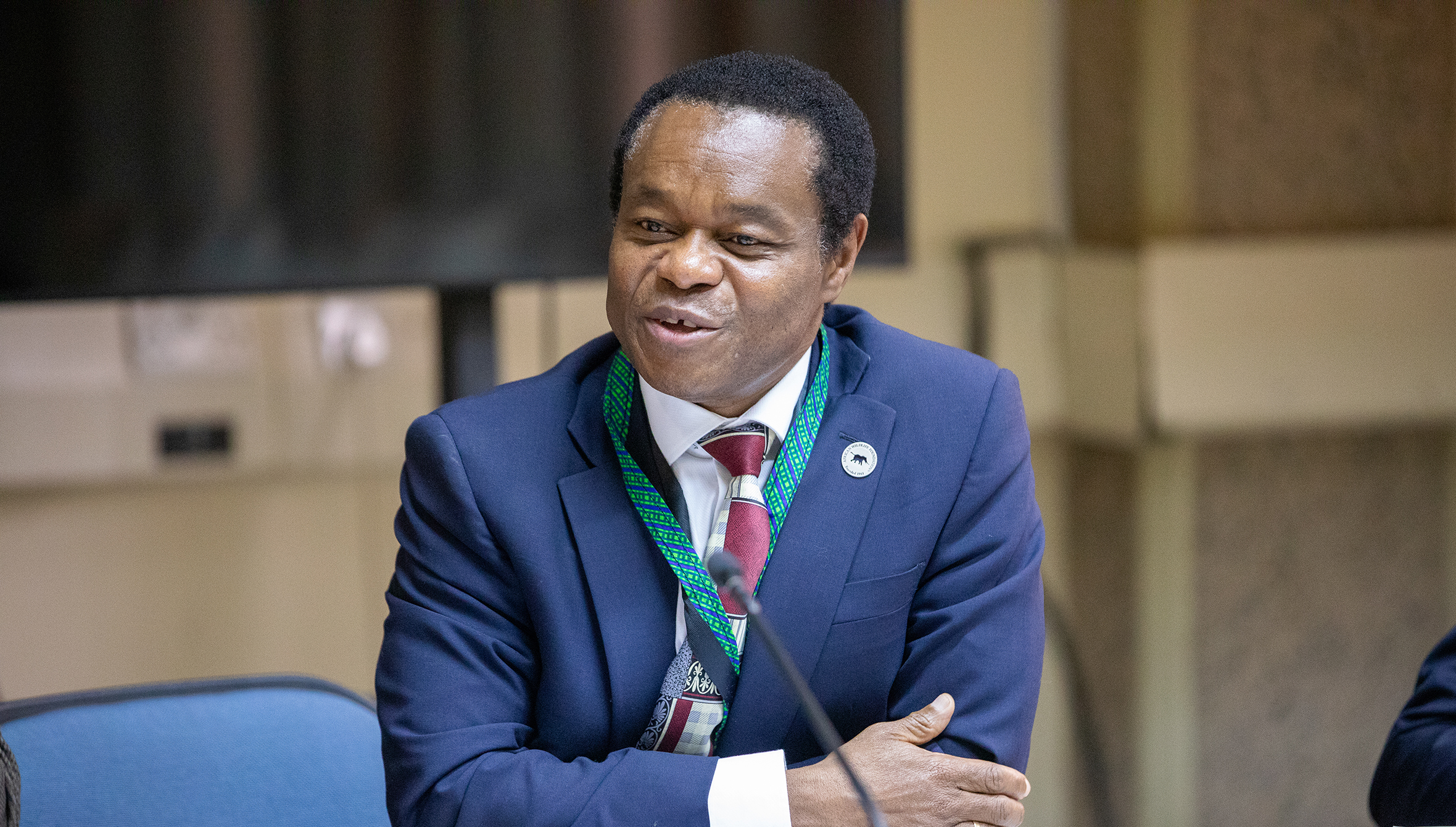
AWF Vice President for Global Policy and Governance Frederick Kumah attends a meeting with African governments at the United Nations Office at Nairobi in 2025.
A Conversation with Frederick Kumah, AWF’s Senior Vice President for Global Policy and Governance
Nature is a strategic asset for Africa. It underpins climate resilience, economic transformation, food and water security, jobs, peace and safety. Yet despite global commitments to protect biodiversity, implementation lags far behind ambition.
The question is no longer what the world has promised, but how those promises can be translated into policies, investments and tangible results for people and nature. The 17th Conference of the Parties to the Convention on Biological Diversity (CBD COP17) will carry out the first global review of progress under the Kunming–Montreal Global Biodiversity Framework.
Working with conservation organisations focused on Africa and the Africa Protected Area Directors (APAD), the African Wildlife Foundation (AWF) has three priorities: strengthening ecological integrity and connectivity, integrating people’s wellbeing into nature conservation, and securing sustainable finance for conservation in Africa. We asked Frederick Kumah, AWF’s Senior Vice President for Global Policy and Governance, what Africa needs from COP17, which partnerships matter most and how global commitments can deliver results on the ground.
What did governments commit to at COP15, what has changed and what should COP17 do differently?
In 2022, at the COP15 meeting in Montreal, 196 countries agreed on a global plan to protect nature, known as the Kunming–Montreal Global Biodiversity Framework, which sets out 23 targets to be achieved by 2030. Three of the most significant are: protecting at least 30% of the world’s land and seas, restoring 30% of degraded natural areas, and raising at least US$200 billion every year to fund conservation.
Since then, countries have been developing their own national plans. At COP16, the Cali Fund was launched to address a long-standing imbalance between those who benefit from biodiversity and those who protect it.
Scientists and companies often use genetic information from plants and animals, stored digitally, to develop new medicines, foods and beauty products. For years, the benefits received by the countries and communities protecting this natural heritage have fallen short of what their efforts deserve. Under the Cali Fund, large companies that profit from these uses are expected to contribute financially to help protect nature and support the people who look after it. If a company profits from nature, it should help protect it.
However, fewer than half of the national goals assessed are on track. COP17 must turn this first progress review into a practical plan. That means identifying what is holding countries back (whether a lack of funding, skills or institutional support) and addressing those barriers. It also means making nature an integral part of how governments plan and make economic decisions.
Why is biodiversity still treated as an environmental issue when nature underpins Africa’s economies?
Nature is the foundation of many African economies, yet biodiversity is still seen as an environmental concern rather than a development priority. Healthy ecosystems support agriculture, tourism, food and water security, livelihoods, public health and climate resilience. When ecosystems degrade, the costs spread across the whole economy and fall hardest on local communities and future generations.
The problem is that economic plans, public budgets and investment decisions rarely reflect the true value of nature. Biodiversity must be built into decisions across government, from finance and infrastructure to agriculture, energy and trade. Nature is not an obstacle to development. It is one of its foundations.
What policy changes would make economic development work with nature, not against it?
Nature must be central to economic planning, not an afterthought. That means integrating biodiversity conservation into national development plans, budgets and investment decisions, improving land-use planning, and considering environmental and social safeguards at an early stage. Governments must also tackle subsidies that harm biodiversity and support activities that benefit it.
The Framework sets clear expectations. Target 18 calls for the reform of harmful incentives, with reductions of at least US$500 billion a year by 2030. Target 15 calls for measures to encourage businesses and financial institutions to assess and disclose their impacts and dependencies on biodiversity. Africa can also develop nature-positive businesses and sustainable wildlife economies that create jobs and support local livelihoods.
The aim is not to choose between growth and conservation, but to ensure that development strengthens the natural systems on which our future depends.
As the world pursues 30x30, how do we make sure it delivers ecological integrity, connectivity and real benefits for people?
30x30 cannot simply be a count of hectares. We must ask whether protected areas are ecologically important, well managed, connected and equitably governed. Target 3 makes this clear: protected areas and other effective area-based conservation measures (OECMs) should be ecologically representative, well connected, effectively managed and equitably governed, with the rights of Indigenous Peoples and local communities respected.
For Africa, that means protecting critical habitats, maintaining wildlife corridors and strengthening cross-border cooperation. It also means recognising Indigenous and Traditional Territories, community conservancies and other locally led approaches. People must be partners in conservation, with their rights, knowledge and voices recognised, and fair access to the benefits and financing that conservation generates. Conservation succeeds when the people living alongside nature have a real stake in its future.
What are AWF’s and APAD’s priorities for COP17, and what do you hope to unlock?
We want COP17 to accelerate implementation, particularly by tackling the financial, technical and institutional barriers facing developing countries. We are advancing three linked priorities.
The first is ecological integrity and connectivity. Progress towards 30x30 should be judged by the quality of conservation, effective management and ecological outcomes, not simply the area counted. The second is putting people at the centre of conservation through inclusive governance, recognition of community rights and approaches that deliver meaningful social and economic benefits. The third is sustainable finance for Africa’s conservation efforts, including support for a Pan-African Conservation Trust Fund (APACT) as a potential long-term financing mechanism for Africa’s protected and conserved areas.
We also support the SBSTTA-28 recommendation that COP17 consider renaming the Programme of Work on Protected Areas to reflect its broader scope, covering protected areas and OECMs and recognising Indigenous and Traditional Territories.
Beyond conservation, we want biodiversity to be integrated into infrastructure, extractive industries, investment and economic planning, supported by stronger national systems for tracking ecological and socioeconomic outcomes. Ultimately, COP17 should strengthen the policies, partnerships and financing that enable African countries to deliver on their commitments.
Which partnerships are critical, and what can we achieve together that we cannot achieve alone?
No single organisation or government can deliver Africa’s biodiversity ambitions. Success requires political leadership, technical expertise, local knowledge, financing and practical experience to come together.
African governments, the African Union Commission (AUC) and the Regional Economic Communities (RECs) shape policy, align priorities and strengthen cross-border cooperation. APAD, conservation organisations, civil society, Indigenous Peoples and local communities bring the knowledge and experience needed to manage landscapes on the ground. Financial institutions and development partners can mobilise the resources required to sustain this work.
Together, we can strengthen Africa’s voice in global biodiversity processes, share successful approaches between countries, improve the management of shared ecosystems and wildlife corridors, and build financing solutions beyond the reach of any single actor. AWF’s role is to bring these strengths together, support African leadership and connect policy discussions with practical solutions. Partnership is not about having more people at the table; it is about combining strengths to deliver at the scale Africa needs.
What should organisations like AWF do to help governments turn commitments into action?
We must move beyond advocacy to practical support. That means helping to translate global targets into national policies, legislation, spatial plans, investment priorities and effective management. It means sharing proven practices, such as Collaborative Management Partnerships, and giving protected-area directors and practitioners opportunities to learn from one another.
We must also help governments and communities develop stronger project pipelines, access biodiversity finance and establish sustainable funding mechanisms. Monitoring must measure real outcomes for ecosystems and people, not just activities and administrative outputs. AWF and APAD can strengthen African platforms for peer learning, ensuring that successful approaches are documented, adapted and scaled across countries.
Our contribution should be judged by how effectively we help governments and communities deliver conservation outcomes, strengthen livelihoods and build more resilient economies.
Africa does not need another set of biodiversity commitments. It needs existing commitments implemented at scale: better policies, stronger institutions, sustainable finance, meaningful partnerships and conservation that works for both nature and people. COP17 is an opportunity to turn ambition into measurable progress, protecting Africa’s natural heritage, benefiting its communities and building more resilient economies.
The real measure of success will not be what countries promise. It will be what they deliver for people and nature.