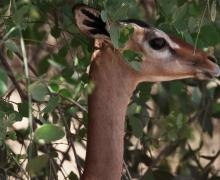
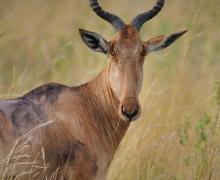
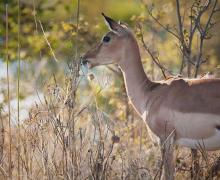
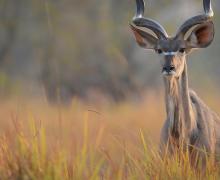
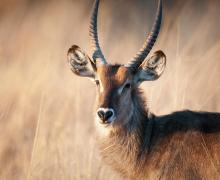
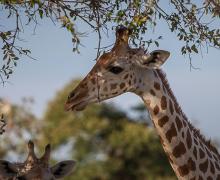
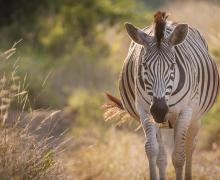
Gerenuks feed at higher reaches than other gazelles and most antelopes by standing erect on their hind legs, with their long necks extended, to browse on tall bushes.

Gerenuk

Physical Characteristics

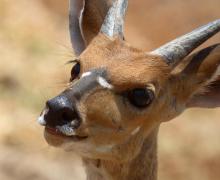
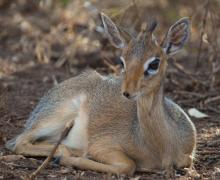
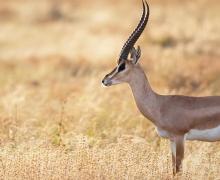
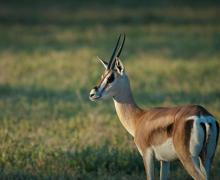
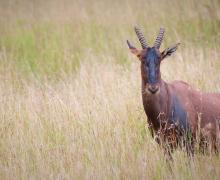
Gerenuk means "giraffe-necked" in the Somali language. Appropriately, this antelope’s most outstanding characteristic is its exceptionally long neck. The gerenuk's head is small for its size, but its eyes and ears are large. Only the males have horns, which are stout and heavily ringed, and they have a more heavily muscled neck than the females do. They are brown on the upper back and lighter on the sides. The short tail looks longer as it ends in a tuft of black hair. Like many other gazelles, gerenuks have pre-orbital glands in front of the eyes that emit a tar-like, scent-bearing substance they deposit on twigs and bushes to mark their territory. They also have scent glands on their knees that are covered by tufts of hair and between their split hooves.

^ Back to top

Habitat

Gerenuks are found in habitats with woody vegetation, especially dry, flat thornbush.

^ Back to top

Behavior

Gerenuks live in small groups, which may consist of related females and their young, or in bachelor groups of males or as solitary males. The latter are thought to be territorial, but as their ranges are large and populations usually sparse, it has been difficult for scientists to determine if they defend these territories. The female groups wander over a home range of 1 to 2 square miles, passing in and out of male territories.

When ready to give birth, the female leaves the group and goes to a secluded spot. After delivery she licks the fawn clean and eats the afterbirth, possibly for the nutrients it contains and to prevent the scent from attracting predators. The adaptation to year-round browsing may permit gerenuks to bear young at any time instead of just before the rainy season, as is the practice for grazing animals.

During the first weeks of its life, or until it can keep up with adults, the baby gerenuk spends its time hidden in the bush while its mother feeds. She returns to the fawn three or four times a day to suckle it, carefully cleaning or eating its waste to leave no trace of scent. Females bleat softly to communicate with their young.

^ Back to top

Diet

The gerenuk is another example of a species fitting a specialized niche in a complex ecosystem. Although some animals do compete for the same foods, many of the different species frequently seen together do not feed on the same plants, or they eat them at different stages of growth or at different heights. Gerenuks, for example, feed at higher reaches than those of other gazelles and most antelopes. They stand erect on their hind legs, with their long necks extended, to browse on tall bushes.

Want to Help?

By using their front legs to pull down higher branches, they can reach leaves 6 to 8 feet off the ground. The tender leaves and shoots of prickly bushes and trees make up most of their diet, along with a nutritious mix of buds, flowers, fruit and climbing plants. They do not eat grass nor do they require water. As they can get enough moisture from the plant life they eat, they can survive in dry thorn-bush country and even in desert.

^ Back to top

Predators and Threats

Habitat loss and fragmentation by humans are the biggest threats to gerenuk populations.


Did You Know?
  • Gerenuks use several vocalizations, including a buzzing sound when alarmed, a whistle when annoyed and a loud bleat when in extreme danger.
  • In their courtship ritual, the male gerenuk approaches a female in heat and repeatedly taps her with one of his front legs under the belly or on the flanks. He may rub her with his preorbital glands to deposit his scent before mating.

^ Back to top

Back to Wildlife Gallery

Find another Animal

Search our gallery for a specific animal found in our 8 Heartlands


Adopt an Animal

Support our research. Adopt a Mountain Gorilla, Zebra, Elephant, Lion, or Giraffe. You can even adopt an entire family.

Learn more >

Quick Facts

Found in these Heartlands: Maasai Steppe, Samburu

Scientific Name: Litocranius walleri

Size: 35 to 40 inches at the shoulder

Weight: 80 to 115 pounds

Lifespan: 20 years

Habitat: Woodland forest to open plains

Diet: Herbivorous browser

Gestation: About 7 months

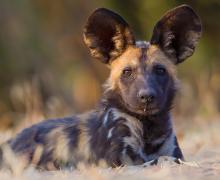
Predators: Humans, wild dogs, cheetahs, leopards, lions, jackals

Related Images

View More Photos