Where We WorkConserving WildlifeProtecting LandEmpowering PeopleEngaging YouAbout AWF
Although a prolific breeder and even a dominant species in some areas, the hartebeest has probably suffered the greatest reduction in range of all African ruminants.

Hartebeest


Physical Characteristics

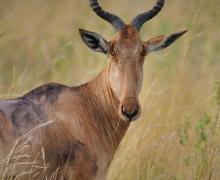
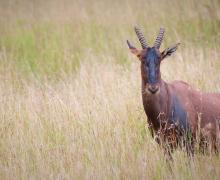
Coke's hartebeest, also called kongoni, is the most widespread hartebeest. It is found on the open grassy plains and tree grasslands in southern Kenya and Tanzania.

The hartebeest is a large, fawn-colored antelope that at first glance seems strangely put together and less elegant than other antelopes. However, being one of the most recent and highly evolved ungulates, it is far from clumsy. In fact, it is one of the fastest antelopes and most enduring runners. These qualities gave rise to its name, which means "tough ox." Its sedentary lifestyle seems to inhibit the mixing of populations and gene flow; as a result, there are several subspecies of hartebeest.

^ Back to top
Habitat

Hartebeest are mainly found in medium and tall grasslands, including savannas. They are more tolerant of high grass and woods than other alcelaphines (archetypical plains antelopes).

^ Back to top

Behavior

The social organization of the hartebeest is somewhat different than that of other antelopes. Adult females do not form permanent associations with other adults; instead, they are often accompanied by up to four generations of their young. Female offspring remain close to their mothers up to the time they give birth to calves of their own. Even male offspring may remain with their mothers for as long as 3 years, an unusually long bonding period. As groups of females move in and out of male territories, the males sometimes chase away the older offspring. Their mothers become defensive and protect them from the males. Although bachelor herds of young males are also formed, they are less structured than those of some antelopes, and age classes are not as conspicuous.

Young are born throughout the year, but conception and breeding peaks may be influenced by the availability of food. The behavior of the female hartebeest when she gives birth is very different from that of the wildebeest. Instead of calving in groups on open plains, the hartebeest female isolates herself in scrub areas to give birth and leaves the young calf hidden for a fortnight, only visiting it briefly to suckle.

Want to Help?

^ Back to top

Diet

The hartebeest feeds almost entirely on grass, but is not very selective and quite tolerant of poor-quality food. It has suffered from the expansion of cattle raising, as hartebeests and cattle compete for the same food.

^ Back to top

Predators and Threats

Although a prolific breeder and even a dominant species in some areas, the hartebeest has probably suffered the greatest reduction in range of all African ruminants. This is both because it is easily hunted (being relatively sedentary), and because its diet is almost equivalent to that of cattle—it must compete for food resources.

Did You Know?
  • The ancient Egyptians are said to have semidomesticated the hartebeest for use as a sacrificial animal. Because the species competes with cattle for food, further attempts at domestication are unlikely.
  • Although a prolific breeder and even a dominant species in some areas, the hartebeest has probably suffered the greatest reduction in range of all African ruminants

^ Back to top

Back to Wildlife Gallery

Find another Animal

Search our gallery for a specific animal found in our 8 Heartlands


Adopt an Animal

Support our research. Adopt a Mountain Gorilla, Zebra, Elephant, Lion, or Giraffe. You can even adopt an entire family.

Learn more >

Quick Facts

Scientific Name: Alcelaphus buselaphus

Size: 48 inches at the shoulder

Weight: 165 to 350 pounds

Lifespan: 12 to 15 years

Habitat: Open plains

Diet: Herbivorous/grazer

Gestation: 8 months

Predators: Cheetahs, jackals, lions, hyenas, leopards,hunting dogs, humans

Related Images

View More Photos